
Shopify development · India
Shopify Development Company in India
Store builds, migrations, Shopify Plus and custom apps for Indian brands, with payments, COD, GST and shipping set up the way Indian stores actually need them.
Updated 4 November 2026 · Web6, Surat, working with brands across India
The short answer
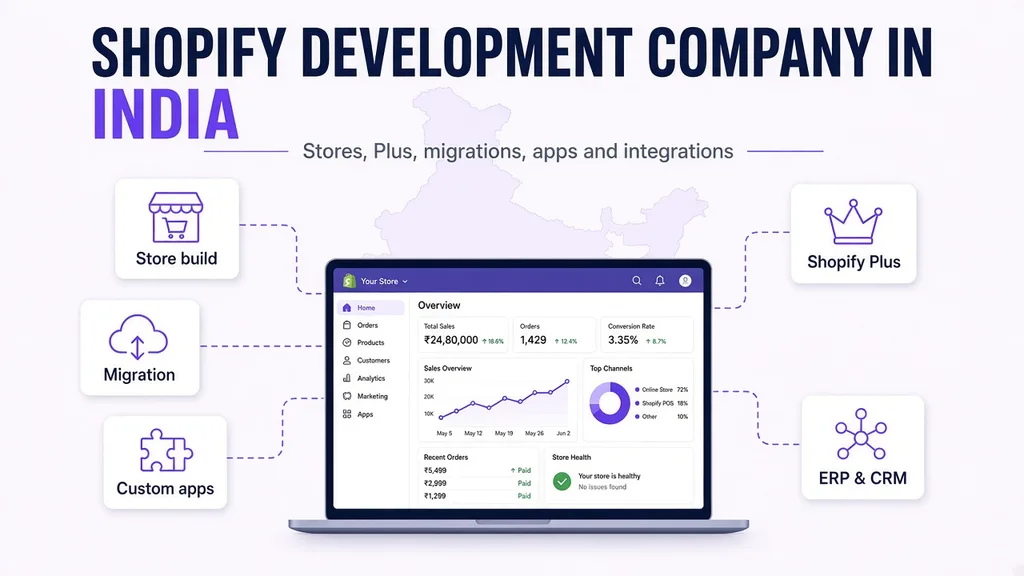
A Shopify development company in India designs, builds, migrates and maintains Shopify stores, and the good ones also handle the parts that are specific to selling in India: UPI and card payments through a third-party gateway, cash on delivery with RTO controls, GST setup and invoices, courier integrations and WhatsApp-first customer support. Typical project budgets run from about ₹50,000 for a theme-led starter store to ₹25,00,000 and more for custom, integrated or Shopify Plus builds. Shopify's own subscription is billed separately.
Web6 is a Shopify development company based in Surat, Gujarat, founded in 2017. We build and migrate Shopify stores for brands across India and abroad, we publish six apps on the Shopify App Store, and we run projects remotely with weekly calls and a shared preview theme. This page explains what we do, how we price it, and how to decide whether we, or any Shopify agency in India, are the right fit.
Key points
- Shopify Payments is not available in India, so every Indian store uses a gateway such as Razorpay, PayU or Cashfree. Shopify adds its own third-party fee on prepaid orders: 2% on Basic, 1% on Grow, 0.6% on Advanced and 0.2% on Plus. Cash on delivery orders carry no Shopify fee.
- Shopify does not issue GST invoices. You need an invoicing app or your accounting software for that.
- Most Indian D2C brands do not need Shopify Plus. A well-built Basic, Grow or Advanced store is enough until volume or Plus-only features justify the jump.
- The store should be created in your name, or transferred to you before launch. An agency should work through collaborator access, never your owner login.
On this page
- What a Shopify development company in India builds
- The India-specific stack
- Shopify development services
- What Shopify development costs in India
- Engagement models
- How a project runs, week by week
- Which Shopify plan to start on
- Working with Web6 from anywhere in India
- How to choose a Shopify partner
- Shopify guides for Indian brands
What a Shopify development company in India builds
"Shopify development" covers several different jobs. It helps to know which one you are buying, because they are priced and staffed differently.
| Job | What it involves | Who usually needs it |
|---|---|---|
| New store build | Theme selection or custom design, catalog setup, payments, shipping, taxes, policies, apps, launch | New D2C brands, offline brands going online |
| Theme customization | Section and block changes, product page and cart improvements, speed fixes on an existing theme | Live stores that convert below expectation |
| Custom theme | Online Store 2.0 theme built from a design system, with metafields and metaobjects for structured content | Brands where design is part of the product |
| Migration | Moving products, customers, orders and URLs from WooCommerce, Magento or a custom site, with 301 redirects | Brands outgrowing WordPress hosting or plugin upkeep |
| Shopify Plus build | Checkout extensibility, Shopify Functions, B2B, expansion stores | High-volume or wholesale-heavy brands |
| Custom app or integration | Private apps, ERP and CRM sync, webhooks, Shopify Functions | Brands whose workflows no public app covers |
| Retainer | Ongoing fixes, conversion work, new sections, app reviews, seasonal campaigns | Any live store that is still growing |
If you are still deciding whether Shopify is the right platform at all, read our Shopify vs WooCommerce vs custom ecommerce comparison first.
The India-specific stack
A Shopify theme looks the same in Mumbai and Melbourne. What changes in India is everything around checkout. These six layers are where Indian stores most often lose money, and where an India-experienced partner earns its fee.
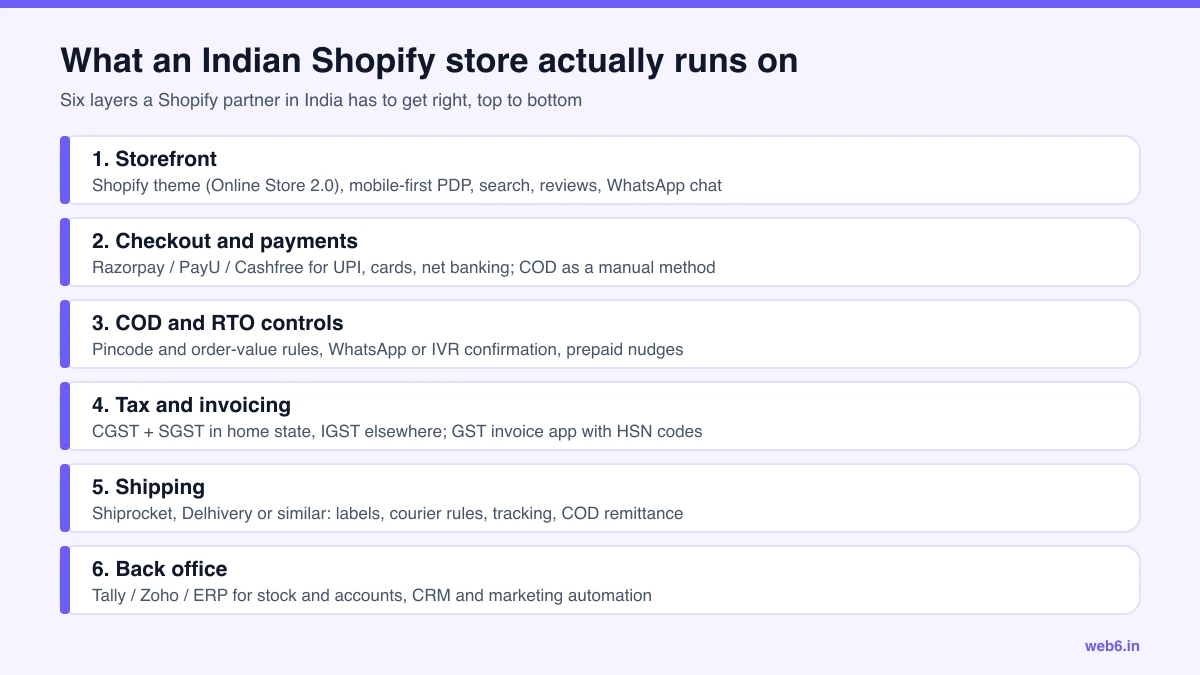
Payments: there is no Shopify Payments in India
Shopify's own payment processor is not offered to Indian businesses. You connect a third-party gateway (Razorpay, PayU, Cashfree, PhonePe PG, CCAvenue and others) for UPI, cards, net banking and wallets. Two fees then apply to each prepaid order: the gateway's processing fee, and Shopify's third-party transaction fee, which depends on your plan.
| Shopify plan (India) | Monthly price, billed monthly | Shopify fee on gateway orders | Shopify fee on COD |
|---|---|---|---|
| Basic | about ₹1,994 | 2% | 0% |
| Grow | about ₹7,447 | 1% | 0% |
| Advanced | about ₹30,164 | 0.6% | 0% |
| Plus | from about ₹1,75,000 | 0.2% | 0% |
Prices are from Shopify's India pricing page in November 2026. Yearly billing is cheaper. Check the page before you budget, because Shopify changes prices and runs promotions.
COD and RTO
Cash on delivery is still how many first-time Indian buyers pay. It is also the main source of return-to-origin (RTO) losses, where a parcel is refused and you pay shipping both ways. A partner should set COD rules before launch: limits by pincode or order value, a WhatsApp or IVR confirmation step, and a prepaid incentive you can test. We built COD Risk Guard for pincode rules because this problem kept coming up, and our COD RTO playbook covers the rest.
GST
Shopify can calculate GST, but the default rates it suggests for India are only a starting point. You set CGST and SGST for your home state, IGST for other states, and tax overrides for products at a different rate. Since 22 September 2025 the main GST slabs are 5% and 18%, with 40% for a short list of luxury and sin goods; the old 12% and 28% slabs no longer apply to most products. Shopify's order emails are not GST invoices, so you need an invoicing app or accounting software that prints your GSTIN, HSN codes and the tax split. Your accountant should confirm rates and HSN codes.
Shipping and back office
Most Indian brands ship through an aggregator such as Shiprocket, or directly with Delhivery, Blue Dart, Xpressbees or India Post. The integration needs to handle labels, courier selection, tracking pages and COD remittance. Stock and accounts usually live in Tally, Zoho or an ERP, and that sync is where custom work often starts. See our guide to Shopify ERP and CRM API integration.
Shopify development services
Shopify store development
We build new stores on a premium theme or a custom Online Store 2.0 theme. Every build includes catalog structure (collections, variants, metafields), payments and COD setup, GST configuration, shipping profiles, policy pages, analytics, and a launch checklist we run with you. Our Shopify store launch checklist for India is the same list we use.
Custom Shopify themes
For brands that need a distinct look, we design a component library in Figma and build it as theme sections your team can rearrange without a developer. We keep apps to a minimum on the storefront and test on mid-range Android phones, because that is what most Indian shoppers use.
Migrations to Shopify
We move stores from WooCommerce, Magento, OpenCart and custom builds. The work that matters most is not the product import, which tools handle well, but the URL map, redirects, customer account plan and the switch-over day. Our guide to WooCommerce to Shopify migration in India walks through it, and our fashion migration case study shows a Magento 2 move with redirect coverage above 99%.
Shopify Plus
We build and maintain Plus stores, including checkout UI extensions, Shopify Functions for discounts and payment rules, B2B catalogs and expansion stores. Before that, we check whether Plus is worth it for you. Many brands asking about Plus are better served by Advanced. Read Shopify Plus development company in India for the cost maths.
Shopify apps and integrations
We have six public apps on the Shopify App Store and build private apps for single brands: ERP sync, custom pricing, order routing and internal dashboards. See Shopify app development company India and public vs custom Shopify apps for when a custom app makes sense.
Speed, CRO and SEO
Once a store is live, the job becomes making it convert. We audit page speed, product page clarity, cart and checkout friction, and search visibility. Our Shopify conversion rate optimization guide lists what we check first, and our speed optimization case study shows the kind of gains to expect.
What Shopify development costs in India
These are planning ranges we use in scoping conversations. They are not fixed packages, and your quote depends on design depth, catalog size, apps, integrations and timeline.
| Project | Indicative budget | Typical timeline |
|---|---|---|
| Starter store on a theme | ₹50,000 to ₹2,00,000 | 2 to 4 weeks |
| Theme customization and branding | ₹1,50,000 to ₹5,00,000 | 3 to 6 weeks |
| Custom-designed store | ₹4,00,000 to ₹12,00,000 | 6 to 12 weeks |
| Migration (as a project or add-on) | ₹2,00,000 to ₹10,00,000+ | 4 to 10 weeks |
| Advanced store with integrations | ₹8,00,000 to ₹25,00,000+ | 8 to 16 weeks |
| Shopify Plus or enterprise | ₹15,00,000 to ₹50,00,000+ | 10 to 20 weeks |
Add these recurring costs to your budget: the Shopify plan, a paid theme licence if used (one-time), app subscriptions, gateway fees and Shopify's third-party fee, and any retainer after launch. Our Shopify website development cost in India guide breaks down every line, including hourly rates and maintenance.
Why two quotes for "the same store" differ
- Discovery. A ₹60,000 quote often skips catalog planning, redirects and QA. A ₹3,00,000 quote usually includes them.
- Design. Using a theme as-is is very different from designing key templates first.
- Data. 50 products with two variants is a day's work. 5,000 products with size charts, metafields and bundles is weeks.
- Integrations. Each ERP, CRM, warehouse or marketplace connection adds build and testing time.
- Who does the work. Senior developers cost more per hour and usually less per project.
Engagement models
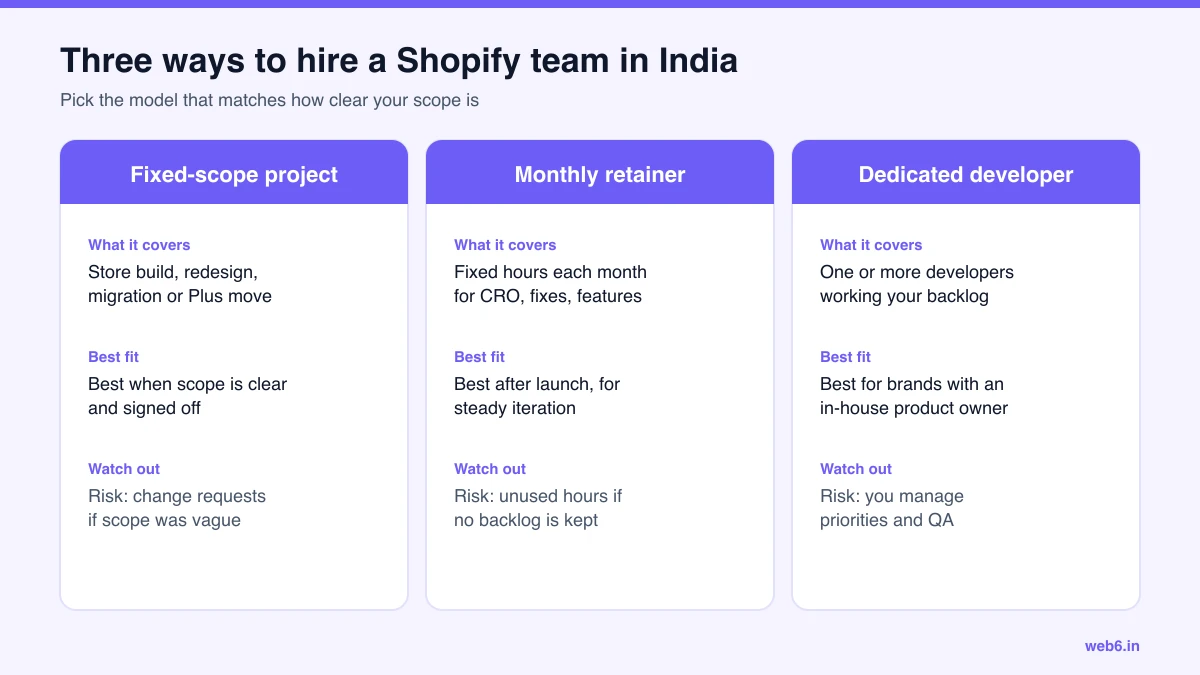
Fixed-scope project works for a new build, redesign, migration or Plus move when the scope can be written down and signed off. You get a fixed price and dates; changes go through a written change request.
Monthly retainer works after launch. You buy a block of hours each month for fixes, new sections, campaigns and conversion tests, and we keep a shared backlog so hours are not wasted.
Dedicated developer works for brands with an in-house product owner who can set priorities and review work every day. It is the cheapest per hour and the most demanding on your team.
If you want to compare these with hiring a freelancer or building an in-house team, our cost guide has a side-by-side table.
How a project runs, week by week
- Discovery (week 1). We review your current store or brand, catalog, apps, payment and shipping setup, and goals. You get a written scope with assumptions, exclusions and a fixed quote.
- Store and access setup. We create a client transfer store under our Partner account, or request collaborator access to your existing store. Either way, the store ends up owned by you.
- Design (weeks 1 to 3). Home, collection, product, cart and key content pages, designed mobile first. For theme builds we skip straight to configuration.
- Build (weeks 2 to 8). Theme work on an unpublished duplicate, catalog import, apps, payments, COD rules, GST and shipping. You review on a preview link every week.
- QA (final 1 to 2 weeks). Test orders for UPI, card, COD and refunds; GST invoice checks; device and browser testing; redirect checks for migrations.
- Launch. Domain connection, password removal, sitemap submission in Google Search Console, and a watch period for the first orders.
- Handover. A recorded walkthrough of your admin, a list of every app and why it is installed, and access for your team.
Which Shopify plan to start on
Plan choice affects fees more than most founders expect. A simple rule of thumb for Indian stores:
- Basic suits stores under roughly ₹2 to 3 lakh a month in prepaid sales, or stores where most orders are COD.
- Grow starts to pay for itself once the 1% fee saving on prepaid orders beats the higher subscription. On monthly billing that is around ₹5.5 lakh of prepaid sales a month.
- Advanced makes sense for larger prepaid volume, more staff accounts, or region-specific pricing through Markets.
- Plus is rarely justified by fees alone for Indian brands. It is justified by Plus-only features. The Plus page shows the break-even.
These are fee calculations, not advice on features. Count your real prepaid share (COD orders do not count) before deciding.
Working with Web6 from anywhere in India
Our office is in Surat, and we run projects remotely for brands elsewhere in India and abroad. A project runs the same way for a brand in Bengaluru, Delhi, Jaipur or Dubai:
- A weekly video call and a shared project board you can see.
- A WhatsApp group for quick questions during your working hours (IST).
- Preview links for every change, so you never review on a live store.
- A written contract and invoices from Web6 Technologies.
- In-person workshops in Surat or at your office for larger projects, if you want them.
If you are in Surat and prefer a local team, our Shopify development company in Surat page covers the same services with local details.
How to choose a Shopify partner
Whoever you hire, check these before signing:
- Ownership. The store, domain and theme licence are in your name.
- Access. They request collaborator access with limited permissions, not your owner password.
- Proof. They show live Shopify stores you can open, and give you a client to call.
- India depth. They can explain gateway fees, COD rules and GST invoices without looking anything up.
- Honesty about Plus. They tell you which features need Plus, an app or custom code, and which do not.
- Support. Response times after launch are written into the contract.
We wrote a full checklist with questions to ask in how to choose a Shopify development company in India, and a method for building a shortlist in best Shopify development companies in India. Shopify's tier names have also changed: the "Shopify Plus Partner" and "Shopify Experts" labels were retired, and partners now show tiers (Select, Plus, Premier, Platinum) in the Shopify Partner Directory.
Shopify guides for Indian brands
Each guide below goes deeper on one decision. They are written for founders and ecommerce managers, not developers.
Choosing a partner
- Best Shopify development companies in India: how to build a shortlist from directories and reviews
- How to choose a Shopify development company in India: questions, red flags and contract checks
Price and platform
- Shopify website development cost in India
- Shopify vs WooCommerce vs custom ecommerce
- Shopify Plus development company in India
Migrate and launch
- WooCommerce to Shopify migration in India
- Shopify store launch checklist for India
- Shopify conversion rate optimization