
Shopify
How Much Does a Shopify Website Cost in India? 2026 Pricing Guide
Written by Web6 Editorial Team · Published 8 August 2026 · 26 min read
Shopify website cost in India is not one fixed number. Two merchants can both “need a Shopify store” and still receive very different quotes because scope, design depth, catalog complexity, migration risk, apps, integrations, checkout requirements, QA, and support change the work.
This 2026 pricing guide helps founders, ecommerce managers, and operations leads understand what actually drives Shopify website development cost in India — so you can budget realistically, compare quotes fairly, and decide when a simple theme build is enough versus when custom work is worth the investment.
How much does a Shopify website cost in India?
In India, Shopify website development cost usually sits in illustrative planning bands rather than a single price: a basic theme-led store may land roughly in the ₹50,000–₹2,00,000 range, stronger theme customization or branded implementation often moves into ₹1,50,000–₹5,00,000, custom-designed stores commonly plan around ₹4,00,000–₹12,00,000, and advanced integration, B2B, or Shopify Plus projects can reach ₹8,00,000–₹25,00,000+ depending on complexity. These are indicative planning ranges, not official market averages or fixed Web6 packages. Shopify subscription fees are separate from development fees, and actual quotes vary by scope.
Key takeaways
- Separate Shopify platform fees from design and development project fees.
- Theme choice, custom design, migration, apps, and integrations move budgets more than product count alone.
- Cheap quotes often exclude strategy, SEO migration, performance work, QA, or post-launch support.
- Freelancer, agency, DIY, and in-house models each fit different scope and risk profiles.
- A clear discovery scope is more useful than comparing headline prices.
- Not every brand needs a fully custom build — a theme-led launch can be the right first step.
Table of contents
- Shopify platform cost vs development cost
- Indicative Shopify project pricing ranges
- Cost factor: theme approach
- Cost factor: custom design
- Cost factor: product catalog
- Cost factor: migration
- Cost factor: Shopify apps
- Cost factor: custom functionality
- Cost factor: checkout
- Cost factor: international selling
- Cost factor: B2B
- Cost factor: speed and performance
- Cost factor: SEO
- Cost factor: QA and testing
- Cost factor: content and creative
- Cost factor: support and maintenance
- Agency vs freelancer vs DIY
- Shopify budget planner
- What should be included in a Shopify quote?
- Hidden costs to watch
- Low-cost package trade-offs
- How to reduce Shopify development cost
- When a custom build is worth it
- When a simple theme build is enough
- Shopify vs custom ecommerce cost
- Shopify Plus cost context
- Timeline vs cost
- How Web6 scopes Shopify projects
- Frequently asked questions
Shopify platform cost vs Shopify development cost
Buyers often mix two different cost lines. Treat them separately.
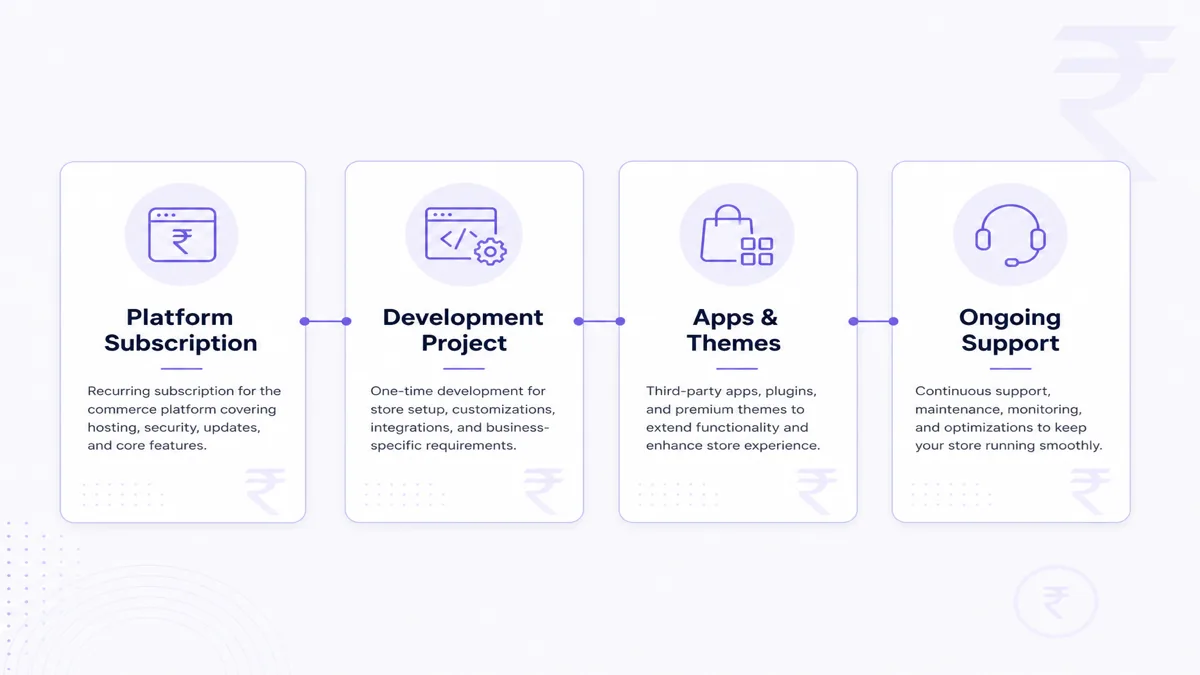
1) Shopify subscription and platform charges
These are recurring Shopify fees for running the platform. According to Shopify India’s pricing page (verified August 2026), published plan pricing includes approximately:
- Basic: about ₹1,499/month when billed yearly (about ₹1,994/month billed monthly)
- Grow: about ₹5,599/month yearly (about ₹7,447/month monthly)
- Advanced: about ₹22,680/month yearly (about ₹30,164/month monthly)
- Plus: from about ₹1,75,000/month
Shopify may also run introductory promotions (for example trial and early discounted months). Plan prices and promotions change, so confirm on Shopify’s official India pricing page before budgeting. Platform cost is not the same as your website build cost.
2) Store design and development project cost
This is the one-time (or phased) fee for planning, design, theme work, catalog setup, migration, integrations, QA, launch, and handover. It is what agencies, freelancers, or in-house teams charge for delivery.
Related recurring costs outside the build invoice
- Shopify plan subscription
- paid theme license (if used)
- app subscriptions
- domain registration/renewal
- payment gateway or transaction-related fees where applicable
- maintenance, CRO, or SEO retainers after launch
Indicative Shopify project pricing ranges in India
The table below uses indicative planning ranges for India agency-style Shopify delivery conversations. These are not official India-wide averages, not fixed Web6 packages, and not guarantees. Actual quotes vary by scope, senior involvement, timeline pressure, and third-party dependencies.
| Project type | Typical scope | Complexity | Budget position (indicative) | Best for |
|---|---|---|---|---|
| Starter Shopify store | Theme setup, basic pages, small catalog, standard checkout | Low | ₹50,000 – ₹2,00,000 | Early-stage brands validating demand |
| Theme customization project | Paid/free theme + branding, section edits, conversion polish | Low–medium | ₹1,50,000 – ₹5,00,000 | Brands that need a stronger storefront without full custom UX |
| Custom-designed Shopify store | UX/UI design + custom theme implementation for key templates | Medium–high | ₹4,00,000 – ₹12,00,000 | Differentiated D2C brands with design-led buying journeys |
| Shopify migration | Catalog, customers, redirects, SEO cutover, content/media | Medium–high | Often ₹2,00,000 – ₹10,00,000+ as a project or add-on | WooCommerce, Magento, custom, or Shopify-to-Shopify moves |
| Advanced Shopify store | Custom UX + apps + integrations + stronger QA | High | ₹8,00,000 – ₹25,00,000+ | Growth brands with operational complexity |
| B2B Shopify project | Account pricing, catalogs, terms, dealer flows, possible ERP | High | ₹10,00,000 – ₹30,00,000+ | Wholesale, dealer, and account-based selling |
| Shopify Plus / enterprise | High-volume ops, advanced checkout needs, multi-brand complexity | Very high | ₹15,00,000 – ₹50,00,000+ | Complex multi-market or high-throughput businesses |
| Custom Shopify app project | Private or public app beyond off-the-shelf tools | Variable | Often ₹2,50,000 – ₹35,00,000+ by app type | Workflows apps cannot cover safely |
For app-specific ranges and hiring checklists, see Web6’s Shopify app development guide. For storefront delivery capability, review Shopify development services.
Cost factor: theme approach
Theme strategy is usually the first major budget fork.
Free Shopify theme
Lower license cost and faster starts. Flexibility depends on the theme’s sections and settings. Heavy “bending” of a free theme into a unique brand system can still consume meaningful development hours.
Paid theme
Paid themes often include richer templates and merchandising patterns. You still pay for implementation, content setup, and quality control. A paid theme is not a finished store.
Theme customization
Common middle path: keep a solid theme foundation, then customize homepage, PDP, collection, cart, and mobile states. Cost rises with the number of custom sections, animations, and edge-case templates.
Fully custom Shopify theme
Highest design control and usually higher implementation/maintenance cost. Useful when brand experience is a competitive asset. Requires stronger QA and clearer ownership of theme code quality.
Budget impact: free/paid theme setup < deep customization < fully custom theme systems.
Cost factor: custom design
There is a difference between “using a theme with branding” and “designing the experience first.”
Theme with branding
Apply logo, colors, fonts, and content into an existing theme. Faster and cheaper when the theme already matches your buying journey.
Custom Figma/UX + Shopify implementation
Designers define homepage, product detail pages, collection pages, cart, search, account experience, and mobile states before developers implement. This increases design and front-end hours, but can reduce later rework if decision-making is disciplined.
Custom design is worth the spend when conversion depends on distinctive product storytelling, complex merchandising, or carefully designed mobile flows. It is optional for many early catalogs.
Cost factor: product catalog
Catalog size matters, but raw product count alone should not determine price.
Cost usually rises with:
- number of products and variants that need cleanup
- collection architecture and filter logic
- metafields and metaobjects for structured product data
- import quality, image standards, and attribute consistency
- complex relationships such as bundles, kits, or related products
A clean 300-SKU catalog with clear attributes can cost less to launch than a messy 80-SKU catalog with broken variants and missing images. Budget for data cleanup when migrating or rebuilding.
Cost factor: migration
Migration is often underestimated because teams count products and forget operational cutover.
Whether you move from WooCommerce, Magento, custom ecommerce, or another Shopify store, plan for:
- products, variants, collections, and images
- customers and historical orders (where needed)
- URL redirects and SEO migration
- metadata, reviews, and content pages
- app data and third-party integrations
- tracking continuity and post-launch verification
Migration risk rises with dirty data, custom legacy fields, and missing redirect maps. For a practical example of catalog and cutover discipline, see Web6’s Shopify migration case study.
Cost factor: Shopify apps
Apps affect both project cost and monthly operating cost.
- Off-the-shelf apps: faster to configure, recurring subscription fees, theme integration effort varies.
- Paid app stacks: can quietly exceed the theme license cost every month.
- Configuration and theme integration: still billable work even when the app is “installed.”
- Custom apps: needed when public apps cannot safely express your rules or workflows.
Installing an app is not the same as custom app development. If you need private workflows, Functions, or App Store products, review custom Shopify app development as a separate budget line.
Cost factor: custom functionality
Custom work increases cost because it adds design, engineering, testing, and ownership.
Common examples:
- custom pricing or product logic
- B2B workflows and dealer portals
- ERP or CRM integration
- custom discounts and Shopify Functions
- automation and third-party APIs
- custom dashboards or internal tools
Integration complexity changes budget because every system boundary introduces authentication, edge cases, failure handling, and QA. A storefront theme change is usually cheaper than a reliable ERP sync.
Cost factor: checkout
Checkout expectations must match Shopify plan realities.
- Standard Shopify checkout: strong baseline conversion and limited UI customization on non-Plus plans.
- Shopify Functions: backend logic customization (discounts, payment/delivery rules, validation, and related capabilities) available more broadly than full checkout UI redesign, with plan exceptions such as Starter.
- Checkout UI extensions and checkout branding: primarily available to Shopify Plus for mid-checkout customization; thank-you/order status surfaces have broader availability.
Do not assume every checkout visual customization is available on every plan. Confirm current Shopify capabilities during discovery before promising branded checkout redesigns.
Cost factor: international selling
Selling across markets adds configuration and content work, even on one Shopify store.
Budget drivers include Shopify Markets setup, multiple currencies, languages/translations, regional domains or subfolders, hreflang and URL strategy, tax/duty configuration, and local payment or shipping requirements. See how Web6 approached multi-market storefront work in the international Shopify store case study.
Cost factor: B2B
B2B Shopify projects usually cost more than simple D2C theme launches because commercial rules are the product.
Expect extra scope for wholesale or account-based pricing, minimum order rules, quote/RFQ flows, payment terms, ERP connections, and dealer accounts. Native Shopify B2B capabilities also differ by plan (for example, catalog limits on non-Plus versus broader Plus B2B catalogs), so plan fit should be validated early.
If wholesale workflows are central, explore B2B ecommerce development as part of budgeting rather than treating B2B as a theme skin.
Cost factor: speed and performance
Performance work is either included as an acceptance standard or postponed as post-launch rescue.
Cost drivers include theme quality, third-party app scripts, JavaScript weight, image optimization, app embeds, and Core Web Vitals remediation on key templates. Cheap builds that ignore mobile performance often create a second project later. For a remediation example, see the Shopify speed optimization project.
Cost factor: SEO
Do not confuse SEO-ready development with ongoing SEO services.
Often part of development
- URL structure and canonical discipline
- redirect maps for migrations
- metadata architecture
- structured data where appropriate
- crawlable templates and internal architecture
- performance foundations
Usually separate ongoing work
- keyword research and content production
- category and product content programs
- link acquisition
- continuous reporting and iteration
For the search side of ecommerce growth, use the ecommerce SEO playbook as a companion — not as a substitute for storefront build scope.
Cost factor: QA and testing
Quality assurance is where low quotes often go missing.
Serious delivery tests mobile devices, major browsers, payment methods, shipping rates, discount logic, analytics tracking, forms, apps, redirects, accessibility basics, and performance gates. Skipping QA reduces invoice size and increases launch risk. Ask every vendor what is tested before go-live and what remains out of scope.
Cost factor: content and creative
Clarify whether the quote includes product photography, copywriting, banners, graphic design, iconography, video, and content upload. Creative production can materially change total project cost even when development hours stay stable. Many “website” quotes assume the merchant supplies final assets.
Cost factor: support and maintenance
After launch, support models vary:
- project handoff only
- monthly maintenance
- support retainer / enhancement hours
- ongoing CRO experiments
- ongoing SEO retainers
Web6 does not publish fixed public maintenance packages in this guide. Treat support as a scoped commercial discussion based on change volume, app ownership, and business risk — not an assumed free forever service.
Agency vs freelancer vs DIY vs in-house
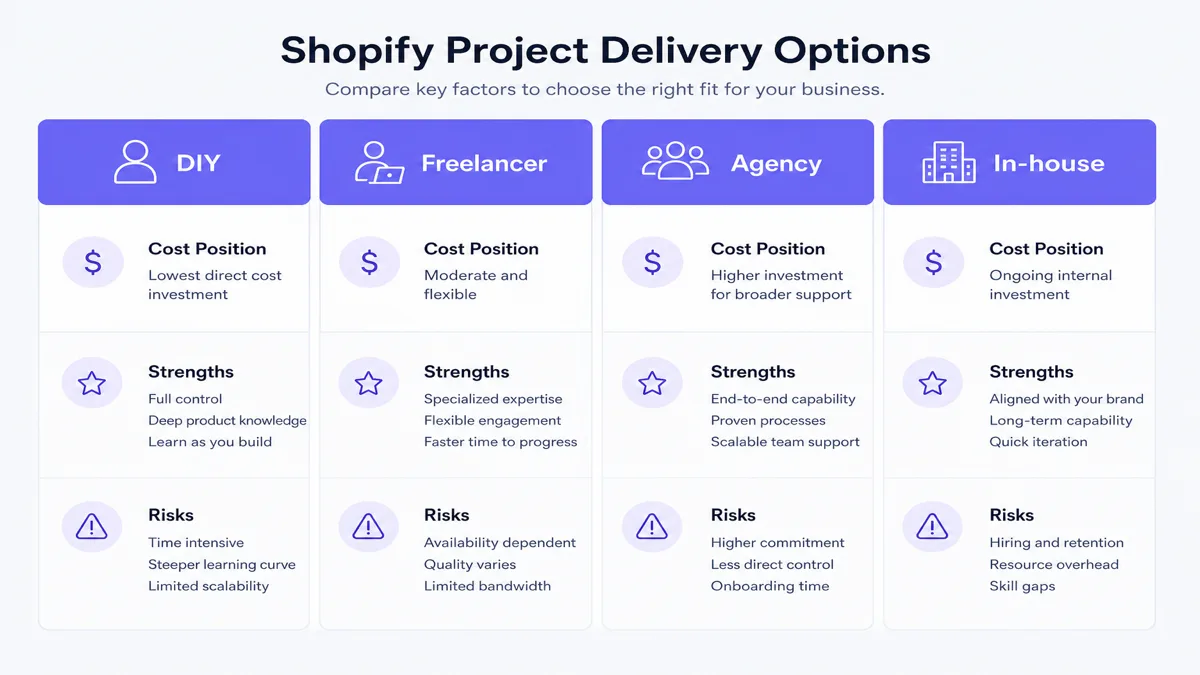
| Option | Cost position | Strengths | Risks | Best for |
|---|---|---|---|---|
| DIY | Lowest cash outlay | Full control, fast experiments for simple catalogs | High time cost, easy to miss SEO/performance/QA | Founders validating a simple offer |
| Freelancer | Often efficient for limited scope | Speed, direct communication, focused execution | Coverage gaps across design, apps, SEO, ops | Theme customization and contained builds |
| Agency | Higher for multidisciplinary work | Design + development + QA + process depth | Over-scoping if discovery is weak | Migrations, custom UX, integrations, Plus work |
| In-house team | High fixed cost, strong long-term leverage | Continuous iteration and institutional knowledge | Hiring/management overhead; uneven specialty coverage | Brands with continuous roadmap volume |
Agency is not always better. Match delivery model to complexity and accountability needs. If you are evaluating partners, the Shopify development company selection guide covers hiring criteria beyond price.
Shopify budget planner
Use this self-assessment before requesting quotes.
| Requirement | Low complexity | Medium | High |
|---|---|---|---|
| Theme | Light setup of existing theme | Paid theme + customization | Custom theme system |
| Design | Brand kit into theme | Key template redesign | Full UX across storefront states |
| Products | Clean small catalog | Variants + metafields | Complex relationships / large cleanup |
| Migration | None or simple CSV | Platform move + redirects | Multi-system historical cutover |
| Apps | Few essential apps | Configured growth stack | Many apps + conflict management |
| Custom functionality | None | Limited rules/automations | Custom apps / deep workflows |
| Integrations | Payments + shipping basics | CRM/ESP/ERP light sync | Mission-critical multi-system sync |
| International | Single market | Currencies/languages | Multi-domain multi-market ops |
| B2B | None | Simple wholesale price lists | Account catalogs, terms, ERP |
| SEO migration | New domain/brand | Redirect map + metadata | Large URL inventory + content rebuild |
| Testing | Basic device checks | Payments/shipping/discounts matrix | Full regression + accessibility + CWV gates |
| Support | Handoff only | Monthly hours | Retainer + roadmap ownership |
What should be included in a Shopify quote?
A useful quote should make inclusions and exclusions explicit.
- Discovery and requirements workshop
- Written scope and assumptions
- Theme/design approach
- Mobile implementation
- Product/catalog setup responsibilities
- App configuration list
- Integrations and owners
- Redirects and SEO cutover tasks
- Analytics/tracking setup
- QA plan
- Launch checklist
- Training/handover
- Support window after launch
- Ownership and access (theme code, apps, credentials)
- Exclusions list
- Change request process and rate card
Hidden costs to watch
Budgets slip when these line items stay invisible:
- paid theme licenses
- recurring app subscriptions
- custom app hosting or infrastructure
- ERP/API vendor costs
- content migration and data cleanup
- paid fonts or stock licenses
- post-launch change requests
- support retainers
- tracking implementation and consent tooling
- localization/translation
- third-party payment or marketplace fees where applicable
Ask vendors to separate one-time build cost from monthly operating cost.
Low-cost package trade-offs
Low-cost packages are not automatically bad. They can be rational for simple catalogs and quick launches. The risk is buying a package that silently excludes the work you still need.
Common exclusions in low-cost offers:
- strategy and information architecture
- custom UX beyond theme settings
- performance optimization
- SEO migration and redirect QA
- serious multi-device QA
- accessibility basics
- maintainable custom code standards
- meaningful post-launch support
Compare scope, not slogans. A higher quote with clear QA and migration work can be cheaper than a low quote plus emergency fixes.
How to reduce Shopify development cost
Buyers can reduce cost without pretending complexity does not exist:
- define must-have versus nice-to-have before design starts
- clean catalog data early
- choose a theme direction before deep custom requests
- avoid stacking unnecessary apps
- prepare branding and content on time
- consolidate feedback into scheduled review rounds
- phase advanced features after revenue validation
- avoid mid-build scope changes that reopen completed templates
When a custom Shopify build is worth it
Custom investment usually makes sense when:
- distinctive UX is part of the brand advantage
- traffic volume makes conversion friction expensive
- catalog or merchandising rules are complex
- international or B2B requirements are core
- integrations are operationally critical
- migration risk is high
- you are investing in a long-term brand platform rather than a temporary experiment
When a simple theme build is enough
Not every merchant needs expensive custom development. A theme-led build can be the right answer when you have a small catalog, standard checkout needs, basic integrations, straightforward branding, and an early-stage validation goal. Launching cleanly with a strong theme often beats delaying revenue for a perfect custom system you do not yet need.
Shopify vs custom ecommerce cost
Shopify and fully custom ecommerce platforms solve different ownership models.
| Dimension | Shopify | Custom ecommerce |
|---|---|---|
| Upfront development | Often faster for standard commerce | Usually higher for equivalent baseline features |
| Hosting/infrastructure | Included in platform model | You own or procure hosting/ops |
| Maintenance | Platform evolves; you maintain theme/apps/custom code | You maintain more of the stack |
| Flexibility | Strong within platform boundaries | Higher absolute flexibility, higher cost to keep it |
| Launch speed | Usually faster for common storefronts | Slower unless you reuse mature internals |
| Long-term ownership | Platform dependency with app/theme control | Deeper ownership, deeper responsibility |
| Integrations | App ecosystem + custom apps/APIs | Fully custom or middleware-led |
Neither is always cheaper. Choose based on required flexibility, team capability, and time-to-launch. For broader storefront platform work, see ecommerce website development. For WooCommerce, custom, B2B and first-year total-cost comparison across platforms, use the ecommerce website cost in India guide.
Shopify Plus cost context
Shopify Plus becomes relevant when business complexity outgrows standard plans — for example high checkout volume, advanced B2B needs, broader checkout customization, or enterprise operational requirements. Plus platform subscription and Plus project implementation are separate costs. Shopify India’s pricing page lists Plus from about ₹1,75,000/month (verified August 2026); confirm current commercial terms directly with Shopify. For delivery patterns at this level, review the Shopify Plus store development case study.
Timeline vs cost
| Project | Typical complexity | Timeline drivers |
|---|---|---|
| Starter theme store | Low | Content readiness, basic setup, light QA |
| Custom-designed store | Medium–high | Design rounds, template build, mobile QA |
| Migration | Medium–high | Data cleanup, redirects, cutover rehearsal |
| Integrated / B2B / Plus | High | Integrations, rule complexity, extended QA |
| Custom app add-on | Variable | Requirements clarity, API constraints, UAT |
Exact timelines are not guarantees. Feedback speed, custom design depth, integrations, migration quality, QA intensity, and app development all move delivery. Compressed deadlines can increase cost because more work happens in parallel with higher coordination overhead.
How Web6 scopes Shopify projects
Web6 scopes Shopify work through discovery before quote finalization. A useful discovery covers business model, catalog reality, current platform, design requirements, apps, integrations, migration needs, markets, SEO cutover, performance expectations, and support ownership.
That process exists so pricing reflects actual delivery risk — not a generic package name. If you want help translating your requirements into a scoped build, start with Web6’s Shopify development services or discuss your requirement with the team. For conversion work after launch, the Shopify conversion rate optimization guide covers measurement and funnel diagnosis separately from build cost.
Frequently asked questions
How much does a Shopify website cost in India?
There is no single price. Indicative planning bands often run from roughly ₹50,000–₹2,00,000 for simple theme-led stores to ₹4,00,000–₹12,00,000 for custom-designed builds, with advanced, B2B, or Plus projects higher. These are planning ranges, not fixed quotes. Shopify subscription fees sit outside development cost.
How much does a Shopify developer charge in India?
Charges vary by experience, city, and engagement model (hourly, project, retainer). Compare delivered scope — design, QA, migration, and support — rather than hourly rates alone. Multidisciplinary agency delivery usually costs more than a single freelancer for the same headline hours because more roles are covered.
Is Shopify expensive for a small business?
Shopify can be cost-effective for small businesses when you keep scope theme-led, limit unnecessary apps, and avoid premature custom development. Platform subscription, apps, and payment-related fees still apply. The expensive outcome is usually overbuilding before product-market fit.
What is included in Shopify website development?
A complete scope typically includes discovery, theme/design implementation, key templates, catalog setup responsibilities, app configuration, analytics, QA, launch, and handover. Migrations, custom apps, creative production, and retainers may be separate. Always read inclusions and exclusions.
Does Shopify development cost include the Shopify plan?
Usually no. Development quotes cover delivery work. Shopify plan fees are paid to Shopify. Confirm whether domains, paid themes, apps, and post-launch support are inside or outside the proposal.
How much does a custom Shopify theme cost?
Custom theme work varies widely. Light customization of an existing theme costs less than a full custom design system. In planning conversations, deeper custom-designed storefronts often sit in multi-lakh INR ranges depending on template count, motion, and mobile states. Ask for assumptions behind any number.
How much does Shopify migration cost?
Migration cost depends on data quality, platform origin, redirect volume, SEO risk, and integration cutover — not only SKU count. Indicative project or add-on ranges often span a few lakhs upward for serious catalog and SEO migrations. Dirty data is the usual budget expander.
Is a Shopify freelancer cheaper than an agency?
Often yes for contained theme work. Agencies can be more economical for complex projects where design, development, QA, and project management must happen together. Choose based on scope risk, not only sticker price.
How much does Shopify maintenance cost?
Maintenance varies from occasional task-based fixes to monthly retainers for enhancements, app updates, and CRO support. There is no universal rate. Define expected monthly change volume before comparing retainers.
How long does it take to build a Shopify store?
Simple theme stores can launch quickly when content is ready. Custom design, migrations, integrations, and B2B rules extend timelines. Feedback speed and QA depth matter as much as coding speed. Treat published timelines as estimates tied to assumptions, not guarantees.