
Ecommerce
How to Choose an Ecommerce Website Development Company in India
Written by Web6 Editorial Team · Published 22 August 2026 · 26 min read
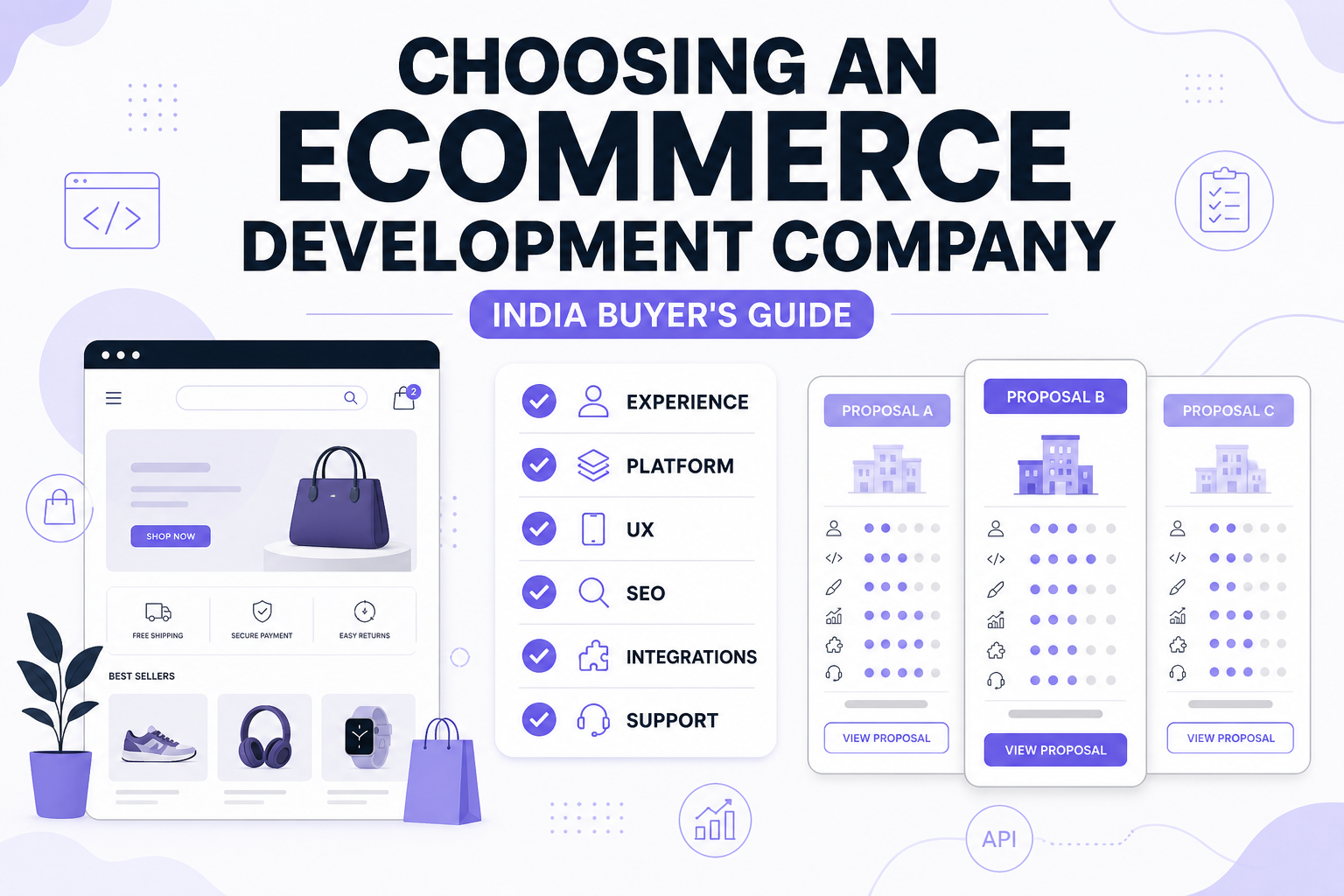
Choosing an ecommerce development company is harder than comparing portfolios or asking for the lowest quote. Two agencies may propose very different budgets because they are solving different versions of the project: one prices a theme-led store with standard payments, while another prices custom UX, migration, ERP sync and post-launch support.
A reliable evaluation should consider platform expertise, ecommerce architecture, UX, integrations, SEO, performance, testing, migration, post-launch support and how clearly the company defines project scope. This guide is a practical selection framework you can use on any shortlist — including Web6 — without treating any one vendor as the default winner.
How do you choose the right ecommerce development company?
Choose an ecommerce development company based on its experience with projects similar to your business, platform expertise, technical capabilities, approach to UX and SEO, integration experience, QA process, communication and post-launch support. Before comparing prices, give each shortlisted company the same requirements so their proposals are comparable. Review actual case studies rather than screenshots alone, ask who will work on the project, verify ownership and third-party costs, and understand what happens after launch. The cheapest quote is not necessarily poor and the highest quote is not necessarily best; the important question is whether the proposed scope matches your business requirements.
Key takeaways
- Define requirements before requesting quotes.
- Send the same brief to every shortlisted provider.
- Compare scope, not only totals.
- Case studies matter more than screenshot galleries.
- Platform expertise should match the stack being proposed.
- SEO, performance, QA and support belong in the evaluation, not only design.
Before hiring an ecommerce development company, verify
- ☐ Relevant ecommerce experience
- ☐ Platform expertise
- ☐ Real case studies
- ☐ UX/UI capability
- ☐ Mobile ecommerce experience
- ☐ SEO knowledge
- ☐ Performance approach
- ☐ Payment integration experience
- ☐ Shipping integration experience
- ☐ ERP/CRM capability if required
- ☐ Migration experience if required
- ☐ QA/testing process
- ☐ Security practices
- ☐ Project management process
- ☐ Clear proposal
- ☐ Ownership terms
- ☐ Post-launch support
- ☐ Realistic timeline
- ☐ Transparent third-party costs
Use this as a discovery checklist, not a pass/fail exam. Missing one item is usually a prompt to ask more questions, not an automatic rejection.
1. Define your ecommerce requirements before contacting agencies
Comparing agencies without a project brief produces incomparable proposals. Company A may price ten features; Company B may price twenty. The totals then look like a price difference when they are actually a scope difference.
Write down business model (B2C / D2C / B2B / marketplace), product and SKU count, variants, markets (India / international), payments, COD, shipping, ERP, CRM, accounting, inventory, warehouses, SEO, migration, custom functionality, mobile-app needs and support expectations. If you are still listing storefront capabilities, use the 25 must-have ecommerce website features checklist first.
Requirements brief (copy into your RFP)
| Requirement | Your need | Priority | Notes |
|---|---|---|---|
| Platform | Must / Should / Later | ||
| Products/SKUs | |||
| Variants | |||
| Payments | |||
| COD | |||
| Shipping | |||
| ERP | |||
| CRM | |||
| B2B | |||
| International | |||
| Migration | |||
| SEO | |||
| Analytics | |||
| Support |
2. Decide whether you need Shopify, WooCommerce or custom ecommerce
Do not hire a company simply because it claims it develops every platform. Ask for evidence on the stack being proposed. Platform choice also changes what “expertise” looks like.
Shopify is often suitable when managed commerce infrastructure, faster deployment and an established app ecosystem fit the business.
WooCommerce can fit when WordPress is already central and the business is comfortable managing hosting, plugins, backups and performance.
Custom ecommerce can fit when unique business logic or integrations cannot reasonably sit on a standard platform.
This article does not replace a full platform comparison. Read Shopify vs WooCommerce vs custom ecommerce before locking the stack. If you are still deciding whether the project is platform, hybrid or full custom, use build vs buy ecommerce first.
What platform expertise should look like
For Shopify, ask about themes, Liquid or the current frontend stack in use, Admin/Storefront APIs, apps and extensions, checkout capabilities, Shopify Functions where relevant, webhooks and ERP integration. For WooCommerce, ask about WordPress, PHP, plugins, hosting, performance, security and maintenance. For custom builds, ask about frontend, backend, database, APIs, infrastructure, security, deployment and monitoring.
A Shopify-specific engagement may still need theme work, a custom app, ERP sync, B2B, international setup or migration. Do not force custom app development when native or App Store functionality is enough. When custom Shopify functionality is on the table, see when a Shopify store needs a custom app and Shopify app development.
3. Look for relevant ecommerce experience, not only years in business
“Ten years of web development” does not automatically equal strong ecommerce experience. Marketing sites, brochure CRMs and ecommerce storefronts are different problem classes.
Look for storefronts, complex catalogs, payment integrations, shipping, checkout, migrations, inventory, ERP/CRM, B2B and international commerce that resemble your project. Relevant project experience matters more than a generic company-age number.
4. Evaluate case studies, not just portfolio screenshots
A screenshot proves design exists. It does not prove technical architecture, integration quality, performance, SEO migration, business functionality or scalability.
Ask case studies to explain the problem, requirements, solution, technology, implementation and a verifiable outcome. Do not expect confidential client data. Public pages, live stores (where still available) and clearly described constraints are more useful than inflated metrics.
| Question | What to look for |
|---|---|
| What was the problem? | Clear business requirement |
| What platform was used? | Appropriate technology |
| What was custom-built? | Technical capability |
| Which integrations were required? | API experience |
| Was migration involved? | Migration expertise |
| What outcome is documented? | Verifiable result |
Examples on this site that show different project types — not a ranking of “best” work — include a fashion store migration, Shopify Plus storefront, international Shopify store, speed optimization and custom Shopify app.
5. Industry experience helps, but it should not be your only criterion
Fashion often needs variants, size guides, filters and returns. Jewellery often needs high-quality product media, specifications and trust signals. B2B manufacturing often needs ERP, dealer pricing, quotes and account workflows.
Industry familiarity can reduce discovery time. Strong ecommerce architecture experience can still transfer between industries. Prefer a partner that understands your catalog and operations over one that only shares your category label.
6. Evaluate ecommerce UX, not only visual design
Look beyond animations, colours and hero banners. Evaluate navigation, product discovery, search, filters, product pages, mobile UX, cart, checkout, accessibility and responsive behaviour. A beautiful store that is difficult to shop is not strong ecommerce UX.
Review mobile layouts on real devices
Ask to review agency work on actual mobile layouts, not only desktop portfolio screenshots. Check menus, filters, variants, sticky actions, product images, forms, cart and checkout. Most Indian ecommerce traffic is mobile; desktop-only evaluation misses the store customers will actually use.
7. Ask how the ecommerce website will actually be built
The agency should be able to explain frontend, commerce platform, backend, database where applicable, APIs, hosting, CDN, integrations, deployment and monitoring without hiding behind buzzwords.
Do not require unnecessary architecture complexity for small projects. A theme-led Shopify store does not need a headless diagram to be professional. A multi-warehouse B2B portal with ERP sync does.
8. Make sure SEO is considered during development
The development company does not necessarily need to provide ongoing SEO. It should understand technical foundations such as crawlability, indexability, URLs, canonical tags, metadata, structured data, sitemap, redirects, internal linking and performance.
This is especially important for a redesign or migration. Pair implementation questions with the ecommerce SEO playbook and, if you need ongoing organic work, SEO services.
SEO migration questions
If you are replacing an existing ecommerce site, ask how old URLs will be mapped, how redirects will be implemented, how metadata will migrate, how canonical tags will be checked, how sitemap changes will be handled and how Search Console will be monitored after launch. Do not launch a migration without an SEO plan.
9. Ask how performance will be handled
Evaluate image optimization, JavaScript, apps/plugins, fonts, caching, CDN, server response where relevant and Core Web Vitals. Ask how performance will be tested before launch.
Do not accept guaranteed PageSpeed 100 claims without context. Lab scores, field data and checkout paths can disagree. Google’s Core Web Vitals thresholds (LCP, INP, CLS at the 75th percentile) are useful targets, not ranking guarantees.
10. Check experience with the systems your business already uses
Potential integrations include ERP, CRM, accounting, warehouse/WMS, shipping, payment, PIM, marketplaces and marketing tools. For operationally complex businesses, integration experience can matter more than visual design.
ERP
If ERP is required, ask what is the source of truth for products, inventory, pricing, orders, customers and invoices — and how failures are handled. Useful concepts include APIs, webhooks, queues, retry logic, logs and reconciliation. See ERP development and Shopify ERP/CRM/API integration when that is the stack.
CRM
CRM work may include customer synchronization, order data, B2B accounts, lead/customer lifecycle and sales workflows. Link that requirement to custom CRM development when the CRM itself needs to be built or extended.
11. Verify payment and checkout experience
For Indian ecommerce, consider UPI, cards, net banking, COD and relevant gateway integrations. For international selling, consider currencies, international payment options and regional checkout constraints. Verify current platform and provider capabilities. Do not use stale fee data from old blogs.
12. Ask about COD if it is part of your model
For businesses with meaningful COD volume, ask whether the architecture can support COD availability rules, pincode restrictions, COD fees, order-value rules, product restrictions, customer rules, verification workflows and prepaid incentives. Not every store needs advanced COD logic. Simple “COD on/off” is enough for many catalogs.
13. Scope shipping and logistics early
Ask about shipping aggregators, courier APIs, pincode serviceability, delivery estimates, weight-based rates, warehouse routing, tracking and international shipping. Complex fulfillment should be scoped before design is approved, because it changes checkout, PDP copy and operational hand-off.
14. B2B ecommerce requires different capabilities
If the project is B2B, evaluate experience with company accounts, dealer pricing, customer-specific catalogs, bulk pricing, MOQ, quotes, purchase orders, credit, approvals, sales reps and ERP. Normal D2C ecommerce experience does not automatically equal B2B expertise. See B2B ecommerce development.
15. Ask how security responsibilities are handled
Discuss platform updates, dependencies, access control, backups, secrets/API keys, HTTPS, secure integrations, logging and incident handling. Responsibility differs between Shopify, WooCommerce and custom ecommerce. Do not ask an agency to “guarantee no hacks.” Ask who patches what, and how access is controlled after launch.
16. Understand the company's testing process
Ask whether QA includes desktop, mobile, browsers, product variants, search, filters, cart, checkout, payment, shipping, discounts, accounts, emails, integrations, analytics and redirects. Professional ecommerce testing is much more than checking whether pages load.
| Area | Example tests |
|---|---|
| Catalog | Products, variants, inventory |
| UX | Mobile, navigation, filters |
| Cart | Quantity, discounts, totals |
| Checkout | Address, shipping, payment |
| Integrations | ERP, CRM, courier |
| SEO | Canonicals, redirects, sitemap |
| Analytics | Events, purchase tracking |
| Performance | Core Web Vitals / lab tests |
17. Understand how the project will be managed
Ask who the main contact is, who is actually building the project, how often updates are provided, how feedback is collected, how milestones are approved, how scope changes are handled and what project-management system is used. Do not require a specific tool. Clarity of ownership matters more than whether they use Jira, Asana or email.
18. Know who will actually work on your project
Potential roles include project manager, UI/UX designer, frontend developer, backend developer, Shopify or WooCommerce specialist, QA, SEO specialist and DevOps where relevant. A small project may not need a separate person for every role. Focus on capability rather than headcount.
Outsourcing and subcontracting
Do not automatically treat subcontracting as a red flag. Ask who is responsible for delivery, who reviews code, who has access and who provides post-launch support. Transparency matters more than whether every hour is in-house.
19. Ask for the development process before signing
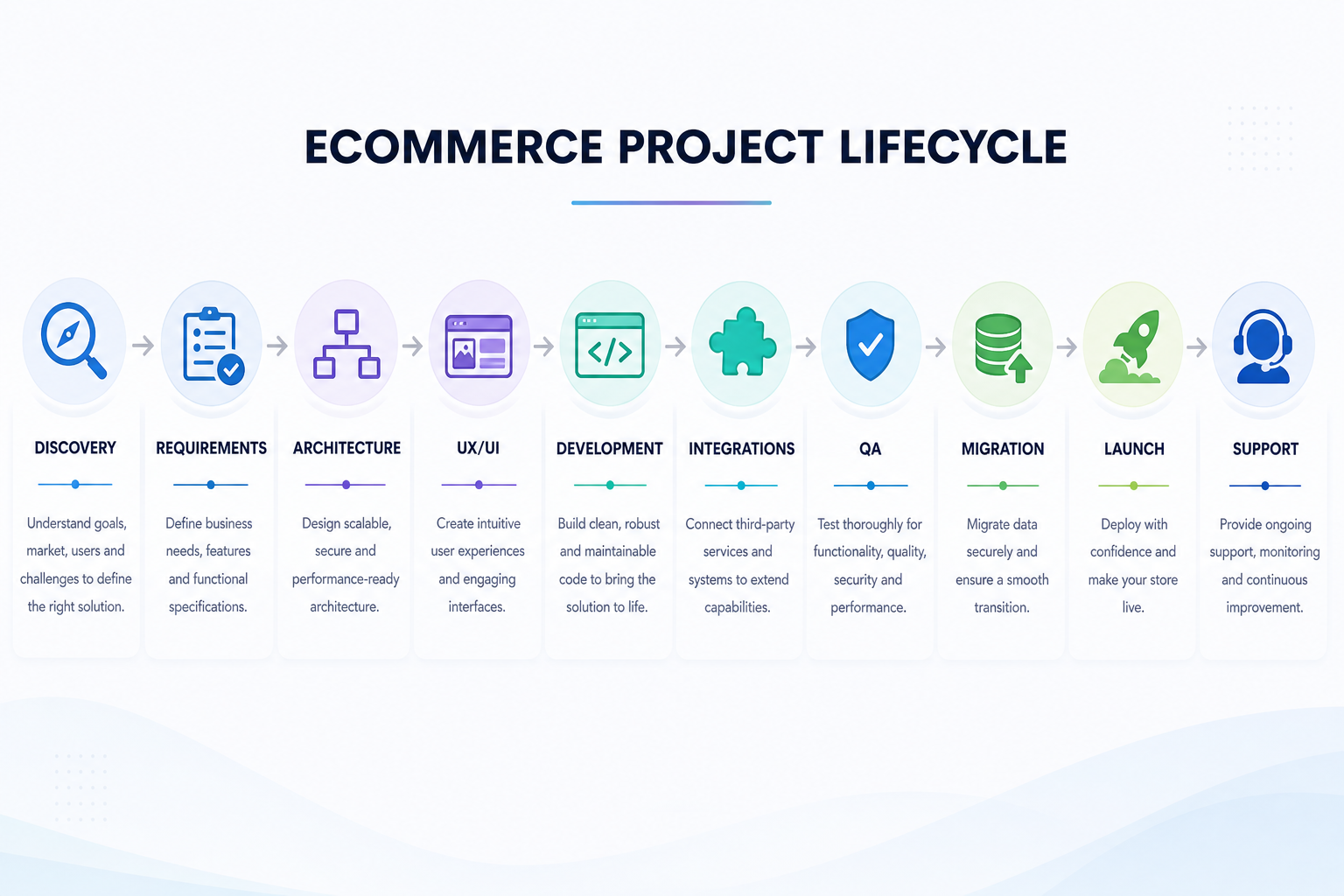
A professional process may look like discovery → requirements → architecture → UX/UI → development → integrations → QA → migration → launch → support. Actual process varies by project. Do not treat one exact workflow as mandatory. Treat missing discovery or missing QA as a reason to ask more questions.
20. Compare scope before comparing price
A good proposal should clarify project objectives, scope, platform, features, design, integrations, product migration, content responsibility, SEO, analytics, QA, timeline, deliverables, exclusions, third-party costs, support, payment schedule and change requests. A single number without scope is difficult to compare.
Proposal comparison matrix
Copy this table into a spreadsheet and fill it from each proposal:
| Area | Company A | Company B | Company C |
|---|---|---|---|
| Platform | |||
| UX/UI | |||
| Development | |||
| Product migration | |||
| Payments | |||
| Shipping | |||
| ERP/CRM | |||
| SEO | |||
| Analytics | |||
| QA | |||
| Support | |||
| Timeline | |||
| Third-party costs | |||
| Total |
21. Do not compare ecommerce agencies on price alone
Quotes differ because scope differs. Quote A may cover a theme-based store, standard integrations, client-handled catalog and limited custom development. Quote B may cover custom UX, migration, ERP integration, SEO migration, QA and post-launch support. Those totals are not comparable by price alone.
For budget structure, not vendor selection, use Ecommerce Website Cost in India: 2026 Pricing Guide. Shopify-only budgets also have a dedicated Shopify website cost in India guide.
Lowest quote
A lower quote may be perfectly appropriate when requirements are simple. The risk appears when important scope has been omitted or misunderstood — not merely because the number is smaller.
Highest quote
A high price does not automatically indicate better quality. Ask what additional expertise, scope, support, customization or risk reduction the price includes.
22. Identify costs outside the development quote
Potential extras include platform subscriptions, themes, apps/plugins, hosting, domains, payment fees, shipping software, email/SMS, ERP/CRM licenses, search tools, CDN and support retainers. Ask whether each is included or separate. First-year total cost of ownership is development + platform/hosting + apps/plugins + support + maintenance + likely near-term extra development.
23. Clarify ownership and account access
Before signing, clarify ownership and access to domain, hosting, Shopify or WordPress account, source code where applicable, Git repository, analytics, Search Console, payment gateway, app/plugin accounts, design files and data. This is not legal advice. Review contractual terms with appropriate professional help.
Source code differs by platform
Shopify projects may involve theme code, custom apps and configuration. WooCommerce typically involves theme, plugin and custom PHP. Custom ecommerce involves application source code. Ownership and licensing should be clear before development starts.
24. Understand what happens after launch
Ask whether there is a bug-fix or warranty period, what counts as a bug versus a new feature, how support is charged, what response times apply, who handles emergencies, who maintains integrations and who monitors third-party platform or app changes.
Common models include project-based support, a monthly retainer, a development-hour package or managed ecommerce support. No one model is universally best. Small catalogs may only need a short warranty. Business-critical stores may need stated support hours, severity levels and maintenance windows — without implying every small store requires an enterprise SLA.
25. Evaluate communication before you hire
Look for clear answers, documented scope, realistic expectations, questions about business requirements and transparent limitations. Be cautious when every answer is “yes, we can do everything.” A strong technical partner should sometimes challenge unnecessary requirements.
26. Ask how the timeline was estimated
Timeline should consider discovery, design, development, catalog, integrations, migration, feedback and testing. Do not compare timelines without comparing scope. Avoid “complete ecommerce website in 3 days” unless the project genuinely is a simple setup.
27. Choose a company that can support realistic growth
Consider future product volume, traffic, new markets, B2B, ERP, warehouses, mobile app, custom apps and automation. Do not overengineer today’s website for hypothetical future requirements. Startups in particular should prioritise speed, maintainability, a sensible MVP, transparent costs and the ability to add functionality later.
10 red flags when choosing an ecommerce development company
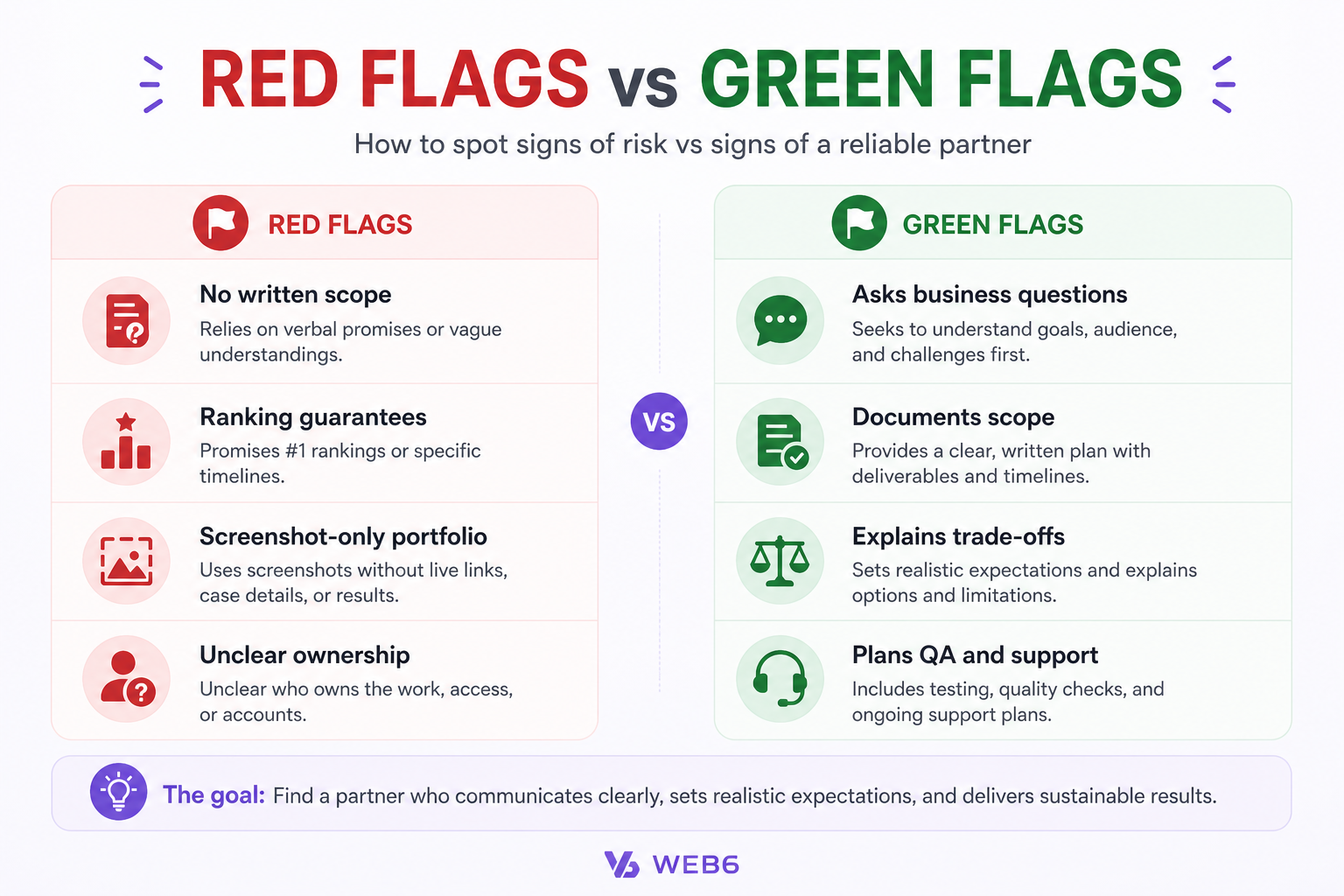
A red flag means investigate further, not automatically reject.
- No written scope
- Cannot explain the platform recommendation
- Only shows screenshots instead of project details
- Guarantees SEO rankings
- Guarantees conversion increases
- Does not discuss mobile
- Does not discuss testing
- Cannot explain post-launch support
- Third-party costs are unclear
- Ownership or access is unclear
Signs of a strong ecommerce development partner
- Asks detailed business questions
- Explains trade-offs
- Documents scope
- Provides relevant examples
- Discusses limitations
- Identifies dependencies
- Separates must-have from optional
- Explains ongoing costs
- Has a QA process
- Plans post-launch support
25 questions to ask an ecommerce development company
- Which ecommerce platform do you recommend for us and why?
- Have you built projects with requirements similar to ours?
- Can you show relevant case studies?
- What functionality will be native vs app/plugin vs custom?
- Who will design the UX/UI?
- Who will develop the project?
- How will mobile UX be tested?
- How will site search and filters work?
- How will payments be implemented?
- How will shipping be integrated?
- How will COD be handled?
- How will ERP/CRM integrations work?
- How will migration be handled?
- How will SEO migration be handled?
- What analytics will be configured?
- How will performance be tested?
- What security responsibilities do you handle?
- What QA is included?
- What is excluded from the quote?
- What third-party costs should we expect?
- How are scope changes priced?
- What is the estimated timeline and what assumptions does it depend on?
- What support is included after launch?
- Who owns the accounts, code and assets?
- What happens if we need additional development later?
Example shortlist scorecard
This is an example evaluation framework. The weights are not universal. Adjust them for your project: a simple D2C theme store may weight UX higher; a manufacturer portal may weight integrations higher.
| Area | Weight | Company A | Company B | Company C |
|---|---|---|---|---|
| Relevant experience | 15 | |||
| Platform expertise | 15 | |||
| Technical capability | 15 | |||
| UX/UI | 10 | |||
| Integrations | 10 | |||
| SEO/performance | 10 | |||
| QA | 10 | |||
| Communication | 5 | |||
| Support | 5 | |||
| Commercial fit | 5 | |||
| Total | 100 |
Commercial fit should evaluate price, scope, payment terms, third-party costs and support together — not “lowest quote = highest score.”
Freelancer vs ecommerce agency vs in-house team
| Option | Potential advantages | Trade-offs | Best fit |
|---|---|---|---|
| Freelancer | Lean cost, direct communication | Capacity and specialist coverage may be limited | Smaller, well-bounded projects |
| Agency | Multiple capabilities in one engagement | Usually more overhead | Multi-disciplinary projects |
| In-house | Deep business knowledge | Hiring, management and retention cost | Continuous development needs |
An agency is not always best. A strong freelancer can outperform a poorly scoped agency on a simple store. An in-house team can still need an agency for a migration spike.
Should you hire a local ecommerce company in India?
Local proximity may help with face-to-face meetings, regional business understanding and communication preferences. Location alone should not determine selection. A remote company with stronger relevant expertise may be the better fit. Surat or Gujarat presence is useful when it comes with ecommerce depth — not because a pin on the map is a ranking factor.
What should Indian businesses specifically evaluate?
Depending on the model, ask about UPI, COD, GST/invoicing requirements where relevant, Indian payment gateways, courier integrations, pincode serviceability, WhatsApp/SMS workflows and regional versus international expansion. This is not tax or legal advice. Confirm current technical and payment facts with providers before you lock scope.
How selection criteria shift by business type
D2C
Prioritise merchandising, mobile UX, promotions, reviews, marketing integrations, analytics, CRO and performance.
B2B
Prioritise ERP, CRM, account pricing, dealer portals, quotation workflows, credit, approvals, bulk orders and custom integrations. See B2B ecommerce development.
Startups
Avoid choosing a complex custom architecture solely for future possibilities. Prioritise speed, maintainability, a sensible MVP, transparent costs and the ability to add functionality later.
Enterprise / complex projects
Evaluate architecture, integration capability, deployment, QA, security, documentation, monitoring, support and governance. Company size alone does not prove enterprise capability.
What to look for when hiring Shopify, WooCommerce or custom developers
Shopify: theme development, APIs, apps, integrations, platform limitations and current Shopify extensibility. See Shopify development.
WooCommerce: WordPress/WooCommerce, PHP, plugins, hosting, performance and maintenance.
Custom: architecture, frontend/backend, database, API, infrastructure, security, DevOps and testing. See custom website development when the storefront itself is custom.
Native vs app vs custom
Ask the development company to classify each feature:
| Requirement | Implementation | Recurring cost? | Custom maintenance? |
|---|---|---|---|
| Reviews | Native / app / custom | ||
| Search | |||
| Wishlist | |||
| ERP | |||
| B2B |
This exposes long-term architecture and cost before you sign.
What should the ecommerce project agreement clarify?
Without providing legal advice: scope, deliverables, timeline, payment milestones, responsibilities, exclusions, change requests, support, ownership/licensing and termination or hand-off where relevant. Encourage appropriate professional or legal review for contractual matters.
Handover
Ask whether final handover includes admin access, source repository where applicable, design files where agreed, analytics, documentation, credentials/account ownership, training and deployment information. Do not share passwords in documentation insecurely.
Documentation
For custom or integrated projects, documentation may include architecture, API mappings, deployment, integration flows, environment configuration and operational procedures. Agree documentation expectations during scope, not after launch.
How many companies should you shortlist?
A focused shortlist of roughly 3–5 genuinely relevant providers is usually easier to evaluate than requesting generic quotes from dozens of agencies. Treat that as practical guidance, not a rule. Send the same core project brief to each. Otherwise Company A prices 10 features and Company B prices 20, and the totals become meaningless.
Proposal value ≈ scope fit + technical fit + delivery confidence + support + commercial fit — not lowest price.
A practical decision process
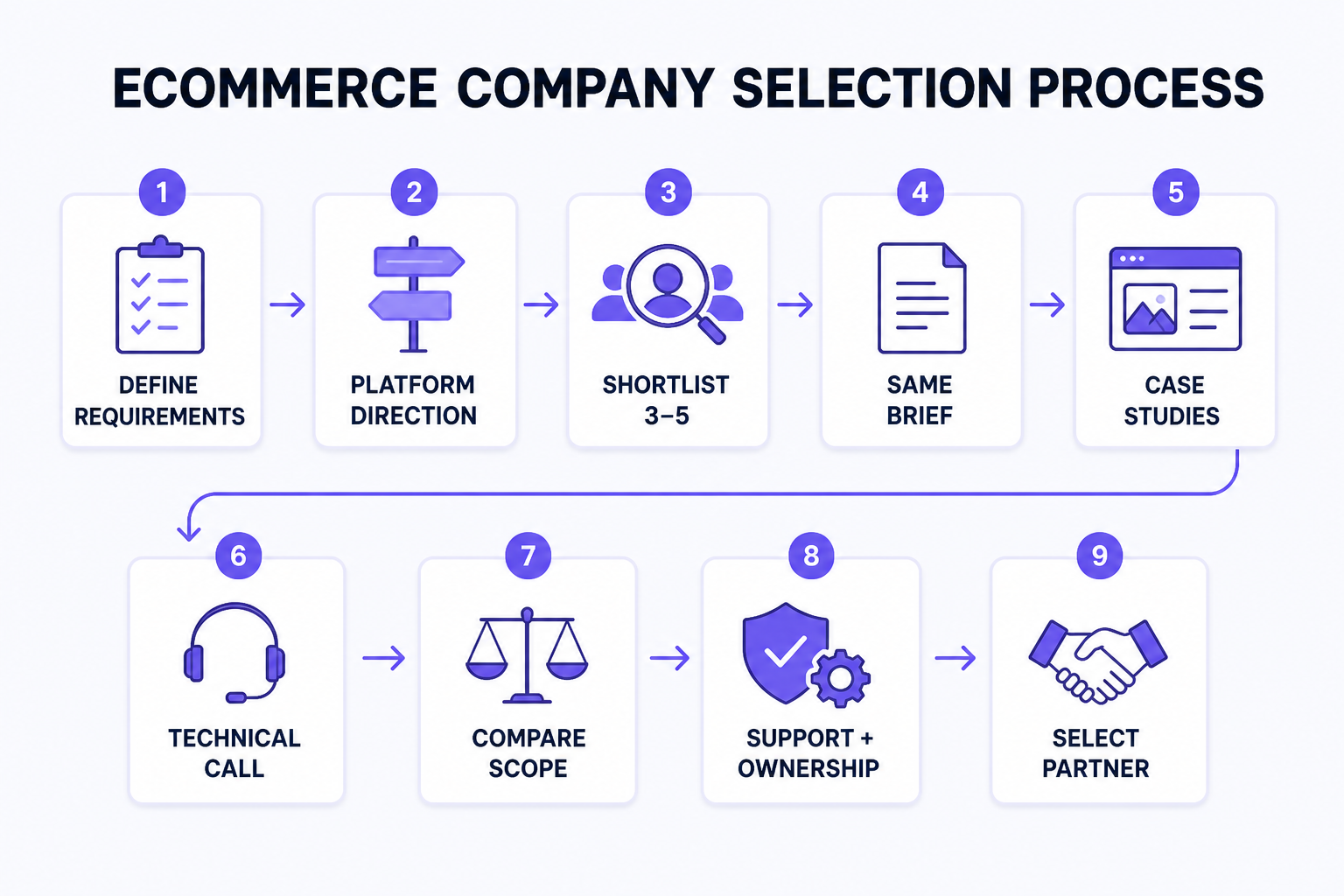
Define requirements → select platform direction → shortlist 3–5 companies → send the same brief → review case studies → hold a technical call → compare scope → check references or evidence where appropriate → clarify support and ownership → select a partner.
Sample ecommerce project brief
Copy and fill:
- Business: [ ]
- Business model: D2C / B2C / B2B / Marketplace
- Current website: [ ]
- Platform: [ ]
- Product count: [ ]
- Variants: [ ]
- Payments: [ ]
- COD: [ ]
- Shipping: [ ]
- ERP: [ ]
- CRM: [ ]
- B2B: [ ]
- International: [ ]
- Migration: [ ]
- SEO: [ ]
- Analytics: [ ]
- Custom features: [ ]
- Target launch: [ ]
- Post-launch support: [ ]
How Web6 approaches ecommerce development projects
Web6 is a Surat, India technology company that builds Shopify storefronts, custom ecommerce, B2B commerce, ERP/CRM integrations, custom Shopify apps and SEO-ready implementations. Published Shopify apps and case studies are public; use them as evidence, not as a substitute for your own brief.
A typical engagement follows requirements discovery, platform/architecture selection, feature planning, UX/UI, development, integrations, QA, launch and post-launch support. That process should still be tested against this guide.
Businesses evaluating Web6 can use the same checklist in this article to compare our proposal with other providers. The criteria are not designed so that only Web6 can pass them.
Have an ecommerce project you need scoped?
If you already know your products, required features, integrations and preferred platform, the next step is turning those requirements into a clear development scope.
Discuss Your Ecommerce Project — or Explore Ecommerce Website Development.
Related reading
- Need to estimate budget? Ecommerce website cost in India
- Not sure which platform? Shopify vs WooCommerce vs custom ecommerce
- Platform, hybrid or full custom? Custom ecommerce vs ready-made platforms
- Still defining functionality? 25 must-have ecommerce features
Frequently asked questions
How do I choose an ecommerce website development company in India?
Define requirements first, choose a platform direction, shortlist a few relevant providers, send the same brief to each, then compare case studies, technical fit, QA, support, ownership and scope — not price alone.
What should I look for in an ecommerce development agency?
Relevant ecommerce experience, platform expertise, real case studies, UX and mobile capability, SEO and performance awareness, integration experience where needed, a testing process, clear proposals and post-launch support.
What questions should I ask an ecommerce developer before hiring?
Ask why they recommend a platform, who will build the project, how mobile, payments, shipping, COD, integrations, migration, SEO, analytics, QA, exclusions, third-party costs, timeline, support and ownership will be handled.
How much does ecommerce website development cost in India?
There is no standard price. Indicative 2026 market observations often place theme-led stores roughly in the ₹50,000–₹3,00,000 development band, custom-branded storefronts often around ₹4,00,000–₹12,00,000, and advanced or B2B work higher or as a custom quote. Platform fees sit outside the build. See the ecommerce cost guide for structure, not a Web6 package list.
Should I choose Shopify, WooCommerce or custom ecommerce?
Shopify usually fits managed, faster D2C launches. WooCommerce can fit WordPress-centric businesses that will maintain hosting and plugins. Custom fits workflows standard platforms cannot support cleanly. Compare TCO and maintenance, not feature lists alone.
Should I hire a freelancer or ecommerce development company?
Freelancers can fit smaller, well-bounded projects. Agencies often fit multi-disciplinary work (UX, development, integrations, QA). In-house fits continuous development. Choose based on scope and capacity, not a rule that agencies always win.
How do I evaluate an ecommerce company's portfolio?
Look past screenshots. Ask what problem was solved, which platform was used, what was custom, which integrations ran, whether migration was involved and what outcome can be verified without confidential data.
Should an ecommerce development company understand SEO?
Yes for technical foundations — crawlability, URLs, canonicals, metadata, structured data, sitemap, redirects, internal linking and performance — especially on migrations. Ongoing SEO can be a separate specialist.
What should an ecommerce development proposal include?
Objectives, scope, platform, features, design, integrations, migration, content responsibility, SEO, analytics, QA, timeline, deliverables, exclusions, third-party costs, support, payment schedule and change-request terms.
How do I compare quotes from different ecommerce agencies?
Send the same brief, then compare scope line by line: platform, UX, development, migration, payments, shipping, ERP/CRM, SEO, analytics, QA, support, timeline and third-party costs. Totals without matched scope are not comparable.
What support should an ecommerce company provide after launch?
At minimum, clarify the bug-fix period, what counts as a bug versus a new feature, how extra work is priced, who maintains integrations and who you contact for emergencies. The right model depends on how critical the store is.
Should I choose a local ecommerce company or a remote agency?
Local proximity can help meetings and regional context. Relevant expertise, communication and delivery confidence usually matter more than city. A remote team with stronger fit can be the better choice.