
Ecommerce
How Much Does an Ecommerce Website Cost in India? 2026 Pricing Guide
Written by Web6 Editorial Team · Published 26 August 2026 · 26 min read
The cost of building an ecommerce website in India can vary dramatically because a small catalog using a ready-made theme is a very different project from a custom B2B portal with ERP integration, customer-specific pricing and automated fulfillment. Platform fees are only one part of the budget; design, development, catalog setup, integrations, migration, testing and ongoing support can matter just as much.
This 2026 buyer’s guide covers indicative budget ranges, platform choices, feature costs, B2B and custom complexity, recurring expenses, hidden costs, freelancer versus agency trade-offs, and how to compare quotes fairly. It is not a Web6 package list. Web6 does not publish fixed ecommerce rates; accurate pricing still needs project scope.
How much does an ecommerce website cost in India?
There is no standard ecommerce website price in India. Publicly listed 2026 India agency and industry pricing, read alongside official platform fees, typically separates platform / subscription cost from design and development project cost. A professional theme-led Shopify or WooCommerce store is often discussed in roughly the ₹50,000–₹3,00,000 development band. Custom-branded storefronts commonly land around ₹4,00,000–₹12,00,000. Advanced stores with deeper integrations, migrations or performance work often move into ₹8,00,000–₹25,00,000+. Serious B2B portals, multi-vendor marketplaces and headless builds are frequently custom quotes — some public India 2026 guides place complex B2B or marketplace programmes from several lakhs into much higher ranges depending on ERP, dealer logic and vendor operations. These are indicative market observations, not official averages and not Web6 packages. GST is often extra. Recurring platform, hosting, app and transaction fees sit outside the build invoice.
Key takeaways
- There is no single ecommerce website price that applies to every Indian business.
- Separate platform subscriptions from design and development project fees.
- Catalog complexity, integrations and B2B workflows move cost more than page count.
- Shopify, WooCommerce and custom stacks have different first-year cost shapes.
- Cheap quotes may exclude QA, migration, content, analytics or support — or they may simply match a smaller scope.
- Compare first-year total cost of ownership, not only the launch invoice.
Ecommerce website cost snapshot (indicative, 2026)
Use this table for planning conversations. Development ranges synthesize publicly available 2026 India agency pricing pages and industry ecommerce cost guides reviewed around publication (August 2026), plus official Shopify India plan pricing where noted. They are indicative, not India-wide averages, and not Web6 package prices. Where evidence is too thin for a fair band, the table says Custom quote. Unless a provider states otherwise, treat development bands as exclusive of GST.
| Project type | Typical scope | Complexity | Indicative budget | Best for |
|---|---|---|---|---|
| Basic ecommerce store | Theme-led Shopify or WooCommerce, small catalog, standard payments/shipping | Low | ₹50,000 – ₹3,00,000 development | Startups validating demand |
| Shopify theme customization | Paid/free theme, branding, section edits, conversion polish | Low–medium | ₹1,50,000 – ₹5,00,000 | D2C brands needing a stronger storefront without full custom UX |
| Custom Shopify store | UX/UI + custom theme work on key templates | Medium–high | ₹4,00,000 – ₹12,00,000 | Design-led D2C brands |
| WooCommerce store | WordPress + WooCommerce theme/plugins, hosting, security basics | Low–medium | ₹50,000 – ₹3,00,000 theme-led; customized often ₹1,50,000 – ₹8,00,000 | Content-centric merchants comfortable owning hosting |
| Custom ecommerce website | Bespoke storefront and admin, unique checkout or catalog logic | High | Often ₹2,00,000 – ₹15,00,000+; complex systems Custom quote | Proprietary workflows that SaaS themes cannot cover cleanly |
| B2B ecommerce portal | Account pricing, dealers, quotes, credit, approvals | High | Custom quote (often higher than standard B2C theme builds) | Manufacturers, distributors, wholesalers |
| ERP-integrated ecommerce | Products, inventory, orders, pricing and/or invoices synced | High | Custom quote (connector vs middleware vs custom API) | Ops-led brands where ERP is the system of record |
| Multi-vendor marketplace | Vendor onboarding, commissions, settlements, moderation | Very high | Custom quote | Platform businesses, not single-brand stores |
| International ecommerce store | Currencies, languages, taxes, regional catalogs, local payments | Medium–high | Scope dependent / Custom quote | Multi-market sellers |
| Headless ecommerce | Custom front end + commerce backend/APIs | High | Custom quote | Unique UX at scale with an engineering team |
Ecommerce website cost has three main parts
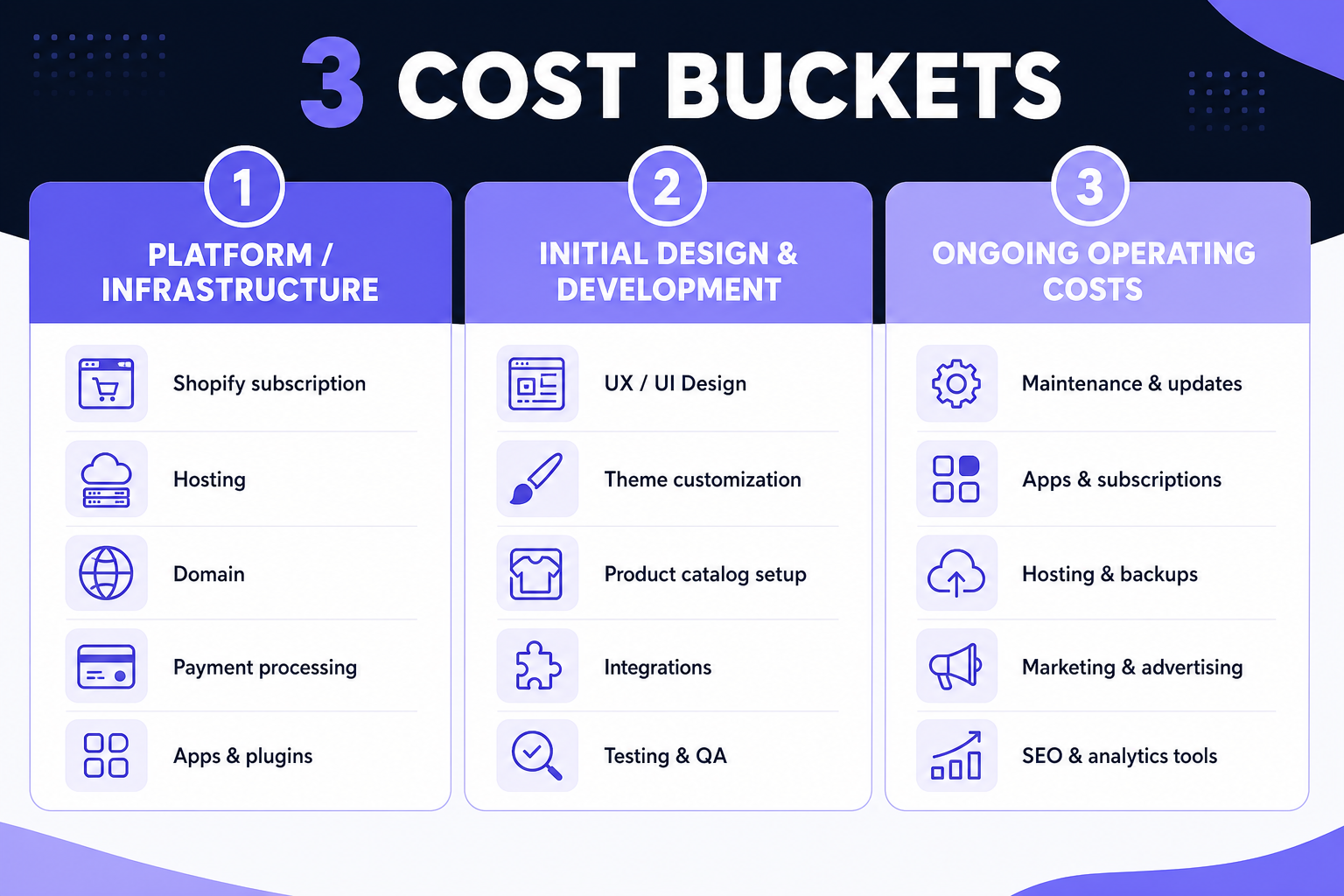
1. Platform / infrastructure
This includes Shopify subscription (or WooCommerce/custom hosting), domain, SSL where not bundled, payment infrastructure and apps or plugins. These costs continue after launch.
2. Initial design and development
This is the project fee for UX/UI, theme or custom front end, backend, catalog setup, integrations, migration, QA and launch. It is what agencies, freelancers or in-house teams charge for delivery.
3. Ongoing operating costs
Maintenance, support, apps, hosting, marketing, SEO and later enhancements. A store that looks inexpensive to launch can become expensive to run if apps, plugins and change requests accumulate.
Buyers who compare only bucket 2 often misread the cheaper quote.
1. Platform choice can significantly affect the budget
No platform is universally cheapest. Shopify, WooCommerce, custom ecommerce and headless each shift cost between upfront engineering, subscriptions and maintenance.
- Shopify: hosted commerce platform with plan subscriptions, theme/app costs and, in India, third-party payment provider fees on top of gateway charges. Development is often faster for standard stores. See Shopify development when that path fits.
- WooCommerce: WordPress ecosystem. Core software is open-source, but professional implementation still needs hosting, theme, plugins, security, performance and maintenance. It is not “free ecommerce.”
- Custom ecommerce: higher initial engineering and greater control over checkout, pricing and operations. You own more of hosting, security and upgrades.
- Headless ecommerce: typically higher complexity and infrastructure needs because the storefront is a separate application talking to commerce APIs.
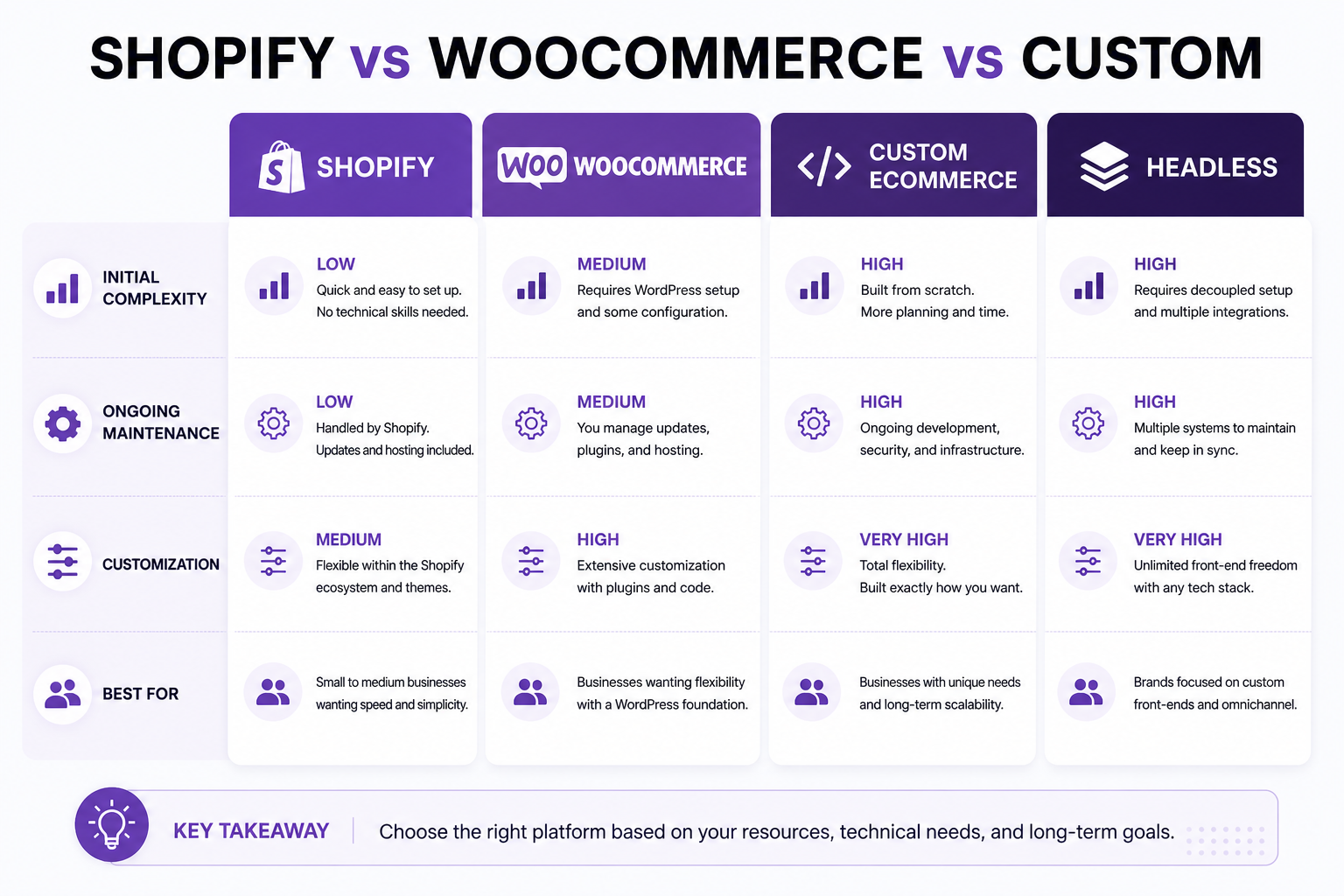
| Platform | Initial complexity | Ongoing maintenance | Customization | Best for |
|---|---|---|---|---|
| Shopify | Often lower for standard D2C | Platform manages much infrastructure; you maintain theme/apps/custom code | Strong within platform and app/custom-app boundaries | Hosted simplicity, standard commerce, faster launch |
| WooCommerce | Moderate; depends on theme/plugins | You own hosting, updates, security and performance | Flexible inside WordPress; plugin quality varies | Content-centric sites and teams already on WordPress |
| Custom ecommerce | Usually higher | Greater application and infrastructure responsibility | Highest freedom for proprietary logic | Unique workflows, deep integrations, non-standard catalogs |
| Headless | High | Front end + APIs + hosting/CDN to operate | Very high UX freedom | Differentiated storefronts with engineering capacity |
How much does a Shopify ecommerce website cost?
Shopify cost has two layers: Shopify’s own plan fees and store design/development. According to Shopify India’s pricing page (verified August 2026), published plan prices include approximately Basic ₹1,499/month billed yearly (₹1,994/month billed monthly), Grow ₹5,599 yearly (₹7,447 monthly), Advanced ₹22,680 yearly (₹30,164 monthly), and Plus from about ₹1,75,000/month. Introductory promotions can differ. Confirm current prices on Shopify before budgeting. GST commonly applies on subscriptions in India and is often additional to the listed plan price.
Development is separate. Indicative India planning bands used on Web6’s dedicated Shopify cost guide are roughly ₹50,000–₹2,00,000 for a basic theme-led store, ₹1,50,000–₹5,00,000 for stronger theme customization, ₹4,00,000–₹12,00,000 for custom-designed stores, and ₹8,00,000–₹25,00,000+ for advanced integration, B2B or Plus delivery. Cost components include the plan, theme, customization, apps, custom development, migration and support. When an off-the-shelf app is not enough, that work sits with Shopify app development rather than inside a theme quote.
For the full Shopify-only breakdown, use the Shopify website development cost in India guide. This article keeps Shopify concise so it does not duplicate that page.
How much does a WooCommerce website cost?
WooCommerce core may be open-source, but a professional Indian store still involves hosting, a theme, plugins, design, development, security, maintenance and performance work. Public 2026 India listings commonly place theme-led WooCommerce implementation around ₹50,000–₹3,00,000, with more customized builds often ₹1,50,000–₹8,00,000 depending on catalog, checkout plugins and hosting quality. Complex WooCommerce with heavy custom code can reach custom-quote territory.
Do not treat WooCommerce as free ecommerce. You typically pay for servers or managed WordPress hosting, premium plugins, SSL if not included, backups, malware hardening and someone to apply updates without breaking checkout. Those recurring lines can offset a lower initial build fee versus Shopify.
How much does custom ecommerce development cost?
Custom ecommerce may be required when you need a unique checkout or workflow, proprietary business logic, complex pricing, deep ERP integration, an unusual catalog, a marketplace, a multi-tenant system, or operations that no theme can model honestly.
Cost is driven by engineering complexity, not the number of marketing pages. Public India 2026 planning bands often start around ₹2,00,000–₹8,00,000 for simpler custom stores and rise into ₹10,00,000–₹15,00,000+ or custom quotes for unique checkout, multi-system integration or high-volume architecture. Marketplace and large B2B programmes are usually scoped separately.
Custom is not automatically “better.” It is worth it when the workflow is the product — and when you can fund maintenance after launch. For platform-agnostic storefront delivery, see ecommerce website development.
2. Template design vs custom UX/UI
Design depth is one of the largest visible cost swings.
- Ready-made theme: fastest and cheapest when branding can live inside an existing layout.
- Theme customization: colors, typography, sections, merchandising blocks — still theme-constrained.
- Custom Figma/UI: designed templates implemented on the platform.
- Full design system: reusable components, states and patterns across the store.
Cost drivers include homepage, collection/category, product detail, cart, checkout-adjacent experiences, account, search, filters and responsive states. A beautiful homepage with a weak PDP still loses money. Custom UX is justified when differentiation or conversion friction is real — not because a mockup looks impressive in a pitch deck.
3. Product catalog complexity
SKU count alone is a weak proxy. One hundred clean simple products can be easier than twenty highly configurable products with size/color matrices, metafields, parent-child relationships and messy spreadsheets.
Budget drivers include number of SKUs, variants, collections/categories, attributes, size/color combinations, metafields or custom attributes, product imports, image processing, catalog cleanup, bulk upload and parent-child products. Quotes that ignore data cleanup often explode during implementation.
Search and filters
Basic search and a few filters are usually included in theme-led builds. Complex faceted search — brand, size, color, availability, price, technical attributes, merchandising rules — can add a search provider subscription, indexing work, development and performance tuning.
Large catalogs with poor search feel “broken” even when the rest of the site is fine. Treat search as a product requirement, not a checkbox.
4. Payment gateway integration
Indian stores typically need cards, UPI, net banking, wallets where supported, COD where relevant, and sometimes international cards. Development work to connect a gateway is usually a project line item. Transaction fees are separate and charged on successful payments.
On Shopify India (verified August 2026), Shopify lists third-party payment provider fees of 2% on Basic, 1% on Grow, 0.6% on Advanced and 0.2% on Plus, in addition to the payment gateway’s own charges. Gateway platform fees vary by provider, method (UPI versus cards versus EMI) and negotiated volume. Public Razorpay documentation around this research described a standard domestic platform fee model plus GST on the fee — rates change, so confirm on the gateway’s current pricing page rather than copying a blog percentage into your P&L.
Do not mix gateway MDR/platform fees with development integration cost in the same cell of a quote comparison.
Shipping
Standard shipping rates or a simple courier plugin are very different from weight, location, product rules, multi-warehouse logic, shipping aggregators, courier APIs, delivery estimates and international shipping. Advanced fulfillment logic adds development complexity and often a separate software subscription.
Cash on delivery (COD)
COD remains commercially important for many Indian catalogs. Common requirements include a COD fee, pincode eligibility, order-value rules, prepaid incentives and risk-based workflows. Off-the-shelf apps can cover many of those cases; custom rules cost more when your risk model is specific.
If COD return-to-origin is already a margin problem, budget for confirmations and risk controls separately from the storefront build. See reducing COD RTO on Shopify in India and, where pincode rules fit, COD Risk Guard.
5. ERP integration can materially change project scope
ERP work may sync products, inventory, orders, customers, pricing, invoices and fulfillment. A simple connector, middleware, and a custom API integration are not the same project.
Custom integration often needs mapping, queues, webhooks, retries, monitoring and reconciliation. Dirty master data in the ERP will not become clean because a storefront went live. For architecture patterns, see ERP development and the Shopify ERP, CRM and API integration guide.
CRM integration
CRM sync may cover customer details, orders, lead data, sales activity and B2B accounts. A one-way “create customer in CRM” flow costs less than complex bi-directional workflows with conflict rules. Link CRM budget to how sales actually works, not to a logo on a slide. See custom CRM development when the CRM itself is part of the operating system.
6. B2B ecommerce usually has different requirements
B2B often needs customer-specific pricing, dealer accounts, tier pricing, bulk orders, minimum quantities, quotations, purchase orders, credit limits, approvals, account managers and ERP sync. These are operational workflows, not merely visual design changes.
That is why B2B quotes frequently look “expensive” next to a D2C theme store with public prices. For commercial B2B delivery, see B2B ecommerce development.
B2B vs B2C cost drivers
| Requirement | B2C | B2B |
|---|---|---|
| Pricing | Usually public | May be account-specific |
| Checkout | Standard | May include approvals/POs |
| Customers | Individual | Accounts/dealers |
| Catalog | Public | May be restricted |
| Integration | Varies | Often ERP/CRM heavy |
| Development complexity | Varies | Often higher |
B2B is not always more expensive. A simple wholesale price list on Shopify B2B can be closer to a mid-complexity D2C build than to a full dealer portal.
7. Multi-vendor marketplaces cost more than normal stores
A marketplace is not simply “an ecommerce website with many sellers.” It typically needs vendor onboarding, commissions, vendor dashboards, settlements, catalog management, orders, disputes, admin moderation and reporting.
Do not compare a single-brand store quote with a marketplace quote. They are different products. Marketplace development is almost always a custom quote.
International ecommerce
Currencies, languages, market-specific domains, taxes, shipping, regional catalogs, local payment methods and localization all increase scope. International is rarely “turn on a currency switch.” Plan content translation, duty/tax handling and support hours as well as engineering.
Does an ecommerce website also need a mobile app?
A responsive ecommerce website should normally come first. A native or hybrid app may be justified for repeat customers, loyalty, frequent purchases, push notifications or app-specific experiences. App development is a separate budget: iOS, Android, APIs/backend, push and app-store maintenance. See mobile app development when that channel is genuinely required — not as a default add-on to every store launch.
8. Ecommerce platform migration cost
Typical paths include WooCommerce → Shopify, Magento → Shopify, custom → Shopify, or an old custom platform → a new platform. Migration may include products, images, collections, customers, orders, content, redirects, metadata, analytics, app data and integrations.
SEO migration planning is critical. Do not simply move URLs and hope Google finds them. Work usually includes old URL → new URL mapping, canonical verification, sitemaps, internal links, metadata and Search Console monitoring. For search architecture after cutover, use the ecommerce SEO playbook. Conversion work after launch is a separate budget from the build; see the Shopify conversion rate optimization guide when the store is live and you are diagnosing the funnel.
9. SEO-ready development vs ongoing SEO
SEO-ready development may include crawlable architecture, metadata structure, canonical setup, redirects, structured data, performance, sitemap and internal linking. That is storefront engineering.
Ongoing SEO is a different budget: keyword/search research, content, category optimization, digital PR and monitoring. Mixing them in one vague “SEO included” line makes quotes incomparable. For ongoing organic work, see SEO services.
10. Ecommerce performance optimization
Speed work covers image optimization, JavaScript, third-party tools, frontend architecture, Core Web Vitals, caching/CDN and server performance. Faster pages can help users and may support search systems; they do not guarantee a specific conversion increase. Cheap builds that load five chat widgets, three sliders and unoptimized hero videos often spend the “savings” later on performance rescue.
Content production
Ask whether the quote includes product descriptions, category content, banners, photography, videos, blog content, legal pages and translations. Many development quotes exclude content production. Founders who assume “the agency will write 400 SKUs” are comparing different scopes.
11. Professional QA adds real project effort
Testing may cover responsive layout, browsers, products, variants, payments, COD, shipping, coupons, account, cart, checkout, notifications, integrations, analytics, redirects and performance. Cheap quotes may exclude comprehensive QA — but not every low-cost provider skips testing. Ask what test matrix is included rather than assuming.
Analytics and tracking
Baseline work often includes GA4, Search Console, pixels, conversion events, ecommerce events and tag manager. Server-side tracking, custom event taxonomies or multi-domain measurement may be a separate line. Advanced analytics implementation is frequently under-quoted because it looks “just add a snippet.”
12. Post-launch support and maintenance
Models include a warranty/bug period, monthly maintenance, a support retainer, development hours or managed ecommerce support. Platform differences matter: Shopify handles more infrastructure centrally; WooCommerce and custom platforms typically require greater application and infrastructure maintenance.
Public India listings for store maintenance vary widely — from small monthly retainers to scoped hour blocks. There is no universal rate. Define whether the retainer covers bugs only, updates, or enhancements.
Recurring ecommerce expenses
| Recurring expense | Why it exists | Typical billing |
|---|---|---|
| Platform | Hosted commerce (for example Shopify) | Monthly / yearly |
| Hosting | WooCommerce / custom / headless | Monthly / yearly |
| Apps / plugins | Added functionality | Monthly / yearly |
| Domain | Website address | Yearly |
| Payment fees | Transactions | Per transaction (revenue-dependent) |
| Maintenance | Updates and support | Monthly / project |
| SEO / marketing | Growth | Ongoing |
Do not add arbitrary rupee amounts to this table. Recurring lines depend on plan, app stack, traffic and negotiated gateway rates.
Hidden ecommerce website costs businesses often forget
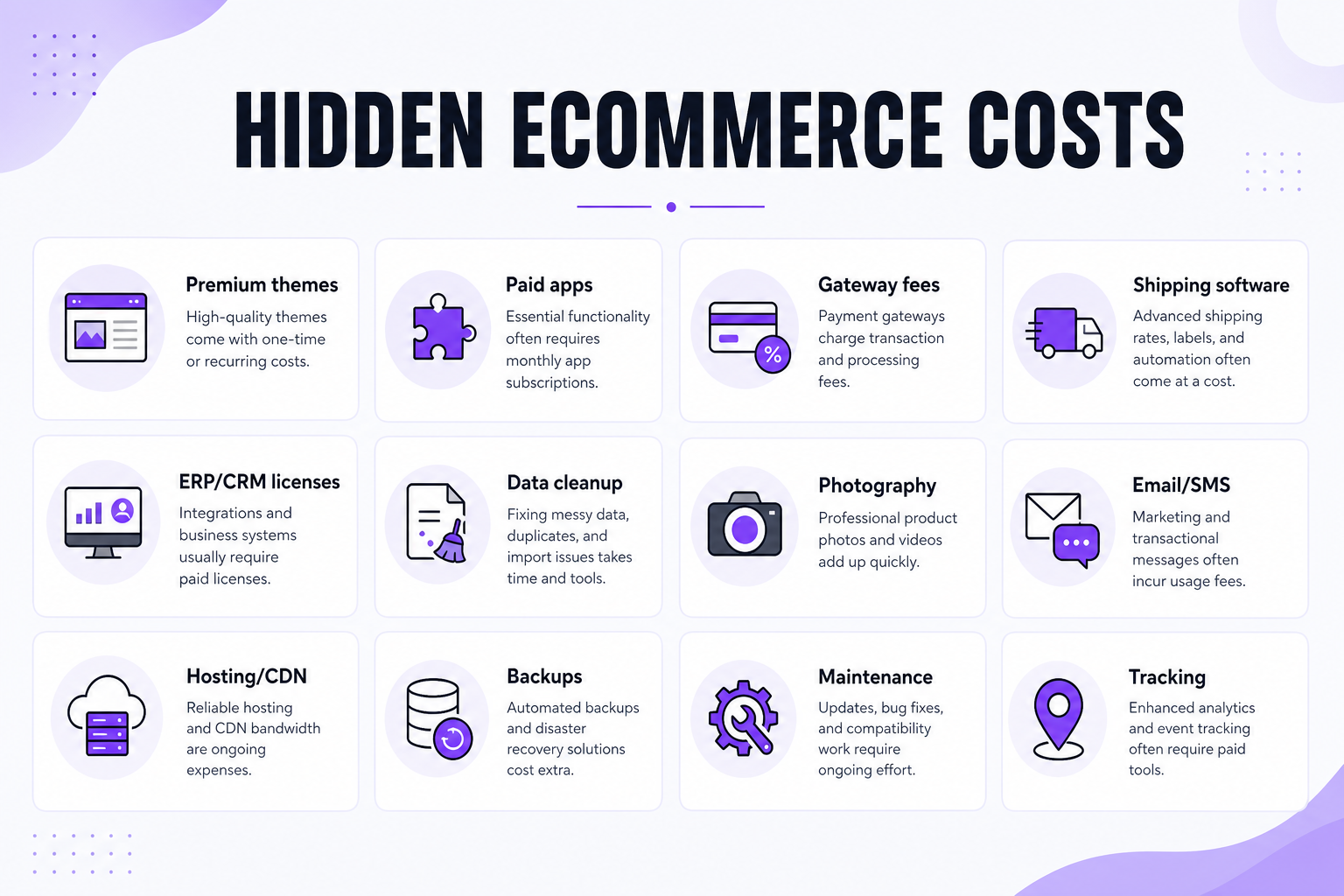
These may or may not apply to your project:
- premium themes
- paid plugins / apps
- gateway fees (and Shopify third-party payment provider fees in India)
- shipping software
- ERP / CRM licenses
- content migration
- product data cleanup
- photography
- email / SMS / WhatsApp tools
- hosting
- CDN
- backups
- maintenance
- tracking
- custom API fees
- ongoing development
A quote that looks low because these sit “with the client” is not dishonest — but it is incomplete if you thought they were included.
Freelancer vs agency vs in-house ecommerce development
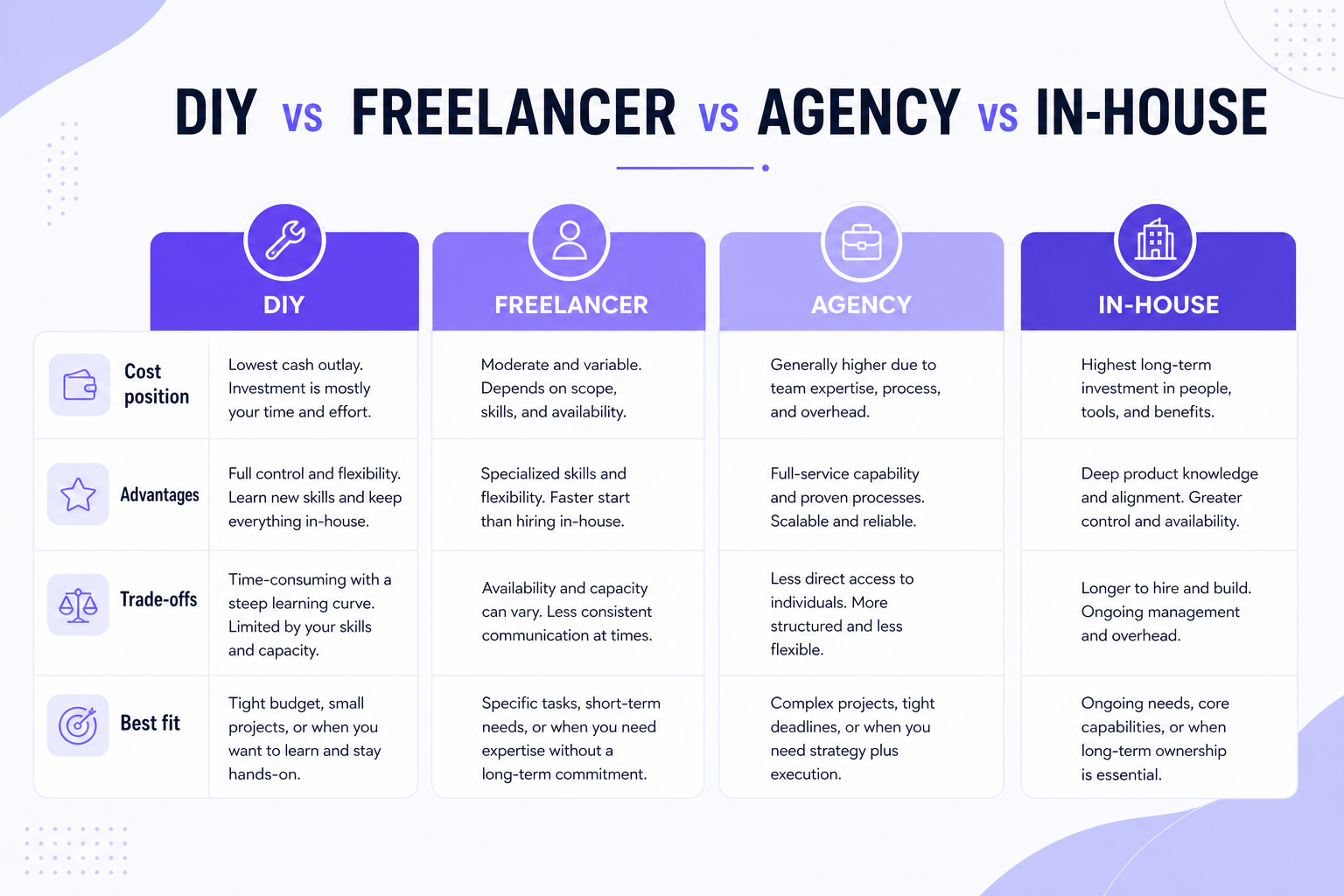
| Option | Cost position | Advantages | Trade-offs | Best fit |
|---|---|---|---|---|
| DIY | Lowest cash outlay | Speed to experiment, full control | Founder time, limited QA/SEO depth | Early-stage, standard catalog, technical confidence |
| Freelancer | Often lower than an agency | Direct communication, flexible hours | Single point of failure; fewer specialist roles | Contained theme or plugin work |
| Agency | Usually higher headline fee | Design, dev, QA, PM under one scope | Process overhead; not needed for every launch | Migrations, integrations, B2B, multi-role delivery |
| In-house | Salary + tools + management | Deep product knowledge, ongoing iteration | Hiring cost, coverage when people leave | Continuous roadmap after product-market fit |
An agency is not always required. A freelancer is not always cheaper once rework, missed QA or unavailable support is counted.
When DIY ecommerce is viable
DIY is viable when you are early-stage, requirements are standard, the catalog is small, and the founder has time and technical confidence. Account for time cost. DIY is not a lesser choice; it is a different investment mix.
Why the cheapest ecommerce quote may not be the cheapest long term
Low quotes sometimes omit custom UX, testing, speed work, SEO migration, integrations, support, security or analytics. Sometimes they simply match a smaller, honest scope — a theme store without migration. Inexpensive websites are not always bad. The risk is comparing a full-scope quote with a partial-scope quote and calling the difference “overpricing.”
What a professional ecommerce quote should include
- [ ] Discovery
- [ ] Project scope
- [ ] Platform
- [ ] UX/UI
- [ ] Responsive development
- [ ] Product/catalog setup
- [ ] Search/filter
- [ ] Payment
- [ ] Shipping
- [ ] Integrations
- [ ] Migration
- [ ] SEO migration/foundation
- [ ] Analytics
- [ ] Testing
- [ ] Deployment
- [ ] Training
- [ ] Support
- [ ] Ownership/access
- [ ] Third-party costs
- [ ] Exclusions
- [ ] Change-request process
Ecommerce budget planner
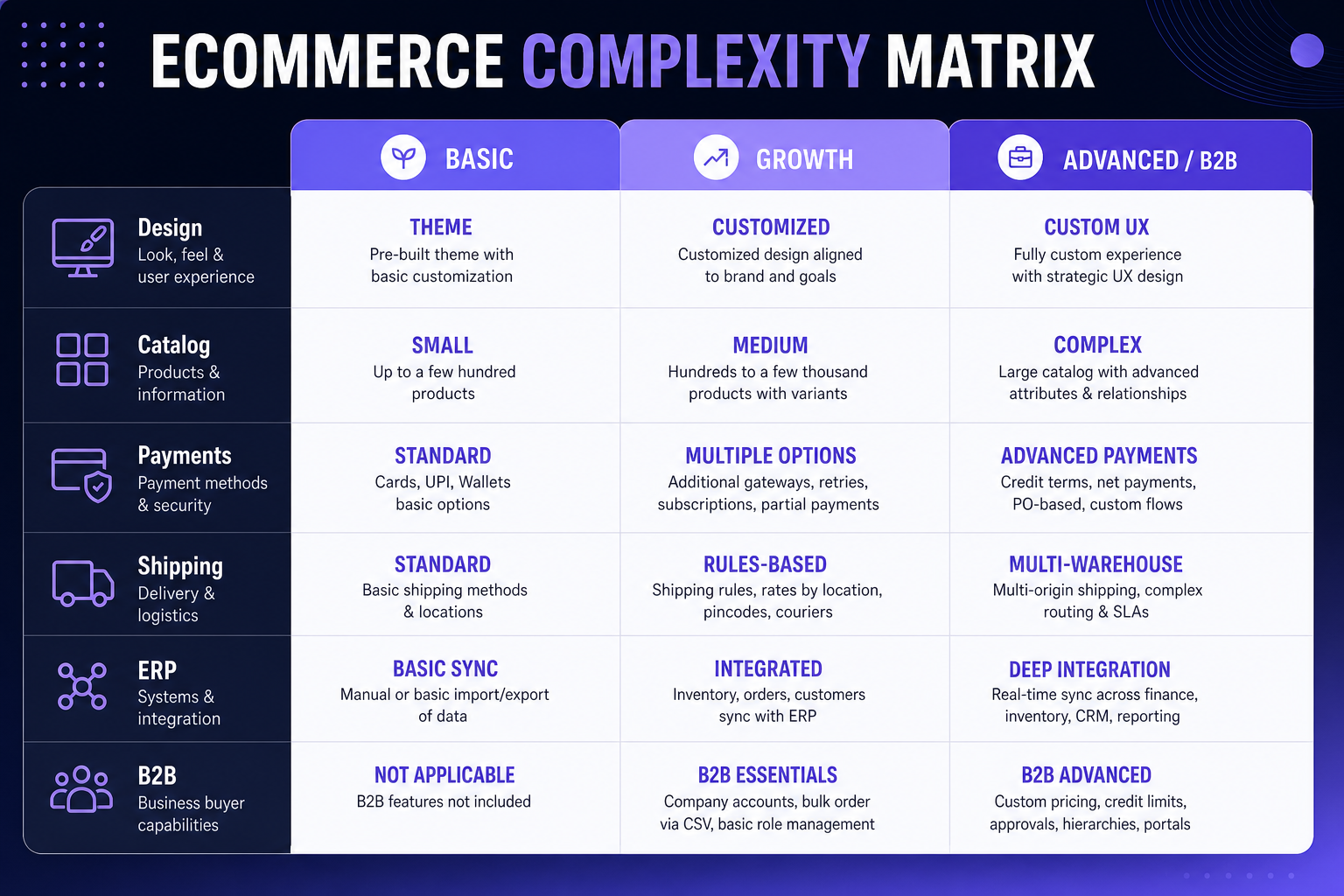
Score your project, then read quotes against that complexity — not against a neighbour’s Instagram store.
| Requirement | Low complexity | Medium complexity | High complexity |
|---|---|---|---|
| Design | Theme | Customized | Custom UX |
| Catalog | Small | Medium | Large / complex |
| Payments | Standard | Multiple | Custom |
| Shipping | Standard | Rules | Multi-warehouse / API |
| ERP | None | Connector | Custom |
| CRM | None | Simple | Bi-directional |
| B2B | None | Basic | Advanced |
| International | Single market | Multi-currency | Multi-market |
| Migration | None | Moderate | Complex |
| Support | Basic | Ongoing | Managed |
Budget tiers (indicative market observations)
These tiers summarize public 2026 India pricing conversations. They are not Web6 packages.
Starter ecommerce project
Scope: theme-led Shopify or WooCommerce, small catalog, standard payments and shipping, light branding. Suitable for: founders validating demand, retailers moving off WhatsApp catalogs. Features: essential pages, mobile-responsive theme, basic analytics. Indicative development: roughly ₹50,000–₹3,00,000 plus platform/hosting.
Growth ecommerce project
Scope: stronger theme customization or light custom UX, medium catalog, apps/plugins, better merchandising. Suitable for: growing D2C and retail brands. Features: conversion-minded templates, more filters, app stack, QA. Indicative development: often ₹1,50,000–₹8,00,000 depending on platform and design depth.
Advanced ecommerce project
Scope: custom-designed storefront, migration, performance work, multiple integrations. Suitable for: established brands, multi-channel ops. Features: custom templates, SEO cutover, analytics events, support plan. Indicative development: often ₹8,00,000–₹25,00,000+.
Custom / B2B ecommerce project
Scope: dealer portals, account pricing, ERP/CRM, marketplace or headless. Suitable for: manufacturers, distributors, platform businesses. Features: operational workflows, not just storefront visuals. Indicative budget: Custom quote. Public guides sometimes cite multi-lakh to much higher ranges; do not treat any single ceiling as a market law.
Illustrative first-year cost (not a quote)
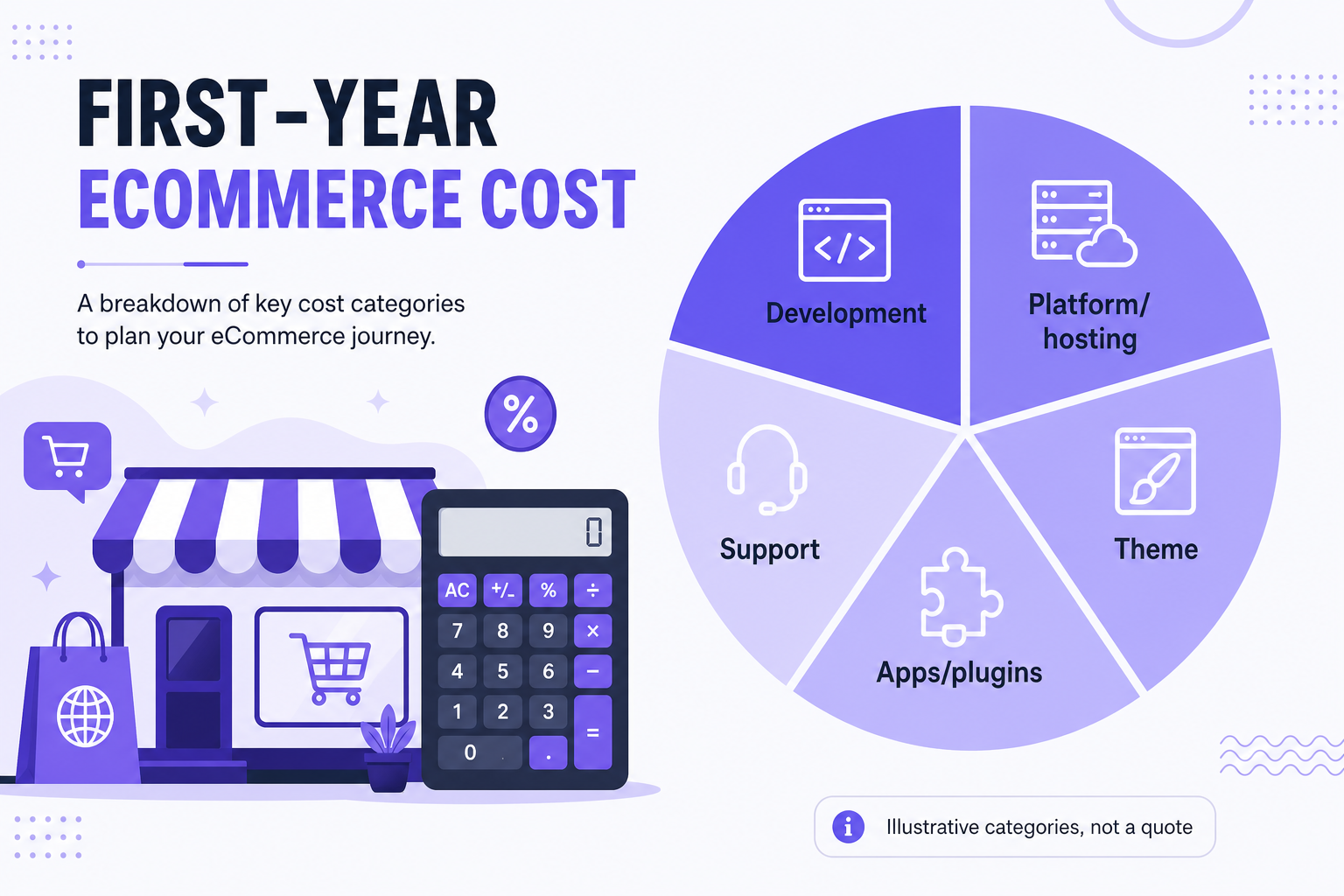
This scenario is illustrative for a theme-led Shopify Basic store in India. It is not a Web6 quote and not a promise that your store will cost the same.
| Line | Illustrative amount | Notes |
|---|---|---|
| Shopify Basic (yearly billing) | ≈ ₹1,499 / month before GST | Official Shopify India pricing, verified August 2026 |
| GST on subscription | Often +18% on the plan fee | Confirm on the Shopify invoice; do not mix GST-inclusive and exclusive numbers |
| Theme / design | Free theme or paid Theme Store license + customization | Paid theme price is set by the theme vendor, not by the developer quote |
| Development | ₹50,000 – ₹2,00,000 | Indicative theme-led starter band |
| Apps | ₹0 if you stay native; otherwise recurring | Each paid app is a separate subscription |
| Support | Optional retainer or hours | Warranty periods differ by provider |
| Payment / Shopify third-party fees | Per transaction | Revenue-dependent; not a fixed project cost |
First-year ecommerce cost ≈ development + platform/hosting + theme + apps/plugins + integrations + content + support + applicable transaction-related costs. Do not add revenue-dependent gateway fees into a fixed project total without showing them separately.
Compare first-year cost, not only development cost
Two quotes with the same build fee can diverge by lakhs over twelve months once subscriptions, apps, hosting and support are included. Always ask: what do I pay to launch, and what do I pay to operate?
Think beyond launch: total cost of ownership
Over two to three years, consider hosting/platform, apps, maintenance, developer support, upgrades, infrastructure and feature development. Do not publish a fake three-year total. Use a spreadsheet with your actual app list and change volume. Custom platforms usually shift more TCO onto your team; Shopify shifts more onto subscriptions and apps.
Shopify vs custom ecommerce cost
| Factor | Shopify | Custom ecommerce |
|---|---|---|
| Initial build | Often lower/faster for standard stores | Often higher |
| Hosting | Included in the platform model | Business responsibility |
| Maintenance | Platform managed partly | More responsibility |
| Customization | Platform boundaries | Greater freedom |
| Apps | Ecosystem | Custom / integrations |
| Launch speed | Often faster | Usually longer |
| Complex workflows | May require apps/customization | Highly customizable |
Shopify is often cheaper to launch for standard commerce. Custom can be cheaper long term only when you would otherwise pay continuously for workarounds, or when the workflow cannot live on a hosted platform honestly. Neither wins by default.
Shopify vs WooCommerce vs custom: decision framework
Choose Shopify when you want hosted simplicity, standard commerce, a quicker launch and an app ecosystem.
Consider WooCommerce when the WordPress ecosystem is a strong fit, content is central, and the merchant accepts hosting and maintenance responsibility.
Consider custom when business logic is unique, integrations are proprietary, or workflow complexity exceeds what themes and apps can sustain.
Do not pick a platform only because the first invoice looks smallest. For the full platform-selection comparison — hosting, SEO, B2B, maintenance and decision scorecards — use Shopify vs WooCommerce vs custom ecommerce. If you are deciding whether custom engineering is even warranted, read when custom ecommerce is necessary. If you are still listing what the store must do, use the ecommerce website feature checklist before you compare quotes. When you are ready to evaluate vendors, use the ecommerce agency selection checklist so quotes are compared on matched scope.
When should you budget for custom B2B development?
Triggers include a dealer portal, negotiated price, approvals, credit, quotes, large orders, ERP-owned inventory, account hierarchy and distributor workflows. If those are core to how you sell, budget for B2B as operations software — then talk to a team that does B2B ecommerce development, not only theme installation.
Ecommerce website vs marketplace
Normal ecommerce: one merchant sells to customers. Marketplace: multiple sellers, commissions, settlements, vendor management and extra operational workflows. Keep them in separate pricing conversations.
Website vs mobile app budget
Budget website development and mobile app development separately. A responsive ecommerce site should work across mobile browsers. Native apps may add iOS, Android, API/backend, push notifications and app-store maintenance on top of the store.
How long does ecommerce development take?
Do not treat any published week-count as a guarantee. Timeline depends on design, catalog readiness, integrations, feedback speed, migration, custom logic and testing. Complex integrations affect both time and cost. Simple theme stores can launch in weeks when content is ready; B2B and ERP programmes often take months.
Cost vs timeline
Compressed timelines may require parallel teams, faster approvals and reduced flexibility. Fast projects do not automatically cost more in every case — but crashing a complex integration into a two-week window usually does.
How to reduce cost without cutting quality
- define scope before development
- separate must-haves from phase two
- prepare product data
- prepare content
- choose the platform deliberately
- avoid unnecessary apps and features
- consolidate feedback
- use a proven theme when custom UX is unnecessary
- avoid changing requirements mid-project
- phase complex integrations
Features you can often delay
Mobile app, advanced loyalty, AI recommendations, advanced personalization, sophisticated B2B and custom reporting can wait if they are not required to take the first order. Delay is not the same as “unimportant.”
When is custom ecommerce development worth the higher cost?
Examples include proprietary workflow, high transaction volume, B2B, unusual pricing, multiple systems, custom fulfillment, strategic UX differentiation and operational automation. The value must justify both engineering and ongoing maintenance. If a theme-led Shopify or WooCommerce store already covers catalog, payments and shipping, expensive custom work is often premature.
When a simple build is enough
Many businesses do not need expensive custom development. A theme-led Shopify or WooCommerce store may be enough when you have a standard catalog, standard payments, standard shipping, straightforward branding, basic integrations and an early-stage validation goal. Launching a clean simple store often beats delaying revenue for a perfect custom system you do not yet need.
10 ecommerce budgeting mistakes to avoid
- Comparing only upfront development price
- Ignoring recurring apps
- Ignoring content and catalog work
- Forgetting migration
- Underestimating integration complexity
- No QA budget
- No support plan
- Building unnecessary features
- Changing scope constantly
- Choosing a platform only because it appears cheapest
Quote comparison template
Copy this into a spreadsheet when you evaluate agencies.
| Area | Agency A | Agency B | Agency C |
|---|---|---|---|
| Platform | |||
| Design | |||
| Development | |||
| Product setup | |||
| Payment | |||
| Shipping | |||
| ERP/CRM | |||
| SEO | |||
| QA | |||
| Support | |||
| Third-party fees | |||
| GST included? | |||
| Total |
Questions to ask an ecommerce developer
- What platform do you recommend and why?
- What is included in the quote?
- Is design custom?
- Is product upload included?
- What third-party fees are excluded?
- How are payment and shipping integrations handled?
- Is ERP/CRM integration included?
- How is migration handled?
- What SEO migration work is included?
- What testing is performed?
- What happens after launch?
- Who owns the code, accounts and data?
How should businesses think about ecommerce development ROI?
Do not treat a storefront invoice as a guaranteed return. Ecommerce value may come from online revenue, wider market reach, lower manual ordering cost, operational automation, reduced sales-team effort, repeat ordering and B2B self-service. Compare that against development, software, maintenance and marketing. A well-built store with no acquisition plan still sits empty.
Do not over-focus on development cost
Building the store is only part of ecommerce success. Budget may also be needed for inventory, photography, advertising, SEO, email, customer service, fulfillment and returns. An inexpensive store with no demand generation rarely outperforms a well-operated mid-budget store.
How Web6 scopes ecommerce development projects
Web6 does not publish fixed ecommerce packages. Scoping usually follows the business, not a menu:
- Understand the business model
- Choose platform / architecture
- Map the catalog
- Define integrations
- Plan UX
- Define development scope
- Plan migration
- QA
- Launch
- Support
That is why accurate ecommerce development pricing generally requires project scope. Requirements → platform → design → catalog → features → integrations → migration → QA → support → real budget. Not: “ecommerce website = one fixed price.”
Need an ecommerce development budget based on your actual requirements?
The most reliable quote comes from defining platform, catalog, design, integrations, migration and ongoing requirements before development begins.
Explore Ecommerce Website Development or discuss your catalog, integrations and launch constraints with the Web6 team.
Pricing methodology
Indicative ranges in this guide are based on publicly available 2026 pricing and scope information from Indian development providers and industry ecommerce cost guides, plus official Shopify India plan pricing (shopify.com/in/pricing, verified August 2026). Gateway fee comments reference provider documentation current at research time and should be re-checked before you model margins. Actual project quotes vary. Development bands are typically discussed exclusive of GST unless a provider states otherwise. Web6 pricing is not listed here because Web6 does not publish fixed ecommerce packages.
Frequently asked questions
How much does an ecommerce website cost in India?
There is no standard ecommerce website price in India. Indicative 2026 market observations often place theme-led Shopify or WooCommerce stores roughly in the ₹50,000–₹3,00,000 development range, custom-branded storefronts often around ₹4,00,000–₹12,00,000, and advanced integration or B2B work higher or as a custom quote. Platform subscriptions and transaction fees are separate. GST is often extra.
How much does a basic online store cost?
A basic template-led store with a small catalog and standard payments/shipping is often quoted in India around ₹50,000–₹3,00,000 for professional setup, plus platform or hosting fees. DIY can cost less in cash but more in founder time. Exact quotes depend on scope.
Is Shopify cheaper than a custom ecommerce website?
Often yes for standard D2C stores, because Shopify includes hosting and many commerce features. Custom platforms usually cost more to build and maintain. Complex unique workflows can still make custom cheaper long term than forcing everything onto apps. Compare first-year total cost, not only the build invoice.
Is WooCommerce cheaper than Shopify?
Not automatically. WooCommerce core is open-source, but professional hosting, themes, plugins, security, performance and maintenance still cost money. Shopify has a clearer subscription; WooCommerce shifts more infrastructure responsibility to you. Compare total cost of ownership for your catalog and team.
How much does custom ecommerce development cost?
Custom ecommerce cost is driven by engineering complexity, not page count. Public India 2026 planning bands often start around ₹2,00,000–₹8,00,000 for simpler custom stores and rise into multi-lakh or custom-quote territory for unique checkout, deep ERP, marketplaces or multi-tenant systems.
How much does a B2B ecommerce website cost?
B2B cost depends on account pricing, approvals, credit, quotes, dealer catalogs and ERP/CRM sync. Many projects need a custom quote. Serious dealer portals with integrations are usually more complex than a standard B2C theme store, but B2B is not automatically more expensive in every case.
Does the development cost include payment gateway fees?
Usually no. Development covers integration work. Gateway and platform transaction fees are charged per sale by the provider and, on Shopify India, may include Shopify’s third-party payment provider fee on top of the gateway’s own charges. Confirm both on current official pricing pages.
How much does ecommerce maintenance cost?
It varies by platform and change volume. Shopify handles more infrastructure centrally; WooCommerce and custom stacks typically need more hosting, security and update work. Public quotes range from small monthly retainers to scoped hour blocks. Ask what is included: bugs, updates, enhancements, or all three.
What are the hidden costs of building an ecommerce store?
Common extras include paid themes, apps/plugins, gateway fees, shipping tools, ERP/CRM licenses, catalog cleanup, photography, email/SMS, hosting/CDN, backups, tracking and ongoing development. Not every project incurs all of them.
Is a freelancer cheaper than an ecommerce agency?
Often for contained theme work. Agencies can be more economical when design, development, QA, migration and project management must happen together. Compare scope and risk, not only the headline fee.
How long does ecommerce development take?
Simple theme stores can launch in weeks when content is ready. Custom design, dirty catalogs, migrations, ERP and B2B rules extend timelines into months. Feedback speed and QA depth matter as much as coding speed. Treat timelines as estimates tied to assumptions.
How can I reduce ecommerce development cost?
Define must-haves versus phase two, prepare product data and content, choose the platform deliberately, avoid unnecessary apps, consolidate feedback, use a proven theme when custom UX is unnecessary, and phase complex integrations.