
Ecommerce
Custom Ecommerce Development vs Ready-Made Platforms: Which Should You Choose?
Written by Web6 Editorial Team · Published 23 August 2026 · 22 min read
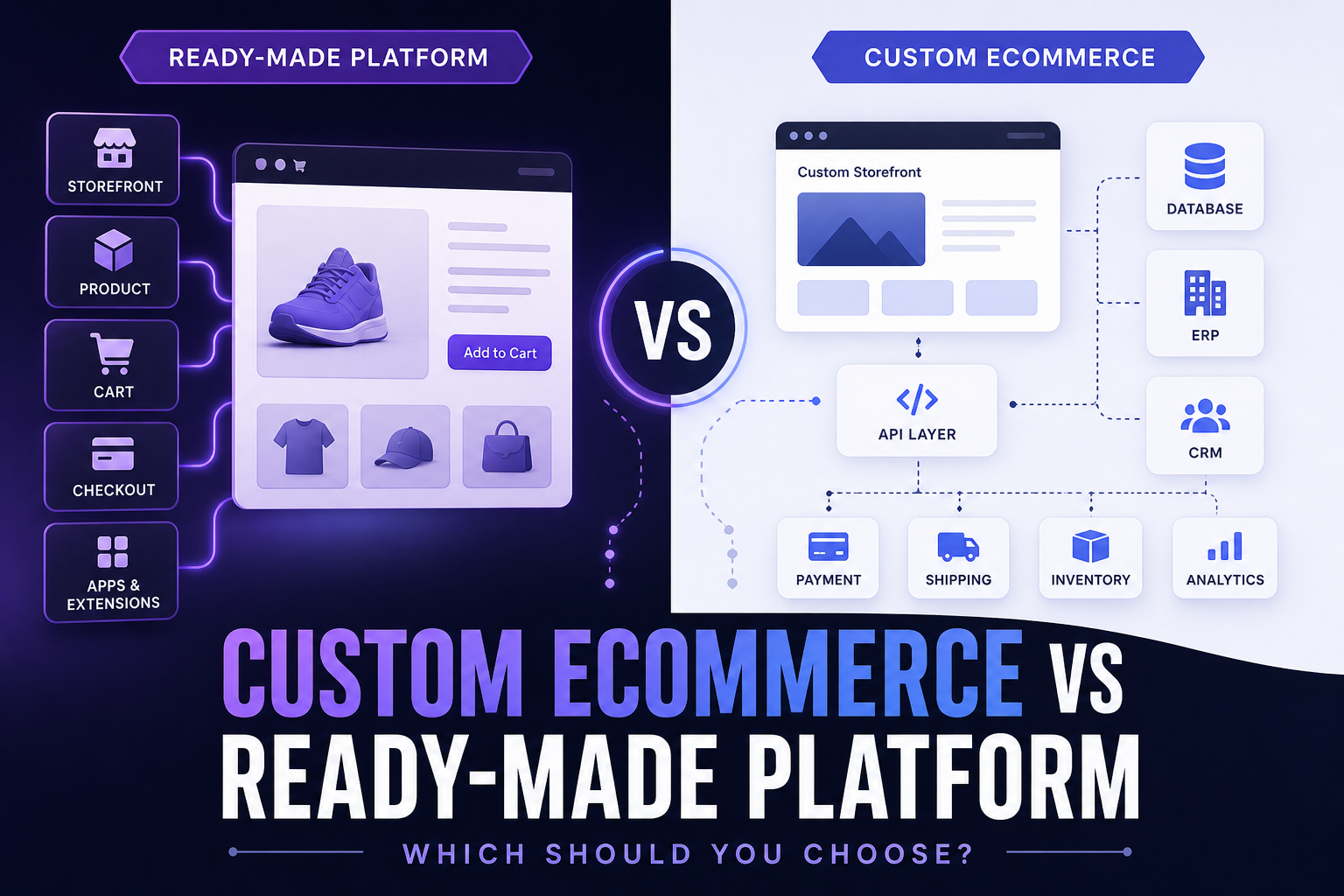
Businesses planning an ecommerce website often assume they have two choices: use a standard platform with limited flexibility, or build everything from scratch. In practice the decision is more nuanced.
Modern ecommerce platforms can support custom themes, apps, APIs and complex integrations. Fully custom ecommerce gives greater architectural control, at the cost of greater development and maintenance responsibility. The real question is not “which approach is better?” It is: how much of your ecommerce operation is genuinely unique?
Should you choose custom ecommerce or a ready-made platform?
For most businesses with standard product catalogs, payments, shipping and checkout requirements, an established ecommerce platform is usually the better starting point because it reduces development time and infrastructure responsibility. Custom ecommerce becomes more appropriate when proprietary workflows, complex B2B requirements, unusual pricing, marketplace logic or deep ERP/operational integrations are central to the business and cannot be implemented cleanly on an existing platform. Before choosing full custom development, also evaluate a hybrid approach: an established commerce platform combined with custom apps, APIs or integrations may provide the required flexibility without rebuilding core commerce functionality.
Choose a platform when
Catalog, checkout, payments and shipping are mostly standard, launch speed matters, and you do not want to own commerce infrastructure.
Consider hybrid when
The commerce core is standard, but you need custom design, a custom app, ERP/CRM sync, advanced COD rules or other operational logic.
Consider custom when
The commerce model itself is proprietary — unusual ordering, multi-vendor marketplace logic, multi-tenant commerce or workflows that conflict with platform architecture — and you can fund ongoing engineering.
Three architecture options, not two
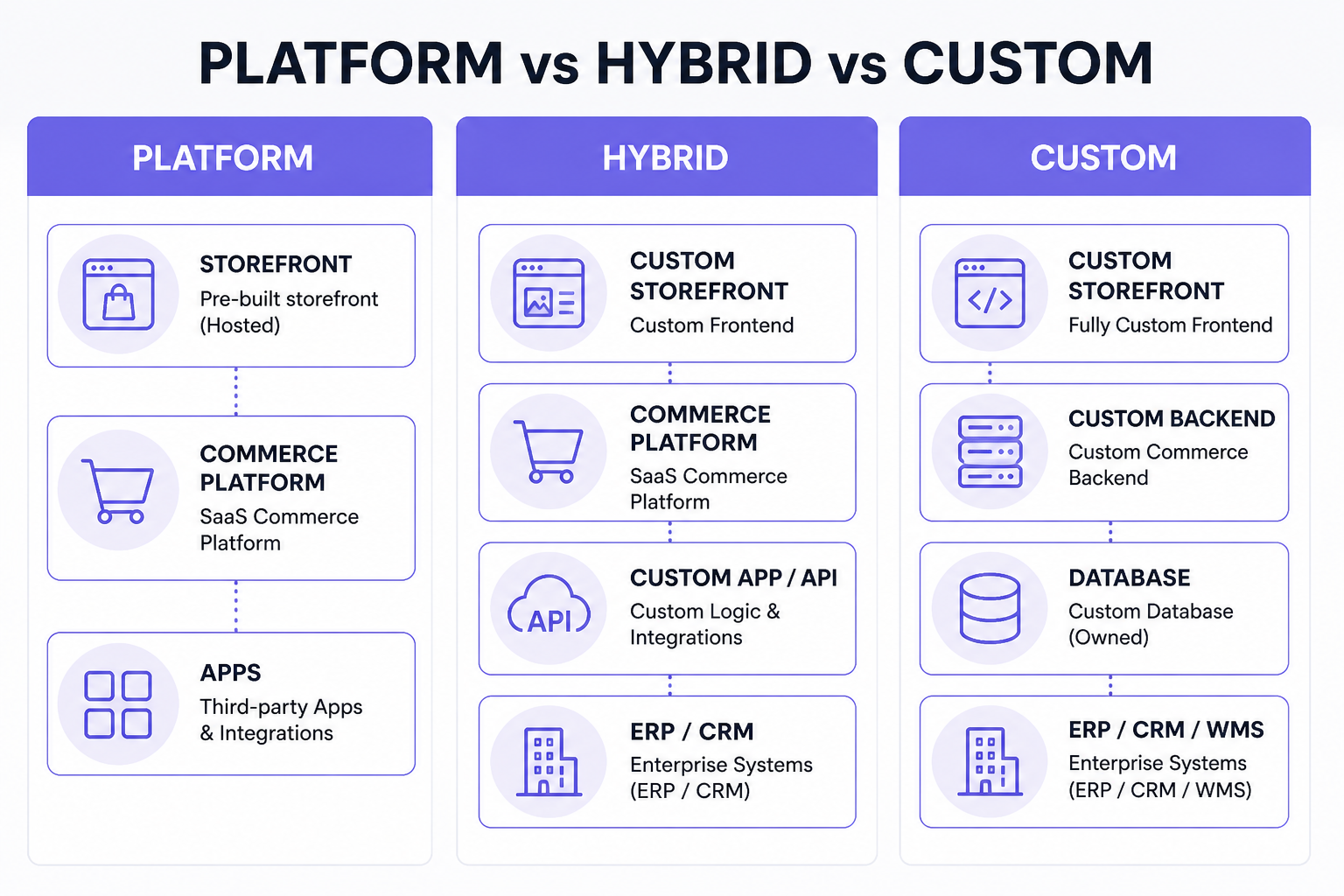
Do not treat Shopify or WooCommerce as “no customization” and custom ecommerce as “the only way to customise.” Most serious stores sit in the middle.
Level 1 — Established platform + standard theme/features. Use native catalog, cart, checkout, payments, shipping and admin with light configuration.
Level 2 — Platform + custom development (hybrid). Custom UX/theme, apps or plugins, APIs, ERP/CRM/WMS integrations and targeted custom apps. Many growing brands belong here.
Level 3 — Full custom ecommerce. Business-specific storefront, backend, pricing, checkout, accounts, admin and integrations. Highest control, highest ownership.
| Factor | Established platform | Platform + custom development | Full custom ecommerce |
|---|---|---|---|
| Launch speed | Faster | Medium | Usually slower |
| Initial engineering | Lower | Medium | Higher |
| Infrastructure responsibility | Lower | Lower / medium | Higher |
| Customization | Strong within platform | Very strong | Maximum |
| Unique workflows | Limited / depends | Strong | Strongest |
| Apps / extensions | Strong | Strong | Mostly custom-built |
| ERP / CRM integration | Often possible | Strong | Fully controlled |
| Maintenance | Lower | Medium | Higher |
| Technical team need | Lower | Medium | Higher |
| Architecture control | Lower | Medium | Maximum |
| Best for | Standard commerce | Growing / complex commerce | Proprietary commerce |
For which specific platform to pick inside Level 1 or 2, use Shopify vs WooCommerce vs custom ecommerce. This article is the build / extend / buy decision.
What is a ready-made ecommerce platform?
An established ecommerce platform already provides major commerce building blocks: product management, cart, checkout, orders, customers, payment and shipping integrations, themes or storefront capabilities, APIs and an app/plugin ecosystem. Shopify and WooCommerce are the examples Indian businesses most often evaluate. Other commerce platforms exist; the architecture question is the same.
Using an established platform does not mean using a generic template. A Shopify or WooCommerce store can still have custom UX, custom code, apps, APIs, ERP and CRM integrations. Distinguish a ready-made platform from a ready-made theme. If Shopify is the likely platform, Shopify development is the implementation path — this article is still about whether a platform is the right architecture.
What is custom ecommerce development?
Custom ecommerce means designing commerce software around your business: storefront, backend, catalog engine, pricing, checkout workflows, accounts, APIs, admin tools, integrations, marketplace logic or operational workflows as needed.
Not every component must be built from zero. Modern custom systems still use payment providers, cloud infrastructure, search, CMS and third-party APIs. Custom means the commerce model and application are yours to design and maintain — not that you reinvent payments or DNS. When the storefront itself is custom rather than theme-based, that often overlaps custom website development.
What is a hybrid ecommerce approach?
Hybrid means: established commerce platform + custom theme or frontend + custom app/API + ERP/CRM/WMS integrations. A typical pattern:
Custom storefront → Shopify or another commerce platform → custom app / API layer → ERP + CRM + WMS.
You reuse mature catalog, cart, checkout and payments, and spend engineering on the workflows that actually differentiate the business. That is often how to avoid reinventing commerce. See when a Shopify store needs a custom app and Shopify app development when the hybrid layer is Shopify-specific.
Build vs buy vs extend
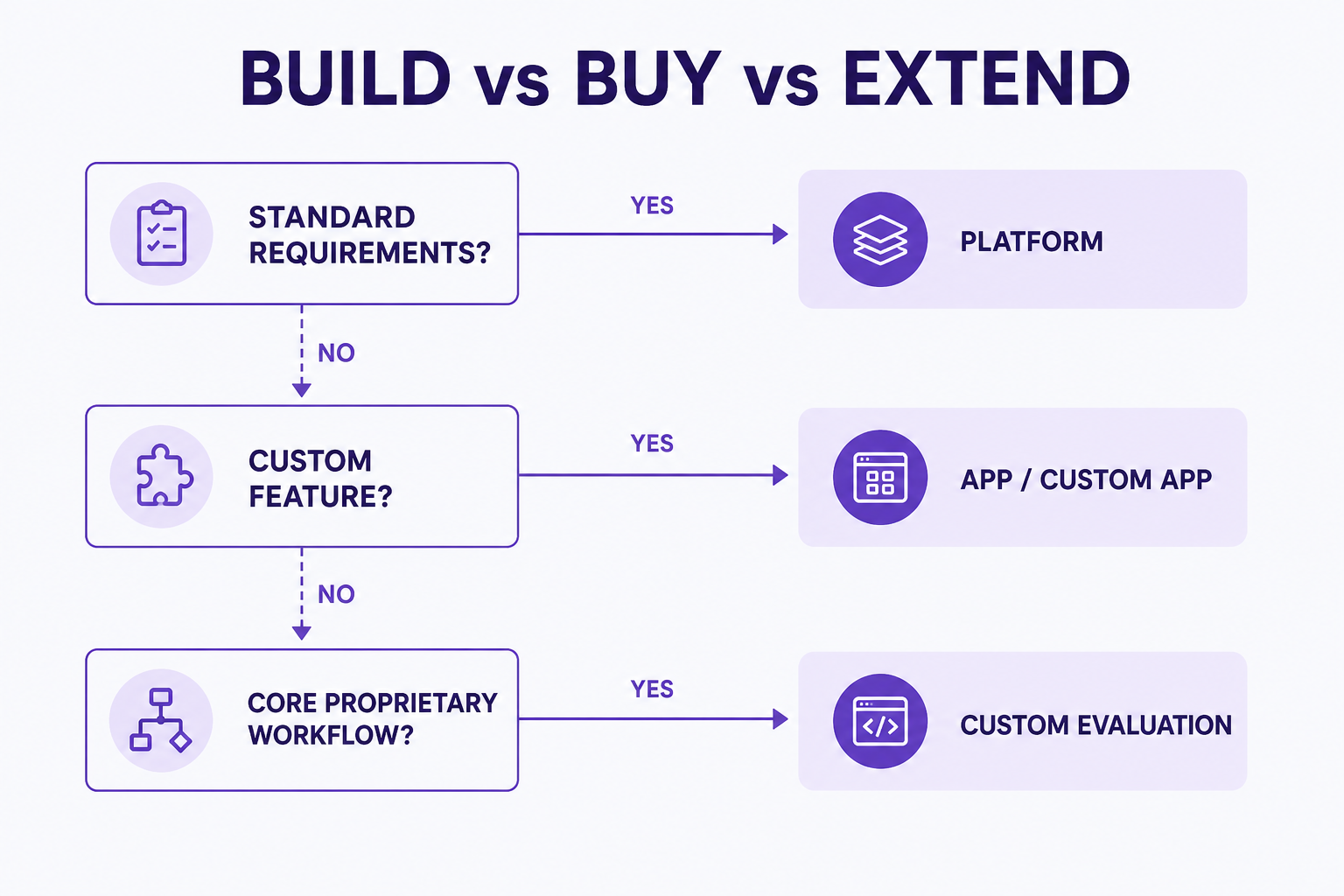
Work down this chain. Move further only when the previous step cannot support the requirement cleanly:
- Is it a standard commerce requirement? → Use native platform capability.
- Can an app or extension solve it? → Extend the platform.
- Can a custom app or API solve it? → Hybrid.
- Is the requirement core to the business and still blocked? → Evaluate full custom ecommerce.
Define features first with the 25 must-have ecommerce website features checklist, then run this tree.
Custom ecommerce vs platform cost
Established platforms may involve subscription or hosting, themes, apps/plugins, implementation, customization and support. Custom ecommerce may involve discovery, UX/UI, frontend, backend, database, infrastructure, integrations, QA, security, monitoring and ongoing maintenance.
Do not compare a Shopify monthly fee with a custom development quote. Those are different cost categories. Compare total cost of ownership over several years. For indicative India project bands, use the ecommerce website cost in India guide rather than inventing another price list here.
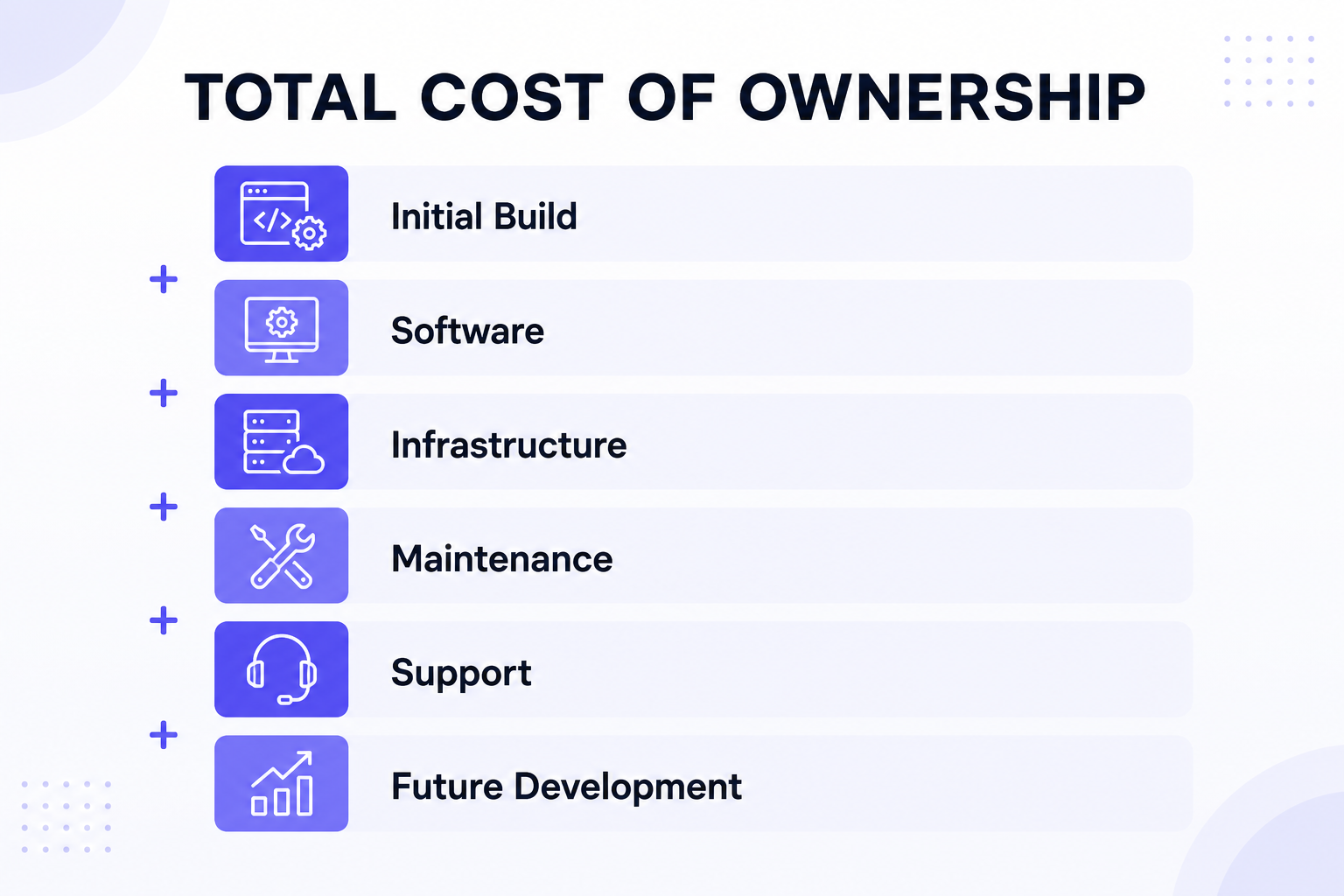
TCO ≈ initial development + platform/hosting + apps and third-party services + maintenance + support + infrastructure + future development + integration maintenance.
Cost of workarounds vs cost of reinventing commerce
A platform can look cheaper until critical workflows depend on many apps, manual processes or fragile integrations. Then hybrid or custom may become cheaper operationally. The opposite error is rebuilding catalog, cart, checkout, orders, accounts, discounts and admin just to avoid a few reasonable platform fees. Ask whether rebuilding that functionality is strategically valuable.
Which approach launches faster?
Established platforms usually reduce the need to build foundational commerce. Custom usually needs more discovery, architecture, engineering, QA and infrastructure. Actual timeline still follows project complexity. A hybrid ERP integration can take longer than a simple custom brochure catalog. Do not treat “platform = two weeks” or “custom = six months” as laws.
Does custom ecommerce provide more flexibility?
Yes, at the architecture level. Modern platforms already support substantial customization: theme/storefront, apps/plugins, custom APIs and integrations, and — on some plans — checkout extensibility. Shopify checkout UI on information, shipping and payment steps is Plus-oriented as of 2026; WooCommerce customization is typically theme, plugin and PHP. Full custom is for when those extension points still cannot express the workflow.
How much technical control does your business actually need?
Consider frontend, backend, database, hosting, deployment, checkout, business logic, integrations and data flows. Maximum control is not automatically an advantage. Control creates responsibility: upgrades, monitoring, backups, security and staffing.
Custom code ownership also does not mean zero dependency. Custom stacks depend on developers, frameworks, cloud, libraries, payment providers and APIs. Platforms create different dependencies. Evaluate portability, not a myth of “custom means no vendor lock-in.”
Which approach requires more maintenance?
Established platform: the provider often handles substantial infrastructure. You still maintain theme, apps, integrations, content and any custom code.
WooCommerce: more direct responsibility for hosting, WordPress, plugins, theme compatibility, backups and security — because WooCommerce is an open-source WordPress ecommerce plugin, not a hosted commerce SaaS. Core being open-source does not make professional ecommerce free.
Custom: your team owns more of the application, infrastructure, dependencies, monitoring, upgrades, security and backups, depending on architecture.
Security responsibility: platform vs custom
Do not claim Shopify is unhackable, WooCommerce is insecure, or custom is more secure. Compare who is responsible for what.
| Area | Platform | Custom ecommerce |
|---|---|---|
| Core platform updates | Mostly provider / platform dependent | Development team |
| Hosting security | Platform / provider dependent | Business / team / hosting provider |
| Custom code | Developer / merchant | Developer / business |
| Access management | Merchant + platform | Business / team |
| Integrations | Shared | Shared |
| Monitoring | Varies | Must be designed and managed |
Is custom ecommerce more scalable?
Not automatically. Scale can mean traffic, orders, catalog size, users, integrations, warehouses, countries or business rules. Established platforms can handle substantial scale. Custom can be designed around unusual scaling requirements — and that engineering is ongoing. A large but straightforward SKU catalog is not, by itself, a reason to leave a platform. Complexity matters more than raw product count: 50 highly configurable products can need more custom logic than 10,000 simple SKUs.
Which approach offers better performance?
Implementation matters more than the label. Platform speed is often limited by theme, apps, scripts and media. Custom speed is limited by frontend architecture, APIs, database, infrastructure and caching. Custom does not automatically mean faster.
Is custom ecommerce better for SEO?
Not automatically. Any viable ecommerce architecture should support crawlable pages, metadata, canonicals, sitemaps, structured data, internal linking, redirects and performance. Custom provides control only if developers implement those correctly. Do not assume custom code ranks better. See the ecommerce SEO playbook for implementation, not architecture slogans.
Catalog complexity can influence the decision
Standard products, variants and collections often fit established platforms well. Complex catalogs may include configurators, thousands of attributes, customer-specific products, unusual relationships, dynamic pricing or PIM-controlled data. Evaluate the actual model before moving to custom. Content-heavy commerce also does not automatically require custom: WooCommerce/WordPress, Shopify plus a CMS, or headless CMS plus commerce may be enough.
When does checkout or payment complexity justify custom?
Standard checkout usually fits established platforms. Unusual approval workflows, complex B2B ordering, proprietary payment flows, quotation-to-order or specialised fulfilment may not. Before building a fully custom checkout, evaluate current platform extensibility (including Shopify Plus checkout UI/Functions where relevant).
For Indian ecommerce, UPI, cards, net banking, COD and common gateways are widely available on established platforms. Custom payment workflows need more engineering and testing. Confirm live provider and platform docs; do not copy stale fee tables.
Advanced COD (pincode, fee, order-value, product or customer rules) does not automatically justify a custom commerce core. Many cases are platform settings, apps/plugins, custom apps or API logic — another reason hybrid matters.
Standard shipping rates, courier integrations and tracking often fit platforms. Proprietary logistics, multi-warehouse routing or unusual fulfilment models may justify custom integration more than a custom commerce core.
Does ERP or CRM integration require custom ecommerce?
Not necessarily. An established platform can often connect to ERP via a connector, middleware, custom app or custom API. Move toward fully custom ecommerce only if the commerce model itself conflicts with platform architecture. See ERP development and Shopify ERP/CRM/API integration.
CRM integration alone is rarely enough reason to rebuild commerce. Typical pattern: platform → custom integration → CRM. See custom CRM development when the CRM itself is custom. Multi-location inventory, WMS sync and order routing follow the same rule: complexity often justifies custom integration, not a new commerce engine.
When does B2B justify custom ecommerce?
B2B may need company accounts, customer-specific or contract pricing, quotes, purchase orders, credit, approvals, bulk orders, dealer portals and ERP-driven catalogs. Evaluate current platform B2B first. On Shopify (2026), core B2B (companies, catalogs, quantity/volume rules) exists on paid plans, with catalog depth and checkout extensibility still stronger on Plus. WooCommerce typically uses extensions or custom PHP. Unusual dealer, credit or approval logic may still need hybrid or a custom B2B portal. See B2B ecommerce development.
Marketplace businesses need a separate evaluation
Multi-vendor marketplaces may need vendor onboarding, catalogs, commissions, settlements, dashboards, moderation, disputes and order splitting. A proprietary marketplace model is a stronger candidate for custom architecture — after you have checked platform apps and dedicated marketplace products. Subscriptions similarly do not automatically require custom; start with native capabilities and apps, then custom billing logic if rules are highly proprietary. Complex product configurators (furniture, industrial equipment, made-to-order) may live as custom applications while the commerce core stays on a platform.
International commerce
Currencies, languages, regional catalogs, tax, payments, shipping and market-specific experiences are partly solved by established platforms (for example Shopify Markets). Custom architecture can help highly specialised multi-market operations. Verify current platform capabilities before assuming you must rebuild them.
Does headless ecommerce mean custom ecommerce?
Not necessarily. Headless often means a custom frontend on an established commerce backend: custom frontend → commerce API → Shopify or another engine. That is another hybrid. Potential gains: frontend flexibility, multi-channel experiences, architectural control. Trade-offs: engineering complexity, deployment, preview/content workflows, integrations and maintenance. Do not choose headless because it sounds modern.
Advantages and disadvantages of established platforms
Typical advantages: faster launch, proven commerce core, existing payment and shipping integrations, app/plugin ecosystems, lower infrastructure responsibility, merchant-friendly admin, documentation and community, easier access to ecosystem developers, and ongoing platform improvements. Qualify by platform: Shopify centralises more hosting; WooCommerce trades that for WordPress/hosting control.
Typical disadvantages: platform constraints, recurring subscription or app costs, ecosystem dependency, some workflows needing workarounds, and architecture/control limits. Do not exaggerate: platforms already run large, complex businesses.
Advantages and disadvantages of custom ecommerce
Typical advantages: business-specific architecture, greater workflow control, custom integrations, proprietary features, infrastructure choice, custom admin/operations and unusual business logic. Do not list better SEO, automatically faster, or automatically more secure as custom advantages.
Typical trade-offs: higher engineering effort, longer development, more QA, infrastructure, maintenance, security updates, developer dependency, documentation and change management. These are reasons to justify custom carefully — not reasons never to build it.
Why platform + custom development is often the middle ground
Example scenario (not a client claim): Shopify + custom theme + custom app + ERP API + CRM + specialised order workflow. You keep mature catalog, cart, checkout and payments, and customise only the strategic layer.
Example: a special order workflow. Instead of replacing Shopify, the path is Shopify → custom app → business workflow. That is usually cheaper to maintain than rebuilding checkout from scratch.
When should you choose an established ecommerce platform?
Strong candidates: standard D2C or retail, typical catalog, common payments and shipping, normal promotions, a need to launch quickly, and limited internal engineering. “Standard” does not mean low quality. Small businesses often prioritise launch speed, manageable cost, simple admin and reliable payments — platform first.
Startups should generally avoid rebuilding solved commerce infrastructure unless custom technology is the competitive advantage. A platform can validate demand faster. Growing D2C brands often stay on platform + custom theme + apps + integrations until a real constraint appears.
When hybrid is usually best
Standard commerce core plus some proprietary workflows: ERP/CRM, custom analytics, a special customer portal, advanced COD, custom operations or unique merchandising. This is a very common Indian manufacturer / growing D2C pattern.
When should you seriously consider custom ecommerce?
Possible triggers: proprietary business model; standard platforms fundamentally conflict with workflows; complex B2B logic; proprietary marketplace; advanced product configuration; deep operational systems at the centre; unique checkout/order architecture; commerce software as strategic IP; multi-tenant commerce; and an organisation that can fund ongoing engineering. One trigger is not an automatic “must build custom.”
When custom ecommerce is probably unnecessary
New startups validating demand; standard D2C; small/simple catalog; common payment/shipping; limited budget; no internal technical resources; requirements already supported by platform or apps; or custom being considered only because it “sounds scalable.” Enterprise size also does not automatically equal custom. Large businesses should still evaluate integration, governance, SLAs, international operations, security, technical resources, TCO and whether an established enterprise commerce platform already fits.
Decision matrix
| Requirement | Platform | Hybrid | Custom |
|---|---|---|---|
| Standard D2C | Strong fit | Usually unnecessary | Usually overkill |
| Custom design | Strong | Strong | Strong |
| ERP integration | Possible | Strong | Strong |
| Complex B2B | Depends | Strong | Strong |
| Proprietary workflow | Depends | Strong | Strongest |
| Marketplace | Depends | Depends | Strong for proprietary model |
| Fast launch | Strongest | Strong | Lower |
| Low maintenance | Strong | Medium | Lower |
| Full infrastructure control | Low | Medium | Strongest |
| Internal engineering required | Lower | Medium | Higher |
Business scenarios (starting points, not rules)
| Business | Likely starting point |
|---|---|
| New fashion D2C brand | Platform |
| Growing D2C with ERP | Hybrid |
| Small retailer | Platform |
| Manufacturer with dealer portal | Hybrid / custom evaluation |
| Proprietary multi-vendor marketplace | Custom evaluation |
| Standard international brand | Platform / hybrid |
| Highly unusual ordering workflow | Hybrid / custom evaluation |
Requirement complexity checklist
Give yourself one point for each that is truly present. This is not a score that automatically equals custom ecommerce.
- ☐ Proprietary pricing engine
- ☐ Complex B2B hierarchy
- ☐ Unique checkout
- ☐ Proprietary marketplace
- ☐ Complex ERP workflows
- ☐ Multiple operational systems
- ☐ Advanced product configuration
- ☐ Multi-tenant architecture
- ☐ Custom fulfilment
- ☐ Commerce technology is strategic IP
The more strategic requirements that cannot be solved cleanly through platform capabilities or extensions, the stronger the case for a custom architecture review.
Feature gap analysis
Before commissioning custom development, map each requirement:
| Requirement | Native platform | App / plugin | Custom extension | Full custom needed? |
|---|---|---|---|---|
| Requirement A | ||||
| Requirement B | ||||
| Requirement C |
Is the custom feature actually a competitive advantage?
Ask: does it differentiate the business, reduce meaningful operational cost, enable a model platforms cannot support, or create proprietary value? If not, prefer existing capabilities where practical.
Technical debt and lock-in
Platform debt: too many apps, workarounds, legacy theme code, fragile integrations. Custom debt: old frameworks, undocumented code, dependencies, poor architecture, infrastructure complexity. No architecture is automatically free of debt.
Does custom ecommerce eliminate vendor lock-in?
No. Platform lock-in is the ecosystem. Plugin lock-in is the extension vendor. Custom lock-in is the development team, framework and architecture knowledge. Cloud lock-in is infrastructure. Ask whether you can export products, customers, orders, content and media; how hard integrations are to replace; and which data is platform-specific.
Platform selection is not irreversible. Migration later can move products, customers, orders, SEO URLs, redirects, content, integrations, analytics and custom functionality — so avoid unnecessary migrations. If you later need a partner, use how to choose an ecommerce development company.
How Web6 evaluates platform vs custom ecommerce projects
Web6 builds Shopify storefronts, hybrid Shopify apps/integrations and custom ecommerce. The evaluation is still:
- Understand the business model
- Document requirements
- Identify standard platform capabilities
- Identify extension/app options
- Map integrations
- Identify genuine feature gaps
- Compare platform / hybrid / custom architecture
- Estimate development and ongoing ownership
If an established platform can meet the requirements cleanly, building an entire custom ecommerce system may add unnecessary cost and maintenance. Custom development should solve a real business constraint or create meaningful strategic value.
Not sure whether your project needs a platform or custom architecture?
Start with the business requirements rather than the technology. Once catalog, checkout, integrations, B2B and operational workflows are clear, the appropriate architecture becomes easier to evaluate.
Discuss Your Ecommerce Requirements.
Need help comparing Shopify, WooCommerce and custom ecommerce specifically? Read the platform comparison guide.
Choose the least complex architecture that works
Standard requirements → platform. Standard commerce plus unique features → hybrid. Proprietary commerce model or core unique workflows → custom evaluation. Choose the least complex architecture that reliably supports the business and realistic future growth.
Frequently asked questions
What is custom ecommerce development?
Designing commerce software around your business — storefront, backend, pricing, checkout, accounts, admin and integrations as needed — instead of relying entirely on an off-the-shelf commerce platform. Custom systems still use third-party payments, cloud and APIs.
What is a ready-made ecommerce platform?
An established commerce system that already provides catalog, cart, checkout, orders, customers, payments, shipping, APIs and an app/plugin ecosystem — for example Shopify or WooCommerce. It is not the same as a generic theme.
Is custom ecommerce better than Shopify?
Not automatically. Shopify is often better when standard commerce plus theme/apps/APIs is enough. Custom is more relevant when the commerce model itself cannot fit platform architecture cleanly. Many businesses need hybrid, not a full rebuild.
Is custom ecommerce more expensive than an ecommerce platform?
Usually higher engineering and ownership, but compare multi-year TCO, not a monthly platform fee versus a custom quote. Workaround-heavy platforms can also become expensive. See the ecommerce cost guide for India project structure.
Is custom ecommerce more scalable?
Not automatically. Platforms can scale traffic and catalogs substantially. Custom can be designed for unusual scaling (rules, warehouses, multi-tenant) if you fund the engineering. Complexity matters more than SKU count.
Is custom ecommerce better for SEO?
No, not automatically. Crawlability, metadata, canonicals, sitemaps, structured data, internal linking, redirects and performance matter on every stack. Custom only helps if those are implemented well.
Can Shopify or WooCommerce support custom functionality?
Yes. Themes, apps/plugins, APIs, webhooks, custom apps and (on Shopify, especially Plus) checkout extensibility cover a large range of custom needs without replacing the commerce core.
Does ERP integration require custom ecommerce?
No. Many businesses integrate ERP through connectors, middleware or custom apps on an established platform. Full custom commerce is for when the commerce model itself conflicts with the platform.
When should a business choose custom ecommerce?
When proprietary workflows, marketplace logic, unusual B2B/ordering or operational systems cannot be implemented cleanly via native features, apps or custom extensions — and the organisation can maintain the software.
What are the disadvantages of custom ecommerce?
Higher engineering, longer delivery, more QA, infrastructure, maintenance, security updates, developer dependency and documentation. Those are ownership costs, not automatic reasons to avoid custom.
What is a hybrid ecommerce architecture?
An established commerce platform plus custom theme/frontend, custom app or API, and integrations (ERP, CRM, WMS). You reuse mature commerce and customise only strategic workflows.
Should a startup build a custom ecommerce platform?
Usually no, unless custom technology is the competitive advantage. A platform typically lets you validate demand faster with less infrastructure ownership.