
Web Development
B2B Website Development for Gujarat Manufacturers & Exporters: Complete Guide
Written by Web6 Editorial Team · Published 3 September 2026 · 20 min read
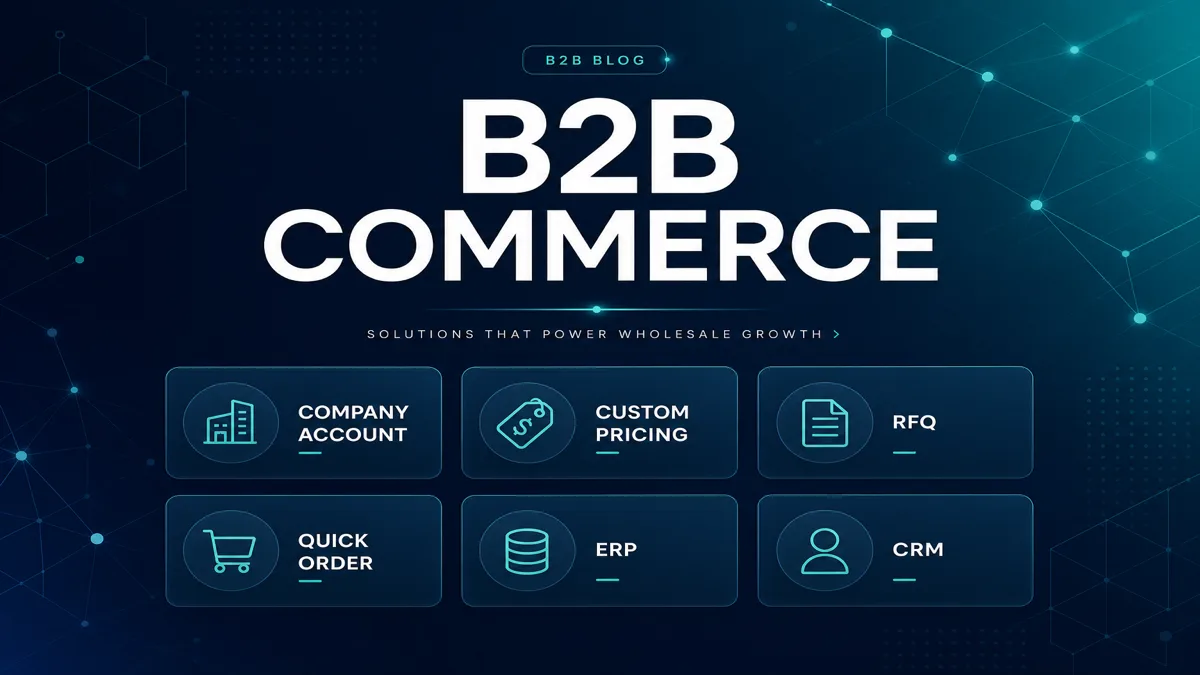
Most "B2B websites" in Gujarat are product brochures with a contact form. Buyers visit, cannot find the MOQ, submit an enquiry that lands in a shared inbox, and move on. That is not a B2B website — it is a missed opportunity disguised as a digital presence.
A real B2B website for a manufacturer, exporter, or distributor is designed around how trade buyers actually purchase: discovery, specification, quotation, account pricing, bulk ordering, approvals, and ERP hand-off. This guide covers what that architecture looks like, which features matter by business type, when platform choices diverge, and how ERP and CRM fit into the full workflow.
For delivery partners, Web6 builds B2B ecommerce development across Gujarat and India. For broader website cost context, see website development cost in Surat. For platform selection, read custom website vs WordPress vs Shopify.
What should a B2B website do for a Gujarat manufacturer or exporter?
A B2B website should support the trade sales process, not replicate a retail storefront. For a Surat textile mill, that means qualified RFQs with fabric specs pre-filled. For a Rajkot engineering supplier, it means technical datasheet downloads and dealer registration. For an Ahmedabad exporter, it means international landing pages that route enquiries to the right sales rep. The website captures qualified interest and connects it to the right system — CRM for leads, ERP for orders. It should reduce sales team overhead on pre-qualification, not add admin work.
B2B website requirements vs B2C — key differences
The same "ecommerce platform" tag covers fundamentally different requirements. Understand the gaps before choosing a stack.
| Requirement | B2C | B2B |
|---|---|---|
| Buyer type | Individual consumer | Company or trade buyer |
| Pricing | Public, fixed list | May vary by account, contract, or volume |
| Order size | Smaller, standard units | Bulk, weight, roll length, lot |
| Approval workflows | Rare | Common — manager approval, credit check, PO |
| RFQ (quotation requests) | Rare | Common, especially for custom or large orders |
| Purchase orders | Uncommon | Often required by buyer's finance team |
| ERP integration | Useful for stock | Often essential — orders, pricing, invoices |
| Account management | Basic profile | Company hierarchy, reps, credit, history |
| Catalog visibility | Public for all | May differ by account tier or contract |
| Payment terms | Immediate payment | Net 30/60, advance, letter of credit, credit limit |
Designing a B2B site from a B2C mental model produces the most common failure: a shopping cart that cannot handle different prices for different buyers.
B2B website needs by Gujarat business type
Manufacturers (Surat, Rajkot, Ahmedabad, Vadodara)
Manufacturers primarily need qualified enquiries and RFQs — not immediate checkout. A Surat textile mill needs fabric category architecture, composition and GSM specs, MOQ signals, wholesale enquiry routing, and CRM handoff. A Rajkot engineering firm needs technical datasheets, capability pages, tolerance/material specs, and dealer or OEM enquiry forms. A Vadodara industrial products company may need compliance documentation and export enquiry flows.
The website's job is to qualify the buyer before a sales rep invests time — not to replace the rep entirely.
Exporters
Export businesses need international discovery plus structured enquiry capture. That means country or market landing pages (not doorway spam — genuine pages for genuine markets), multi-product RFQ forms, downloads (product certifications, spec sheets, compliance docs), and clear trust signals for international buyers unfamiliar with the supplier. Export enquiry fields differ from domestic wholesale: buyer's country, incoterm preference, port, target volume, certification needs.
Wholesalers and distributors
Wholesale trade often runs on repeat reordering. Key requirements: category and filter browse, MOQ per product, bulk enquiry or logged-in ordering, order history, and eventually account-specific pricing for established buyers. Gujarat wholesale clusters in textiles, chemicals, FMCG, and agri-inputs each follow this pattern with slightly different catalog and MOQ logic.
Industrial suppliers and engineering companies
Industrial B2B tends toward specification-first selling. Products are chosen by technical parameter before price. Websites should prioritize filter-by-specification, technical PDF downloads, RFQ with attachment support (CAD files, drawings), and dealer or OEM application forms. Quote turnaround and customer service quality matter more than fast checkout for most industrial buyers.
Textile and fashion (Surat)
Covered in depth in website development for textile businesses in Surat. In summary: catalog depth, fabric attributes as filters, MOQ by product or colour, wholesale enquiry, dealer forms, and optional ecommerce for D2C. B2B textile may need account-specific pricing and ERP sync when the dealer network is large.
B2B website features — complete checklist
Catalog and discovery
- Product catalog with technical specifications. Not just marketing copy — structured fields (composition, tolerances, size, weight, certification, compliance) that match how B2B buyers evaluate.
- Category and attribute-based filters. Industry, specification, application, material, or use-case filters reduce irrelevant enquiries.
- Downloadable spec sheets, datasheets, compliance documents. Critical for export and industrial buyers. Version control matters — stale PDFs erode trust.
- MOQ display. Per product, per colour/variant, or global. Showing MOQ reduces unqualified leads from retail buyers in a wholesale catalog.
Enquiry and quotation
- RFQ (request for quotation) forms. Structured — product reference, quantity, delivery context, timeline, attachments. Not a generic "message" field. Routes to CRM with product context intact.
- Bulk enquiry forms. For buyers wanting multiple product quotes in one submission rather than individual product RFQs.
- Sample or swatch requests. Common in textile, building materials, and chemical distribution.
- Export enquiry forms. Separate from domestic wholesale — country, port, incoterm, certification requirements.
Accounts and pricing
- Company accounts. An account represents a buying organisation, not an individual. Support multiple users per account with role separation (buyer, manager, approver).
- Customer-specific or account-tier pricing. Dealers at different tiers, contracted customers, export vs domestic rates. Prices may be login-gated, assigned by sales, or imported from ERP.
- Credit limit display. For repeat B2B buyers, showing available credit reduces back-and-forth with finance teams.
- Order history and re-order. Especially valuable for distributors reordering known SKUs — cuts sales admin on routine purchases.
- Saved product lists or quick-order pads. Regular buyers need to reorder a known list without catalog browsing every time.
Order workflow
- Approval workflows. Internal purchase approvals before order commits — common in larger buying organisations.
- Purchase order (PO) reference fields. Many B2B buyers require their own PO number on the order for reconciliation.
- Quote-to-order conversion. Sales team creates a quote in CRM or ERP, buyer reviews and approves — website surfaces the quote in the account portal.
- Bulk and split shipping options. Manufacturers selling to distributors with multiple delivery locations or staged delivery schedules.
Sales operations
- Sales rep assignment. Enquiries or accounts routed to a specific rep, not a shared inbox. CRM handles this — website triggers the routing.
- Dealer and distributor registration. Application forms for new channel partners — territory, existing business, capacity, references. Gate account-specific pricing and portals post-approval.
- International enquiry qualification. Pre-qualify by country, buyer type, volume intent — reduces export sales team overhead.
Manufacturer workflow — from Google to ERP
Google search (product + location/spec)
  → Product or category page
  → Technical specification + MOQ
  → RFQ form (with product context)
  → CRM record + rep assignment
  → Quote generated and sent
  → Buyer approval
  → Sales order
  → ERP (inventory, production, despatch, invoice)
Each step is a failure point. Common gaps: product page has no spec table so buyer cannot self-qualify; RFQ lands in email without product context; CRM has no quote status so rep re-asks the same questions; no ERP handoff so orders are re-keyed manually.
Exporter workflow — international to enquiry
Country or product query (Google, B2B directory referral)
  → International landing page (market + product category)
  → Catalog or product capability page
  → Export enquiry form (country, volume, certification, incoterm)
  → CRM qualification by export sales team
  → Sample / compliance step (offline)
  → Pricing and terms negotiation
  → Order
The website handles discovery and qualified capture. Compliance, logistics, LC, and pricing negotiation typically remain offline for larger export transactions. The website should not promise logistics it cannot deliver.
CRM and ERP architecture — what goes where
Many B2B implementation failures come from confusing CRM and ERP responsibilities or trying to replicate ERP in the website.
CRM — system of record for leads and opportunities
- Website enquiries, RFQs, and dealer applications land as CRM leads or contacts.
- Sales team qualifies, assigns, and progresses opportunities through pipeline stages.
- Quotes and proposals created in CRM or ERP, linked to opportunity.
- Won/lost outcomes with reason codes feed back to marketing for channel quality review.
ERP — system of record for orders, inventory, pricing, and finance
- Once a sale converts, the order lives in ERP — production schedule, inventory allocation, despatch, shipping, invoicing.
- Customer master, credit limit, payment terms, and contract pricing often mastered in ERP.
- Stock and availability sync to website may flow from ERP — decide batch vs real-time, and who owns data accuracy.
- Website should not become a second ERP — it should consume and surface ERP data, not duplicate it.
Integration scope to decide during discovery
- Which fields flow ERP → website (products, stock, pricing) and how often?
- Which fields flow website → ERP (orders, new customers, enquiries) and via what mechanism?
- What happens on conflict — website sale for out-of-stock ERP item?
- Who owns master data for each entity?
Complex ERP integration typically warrants its own discovery sprint. See ERP development and custom CRM development for integration planning.
Common ERP integration patterns in Gujarat manufacturing
- Scheduled product sync (nightly or hourly): ERP pushes product, pricing, and stock to website database. Simple and robust for catalogs that do not change intraday. Acceptable "as-at" lag shown to buyers.
- Order push on checkout: Website sends confirmed order to ERP via API or webhook. ERP creates sales order; production or despatch process follows ERP timeline, not website confirmation.
- Customer master sync: New accounts created on website trigger CRM/ERP customer creation with rep assignment. Avoids duplicate customer records in two systems.
- Real-time stock query: More complex — website queries ERP API at browse or checkout for live availability. Only justified when stock accuracy is critical to buyer confidence and ERP API can sustain the load.
- Invoice and statement access: ERP generates invoices; portal surfaces PDF download. Reduces finance team calls for statement copies from dealers.
Most Gujarat manufacturers using Tally, SAP Business One, or industry-specific ERP should start with scheduled product and stock sync plus order push — validate that before investing in real-time queries.
Platform choice — Shopify B2B, WooCommerce, or custom
No platform wins for every B2B use case. Assess against your actual requirements, not a brand preference.
Shopify (with B2B features on appropriate plans)
Shopify offers B2B capabilities including company accounts, location-level pricing, payment terms, and order minimums — feature availability varies by plan (verify current Shopify B2B documentation before committing). Works well for: manufacturers with a manageable dealer network, D2C + wholesale hybrid, straightforward tier-based pricing, and teams that want managed infrastructure without server ownership.
Evaluate carefully when: pricing rules are highly complex, ERP integration requires deep customisation, approval workflows are non-standard, or product ordering logic (roll lengths, kit assembly, configurable products) does not map to standard Shopify variants. See Shopify development.
WooCommerce
WooCommerce plus B2B plugins can handle wholesale pricing, customer groups, MOQ, and account gating. Suits smaller wholesale operations comfortable owning hosting and plugin maintenance. May not scale cleanly to very large catalogs or complex multi-level approval and credit workflows without significant customisation.
Custom B2B platform (Laravel, Node.js, or hybrid)
Custom development is justified when: pricing rules cannot be served by off-the-shelf platform logic, ERP integration requires deep API middleware, ordering workflows are genuinely unique (made-to-order manufacturing steps, configurable specifications), or the business model itself is the product (marketplace, SaaS-like portal). Custom carries higher initial engineering cost and ongoing maintenance responsibility. See B2B ecommerce development.
Hybrid approaches
Some Gujarat manufacturers use Shopify for D2C consumer sales alongside a custom portal for dealer pricing and order management. Running two systems has operational cost — plan who maintains product data synchronisation.
| Factor | Shopify B2B | WooCommerce | Custom |
|---|---|---|---|
| Pricing complexity | Good for tier-based | Moderate with plugins | Fully configurable |
| Account management | Strong on qualifying plans | Plugin-dependent | Fully configurable |
| ERP integration | Via API + apps | Via plugin + API | Direct API/middleware |
| Approval workflows | Limited | Limited with plugins | Fully configurable |
| Infrastructure ownership | Managed (SaaS) | Self-hosted | Self-hosted/cloud |
| Initial cost | Moderate + subscription | Moderate + hosting | Higher upfront |
| Scale and maintenance | Platform handles scaling | Manual management | Engineered to requirement |
SEO architecture for B2B Gujarat websites
B2B SEO is structural — category and product page architecture, not keyword-stuffed landing pages for every city name.
- Product-category architecture. Industry hub pages → product family pages → individual product pages. Each level targets a distinct intent cluster.
- Technical product content. Specs, materials, certifications, applications — this content attracts engineers and procurement managers searching by specification rather than brand.
- Industry and capability pages. "Textile machinery supplier Gujarat" or "engineering parts manufacturer Rajkot" — targeted, genuine industry context pages, not doorway stubs.
- International targeting. Country or market pages when you genuinely serve that market — with unique content, local contact details, and relevant product selection. Hreflang only when you have separate language versions of the same content.
- B2B landing pages. Dealer programme, wholesale application, export enquiry — distinct pages with relevant CTAs, not buried sub-sections of a homepage.
- Technical SEO foundations. Crawlable catalog, faceted URL strategy, fast loading on slow connections, mobile parity. See SEO-friendly website development checklist.
International SEO considerations for Gujarat exporters
- Use subdirectories or ccTLDs only with genuine market commitment — do not add /us/ and /uk/ pages with identical content.
- Hreflang is appropriate when genuinely different language versions exist for the same page.
- Country-specific enquiry forms and contact details improve trust with international buyers.
- Avoid creating dozens of near-identical "XYZ manufacturer in [country]" pages — Google treats this as doorway content.
Ongoing international SEO strategy pairs with SEO services beyond launch foundations.
Dealer and distributor portal framework
A dealer portal is a logged-in section of the website (or a separate application) giving channel partners access to:
- Contracted pricing or tier discount structure
- Stock availability (live or batch-synced from ERP/warehouse)
- Quick or bulk order entry by SKU or product code
- Order status and tracking links
- Invoice and credit note downloads
- Marketing assets — product images, spec sheets, brand materials
- Sales support — assigned rep contact, territory information
Phase portal features: start with enquiry and catalog access, add login-based pricing after dealer onboarding process is stable, then add ERP-synced stock and order status once integration is tested. Launching a portal with inaccurate stock data or wrong pricing erodes trust faster than having no portal at all.
Gujarat industrial context — realistic workflow examples
Gujarat's manufacturing and trade economy spans multiple clusters, each with distinct B2B website needs. Examples are illustrative business patterns, not Web6 client references.
- Surat textile mill: Fabric catalog with GSM/composition/width filters, MOQ per colour, wholesale RFQ routed to export or domestic sales team separately, dealer portal for repeat greige buyers in Phase 2.
- Rajkot engineering/auto parts supplier: Spec-first catalog (tolerances, material, finish), technical drawing upload on RFQ, OEM enquiry vs aftermarket spare parts separated, compliance certificate downloads for export.
- Ahmedabad industrial distributor: Multi-brand catalog with brand/category/application filters, credit-term ordering for established accounts, sales rep assignment by geography, ERP stock sync from SAP or Tally.
- Vadodara chemical/pharmaceutical ingredient exporter: Product by CAS number or application, CoA (certificate of analysis) and MSDS downloads, export-specific RFQ with regulatory context, country landing pages for key markets.
Each scenario requires a different feature priority order at launch. Shared pattern: catalog → enquiry/RFQ → CRM → quote → order → ERP. The sophistication of the account and pricing layer depends on dealer network size and contract complexity.
Why B2B websites in Gujarat often underperform
The most common failure patterns seen across manufacturing and export B2B sites:
- Generic catalog, no specs: Products listed with only a name and a stock photo. No composition, material, weight, tolerance, or compliance data — so buyers cannot self-qualify and the enquiry form carries no useful context.
- Single contact form for all enquiry types: Domestic wholesale, export, dealer application, and sample request all land in the same inbox with no differentiation. Sales team wastes time routing manually.
- No CRM integration: Enquiries arrive in email, get forwarded, and die in thread chains. No pipeline visibility, no rep accountability, no follow-up audit trail.
- Pricing mismatch between site and sales quote: Website shows outdated list prices; dealer expects contract rate. Trust erodes on first interaction.
- Mobile unusable: Many B2B buyers in Gujarat browse on mobile during site visits, trade fairs, or travel. A form that cannot be submitted on a phone loses real leads.
- SEO invisible: No category architecture, generic product names as page titles, no technical spec content. International buyers searching by specification or compliance term never find the supplier.
These problems are structural — they require architecture and integration decisions, not only a better homepage design.
B2B launch checklist
Use this before go-live. Not every item applies to every business — mark N/A explicitly.
| Area | Check |
|---|---|
| Catalog | Technical specs present on product pages |
| Catalog | MOQ visible per product or at category level |
| Catalog | Downloads (datasheets, certs) attached and accessible |
| Enquiry | RFQ form captures product reference, quantity, context |
| Enquiry | Export enquiry form has country + certification fields |
| CRM | Enquiry lands in CRM with source and product context |
| CRM | Rep assignment rules tested |
| Accounts | Dealer/wholesale registration form live and routed |
| Accounts | Login-gated pricing tested for correct tier display |
| Orders | Bulk order entry or quick order tested end-to-end |
| ERP | Integration fields, frequency, and conflict rules documented |
| SEO | Category and product URL structure documented and crawlable |
| SEO | International pages have unique content and local enquiry paths |
| SEO | Pre-launch crawl run — noindex, canonical, redirect QA complete |
| Analytics | RFQ submit, export enquiry, account registration tracked as events |
B2B pricing models — decision framework
How pricing works on the site depends on business model:
- Public list pricing — all buyers see the same price. Works for commodity wholesale with no contract differentiation.
- Quote-only — no prices shown; all buyers request a quote. Works for custom manufacturing, large industrial, high-variability export.
- Login-gated pricing — public catalog, prices only visible after account approval. Common for wholesale with multiple tiers.
- Account-specific pricing — each approved account sees their contracted price, imported from ERP or set in CRM/portal admin. Most complex but most accurate for established dealer networks.
- Mixed model — public retail price shown; logged-in dealers see their net price. Requires careful UI so public buyers are not confused by "your price" logic.
Choose the model before selecting a platform — some platforms handle account-specific pricing cleanly; others require workarounds that become technical debt.
Implementation path for Gujarat B2B businesses
- Document primary sales model (RFQ, wholesale repeat, export, dealer portal, or hybrid).
- Map buyer journey from discovery to order and identify which steps website handles vs sales team vs ERP.
- Define catalog structure — product families, attributes, filters, spec fields.
- Specify enquiry types and CRM routing rules.
- Decide pricing model and whether account tiers are day-one or phase-two.
- Select platform against requirements — Shopify, WooCommerce, or custom based on pricing complexity, ERP, and workflow.
- Define ERP integration scope, system of record, and data frequency.
- Plan SEO architecture for category and international pages before URLs are finalised.
- Phase dealer portal login and account pricing if day-one catalog + enquiry is achievable without them.
- Run pre-launch B2B checklist before announcing to dealer network.
Web6 provides B2B ecommerce development, custom website development, ERP development and custom CRM development for manufacturers, exporters, wholesalers and distributors across Gujarat.
Related guides
Frequently asked questions
What is a B2B website?
A B2B website serves trade buyers — companies, dealers, distributors, or procurement teams — rather than individual retail consumers. It supports discovery, specification, RFQ, account pricing, bulk ordering, approvals, and ERP integration in ways a standard retail site typically does not.
Does a Gujarat manufacturer need ecommerce on their website?
Not necessarily in the retail sense. Many manufacturers need a strong catalog, technical specs, and RFQ flows rather than checkout. Add online ordering when buyers are ready to self-serve and pricing is defined enough to automate — for most Gujarat industrial manufacturers, that is a phase-two feature.
What is an RFQ system on a B2B website?
RFQ (request for quotation) lets buyers submit a structured request for pricing and availability — product reference, quantity, delivery context, attachments. It replaces an unstructured email with structured data that routes directly to a CRM lead with full context, reducing back-and-forth for the sales team.
Can different buyers see different prices on a B2B website?
Yes. Account-specific or tier-based pricing is a standard B2B requirement. Options include public list prices, login-gated prices, account-specific rates imported from ERP, or quote-only. Platform and integration complexity varies — choose the model before the platform.
Can a B2B website sync with ERP?
Often yes — products, stock, pricing, customers, and orders can sync depending on ERP APIs and process design. ERP should remain the system of record; the website consumes and surfaces ERP data rather than duplicating it. Integration scope needs its own discovery.
Can distributors have their own accounts on the website?
Yes. Company accounts with role separation (buyer, manager, approver), contracted pricing, order history, and credit display are standard B2B portal features. The complexity of implementation depends on how many dealers you have and how differentiated their pricing is.
Can orders require internal approval before processing?
Yes. Approval workflows — manager review before a large order commits, finance approval on credit-extended accounts — are achievable on B2B platforms or custom portals. Standard Shopify checkout does not support this natively; verify plan and app availability.
Can a B2B website support purchase orders from buyers?
Yes. Accepting a buyer's PO reference number on order is a common B2B requirement. For PO-against-credit-account workflows, custom or B2B-focused platform configurations apply.
Which platform is best for B2B website development in Gujarat?
Depends on requirements. Shopify B2B suits manageable dealer networks with tier pricing. WooCommerce suits smaller wholesale with standard plugin support. Custom platforms suit complex pricing, deep ERP integration, or unique ordering logic. Assess requirements first — not a platform label.
How much does B2B website development cost?
Scope-driven: catalog depth, account pricing complexity, ERP integration, custom workflows, and design. No fixed rate — see the website development cost guide for budget frameworks and compare written proposals.
How long does B2B website development take?
Depends on catalog readiness, ERP integration complexity, custom workflows, and approvals. A focused catalog-plus-enquiry site moves faster than a full dealer portal with ERP sync. Ask for milestone plans tied to documented scope.
How should Gujarat exporters use SEO for international buyers?
Build genuine country or market pages for markets you actually serve, with unique content and specific enquiry paths. Technical product content (specs, certifications, compliance) attracts international procurement search. Hreflang only when genuinely different language versions exist. Avoid doorway pages swapping city names.