
Web Development
How to Choose a Website Development Company in Surat: 12 Things to Check
Written by Web6 Editorial Team · Published 3 September 2026 · 18 min read
Two website development companies can quote very different prices for what appears to be the same website. The difference is often in what is included: architecture, performance, SEO foundations, responsive design, CMS access, testing, integrations, support and ownership terms.
This guide gives Surat businesses 12 practical checks before hiring — so you evaluate fit and scope, not slogans. It is a buying guide, not a ranking list.
If you are still deciding which technology fits after you shortlist vendors, read custom website vs WordPress vs Shopify. For budget planning before you compare quotes, see website development cost in Surat. For commercial delivery of a custom build, see custom website development.
How do you choose a website development company in Surat?
Start by documenting requirements, then shortlist firms with a relevant live portfolio and the technical ability to recommend a stack for those requirements — not a favourite tool. Review mobile UX, SEO foundations, performance discipline, CMS access, ownership of domain/hosting/code, integrations, security and post-launch support. Compare written scope and milestones, not only the lowest quote. Check reviews and references for communication and delivery quality. Industry familiarity helps, but clear discovery and engineering quality matter more than a matching industry label alone.
What to check before hiring
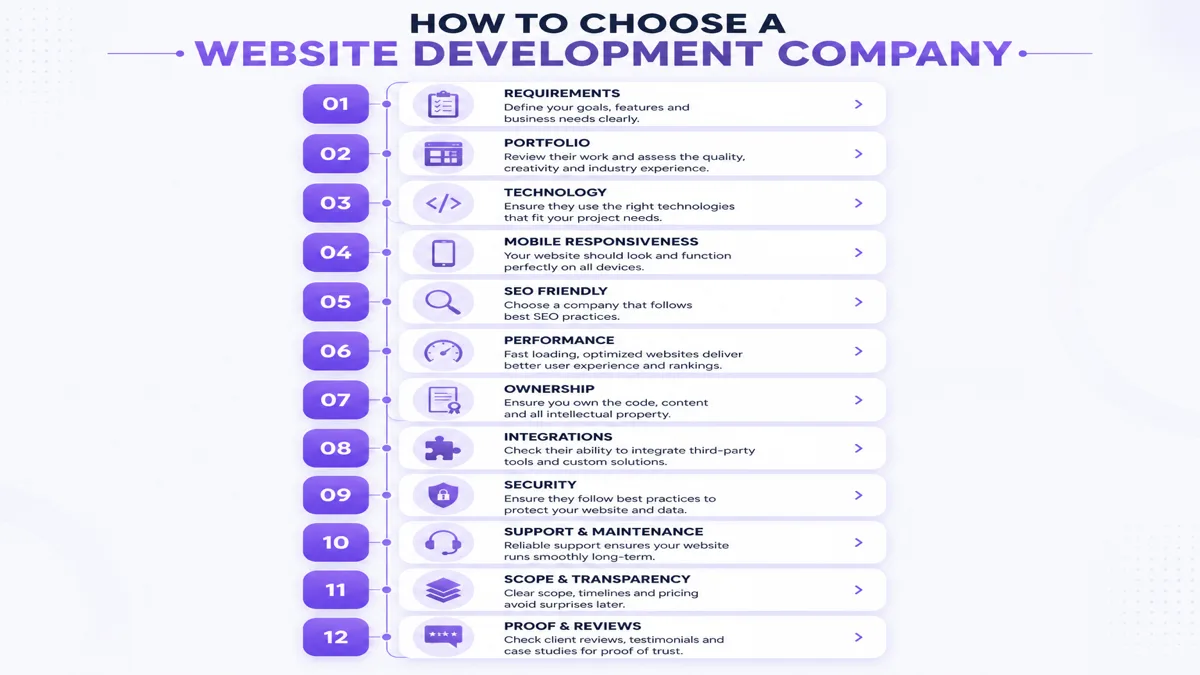
| What to check | Why it matters |
|---|---|
| Business understanding | Website must support actual goals |
| Relevant portfolio | Shows practical experience |
| Technical capability | Affects scalability and maintenance |
| Mobile UX | Most users may visit on mobile |
| SEO foundation | Helps search engines crawl and understand the site |
| Performance | Affects UX and conversions |
| CMS & ownership | Determines future control |
| Integrations | Connects website with business systems |
| Security | Protects site and users |
| Support | Matters after launch |
| Pricing scope | Prevents hidden surprises |
| Reviews & proof | Helps assess reliability |
1. Do they understand your business before recommending a website?
A capable partner should learn your business model, customers, goals, products or services, lead flow, ecommerce needs, integrations, content plan and SEO goals before locking a stack. Discovery does not need to be a multi-week workshop, but it should produce a shared understanding of what success looks like.
Red flag: immediately recommending WordPress, Shopify or “custom” without discovery.
A textile manufacturer, a local service firm and an ecommerce fashion store usually need different architecture — even if all three “need a website.” Ask the company to restate your goals in their own words before they propose a package.
2. Check their portfolio — but look beyond visual design
Screenshots are not enough. Open live sites when possible and check mobile usability, loading feel, navigation, forms, ecommerce or enquiry flows, conversion paths, page structure and technical quality. Look at how forms fail, how empty states read, and whether contact or checkout paths feel intentional.
Ask whether the company owned full development or only design, and whether the site is still live. Industry experience can help, but it should not automatically outweigh technical capability. A team does not need an identical prior client if it can correctly understand and execute your requirements.
3. Evaluate their technical development capability
Capability may span custom development, Shopify, WordPress, modern frontends, APIs, databases, CMS platforms and cloud hosting. The useful question is not which logo they prefer — it is whether they choose a stack based on requirements, maintenance and ownership.
Questions to ask
- Why do you recommend this platform?
- How easy will it be to maintain?
- Can it scale with our catalog or content?
- Who controls hosting?
- Can another developer maintain it later?
- What happens if requirements change?
- What third-party services are required?
4. Review the mobile experience, not just desktop design
Check navigation, buttons, forms, text readability, images, sticky elements, checkout where applicable, tap targets and layout stability on a real phone. Mobile-first design does not automatically guarantee SEO rankings — it is a usability baseline.
5. Ask how SEO is built into the website
SEO-friendly development should support crawlable navigation, clean URLs, titles, meta descriptions, headings, canonicals, sitemap, robots guidance, structured data where relevant, internal linking, image optimization, mobile usability and performance. Treat SEO as part of architecture — not a plugin bolted on after launch.
Separate SEO-friendly website development from an ongoing SEO services program. Developers do not always provide continuous SEO strategy; clarify which you are buying.
SEO red flags
- “SEO is just adding keywords.”
- Guaranteed page-one rankings
- “We will submit your site to 1,000 search engines.”
- “SEO only needs meta tags.”
6. Ask how they handle website speed and Core Web Vitals
Performance depends on image optimization, JS/CSS weight, fonts, caching, rendering strategy, CDN use, third-party scripts, server response and lazy loading. Google’s Core Web Vitals currently focus on metrics such as LCP, INP and CLS — useful for user experience, but perfect scores are not always achievable and do not guarantee rankings.
Questions to ask
- Do you optimize images and media delivery?
- How do you prevent layout shifts?
- How are third-party scripts handled?
- What performance testing happens before launch?
- What happens if a marketing app slows the site later?
7. Understand how you will manage the website after launch
Clarify who can edit pages, blogs, products, images, SEO metadata, banners and forms. Ask whether every small change needs a developer, whether a CMS is included, and what admin access you receive.
8. Confirm who owns the website, domain, hosting and accounts
Domain control should ideally sit with the business. Document ownership or access for domain, hosting, source code (for custom work), CMS admin, analytics, Search Console, Google Business Profile where relevant, third-party subscriptions, email and design assets. License models differ — some SaaS platforms never transfer platform source code; that is normal, but it should be explained up front so you are not surprised later.
Also clarify who pays for renewals (domain, hosting, themes, apps, email) and what happens if the relationship ends mid-project. A short ownership schedule in the proposal prevents most post-launch disputes.
Ownership red flags
- Agency refuses admin access without a clear reason
- Domain permanently controlled by the developer without agreement
- Business does not know where hosting lives
- No documented ownership terms for custom development
9. Check whether they can integrate your business systems
Integrations may include CRM, ERP, payments, shipping, legitimate WhatsApp or messaging tools, email marketing, analytics, inventory, accounting and custom APIs. This matters especially for B2B, ecommerce and operational sites. See custom CRM development, ERP development and ecommerce website development when those systems are part of the brief.
Illustrative flows:
Website form → CRM → sales team
Ecommerce → payment → order → ERP / inventory → fulfillment
10. Ask how website security is handled
Discuss HTTPS, dependency updates, authentication, admin permissions, backups, form/spam protection, secret handling, software updates and hosting security. No vendor can promise absolute security. Ask how often backups run, who stores them, how restore works, and how the answer differs for hosted SaaS versus custom infrastructure.
11. Understand what happens after the website goes live
Ask about support period contents, bug-fix coverage, pricing for new features, hosting responsibility, plugin/app updates, whether maintenance is optional, and the response process. Support terms vary by company — get them in writing rather than assuming.
12. Compare scope, not just the lowest website development quote
Quotes differ because strategy, design depth, page count, CMS, custom functionality, ecommerce, content, SEO setup, integrations, testing, hosting and support differ. The cheapest quote can be enough for a simple need — if the written scope matches reality. The cheapest quote is not always bad; an undefined low quote is risky.
| Requirement | Complexity impact |
|---|---|
| Basic company website | Lower |
| Custom UI/UX | Medium |
| CMS | Medium |
| Ecommerce | Medium–High |
| Custom product logic | High |
| CRM/ERP integration | High |
| Customer portal | High |
| Multilingual website | Medium–High |
| Custom backend | High |
Relative complexity only — not a price list. For ecommerce budget structure, see ecommerce website cost in India.
How should you evaluate reviews and testimonials?
Look for detailed reviews, project context, consistency, communication feedback and post-launch support mentions. Star ratings help, but they are not enough alone. When evaluating Web6, use the verified Google Business Profile rating published on web6.in (currently 4.9 from 40 Google reviews in site configuration) rather than unverified third-party claims.
How important is communication during website development?
Good projects require decisions on content, design, features, scope, integrations and testing. Ask who the contact person is, how requirements are documented, and how change requests are handled. Poor communication often costs more than a higher day rate.
20 questions to ask a website development company before hiring
- Have you worked on websites with similar complexity?
- Why do you recommend this technology?
- Will the website be responsive?
- How will SEO fundamentals be implemented?
- Who owns the domain?
- Who owns the source code (or what license applies)?
- What CMS will I use?
- Can I edit pages myself?
- What is included in the quoted scope?
- What is not included?
- How are additional features charged?
- Who handles hosting?
- What integrations can you build?
- How do you test performance?
- How do you handle security and backups?
- What happens after launch?
- Will I get Analytics and Search Console access?
- How are backups restored if something fails?
- What is the process for future changes?
- Can you show live projects?
Red flags when hiring a website development company
- Guaranteed Google rankings
- No written scope
- Unclear ownership
- No live portfolio
- Vague technology explanation
- No mobile QA
- No testing process
- Hidden recurring dependencies
- No access to business accounts
- Unrealistically low quote without defined scope
- Copied template presented as custom development without disclosure
- Poor communication
Template-based websites are not automatically bad — they become a problem when sold as fully custom without clarity.
What should Surat businesses look for specifically?
Local industries often share patterns, not identical needs. Use these as conversation starters with a shortlisted company:
- Textile / fashion: catalogs, wholesale enquiries, ecommerce, product filtering, operational messaging where legitimate
- Manufacturing: B2B enquiries, specifications, dealer forms, ERP hooks, export leads
- Jewellery: high-quality imagery, catalog structure, performance, trust, ecommerce where relevant
- Local services: local SEO foundations, lead forms, calls, maps, Google Business Profile alignment
- Exporters: international content, country targeting, lead qualification, clear product/service pages
Ask how the proposed architecture handles your highest-risk requirement first — for example MOQ enquiry for wholesale, RFQ for manufacturing, or Core Web Vitals for image-heavy catalogues — before debating colour themes.
Do you need custom development, Shopify or WordPress?
| Requirement | Custom website | Shopify | WordPress |
|---|---|---|---|
| Corporate website | Strong | Limited use case | Strong |
| Ecommerce | Strong | Strong | Strong with commerce stack |
| Unique workflows | Strong | Depends | Depends |
| Fast standard store launch | Depends | Strong | Depends |
| Custom backend | Strong | Limited / platform-dependent | Possible |
| Maintenance | Depends | Platform-managed in parts | Depends |
No universal winner. For a deeper decision guide, use custom website vs WordPress vs Shopify. Ecommerce-focused teams may also compare Shopify vs WooCommerce vs custom ecommerce or explore Shopify development.
Website development company vs freelancer: which should you choose?
A company may offer multiple skill sets, design plus development, project management and ongoing support. A freelancer may offer lower overhead, direct communication and deep specialist expertise. Choose based on project complexity and risk tolerance — freelancers are not automatically inferior.
If the project needs concurrent design, frontend, backend, content modelling and post-launch coverage, a company (or a tightly coordinated small team) often reduces single-person risk. If you need a specialist rebuild of a known stack with a clear brief, a strong freelancer can be the better fit.
Do you need a website development company based in Surat?
Not always. A local team can help with in-person communication, local business context and an ongoing relationship. Technical quality, communication and fit still matter more than physical proximity alone. Many successful projects run remotely with clear documentation.
If you prefer a Surat-based partner, still apply the same twelve checks. Location is a preference, not a substitute for written scope, ownership clarity and live proof.
What should a professional website development process look like?
A common healthy path: discovery → requirements → sitemap / architecture → UI/UX → development → content → SEO foundation → testing → launch → support. Agencies may name stages differently; the point is documented decisions before and during build.
Ask where content comes from, who writes it, and what happens if content is late — timeline slips are often content slips, not engineering surprises. A professional process makes those assumptions visible.
Before signing a website development contract
- Final scope documented
- Pages/features listed
- Technology explained
- Hosting clarified
- Domain ownership clarified
- Source-code ownership / licensing clarified
- CMS access clarified
- Third-party costs listed
- SEO deliverables listed
- Integration scope listed
- Revision process clarified
- Payment milestones clarified
- Timeline assumptions clarified
- Support terms clarified
- Analytics access included
- Launch responsibility clarified
Website development services in Surat
Web6 provides website development services spanning custom websites, ecommerce website development, Shopify storefronts, technical SEO foundations, and CRM/ERP integrations when the brief needs them. Having development and SEO capability in one workflow can help when ranking improvements require code changes — without treating launch as a ranking guarantee.
Planning a new website for your business?
Before choosing a platform or development approach, define what the website needs to accomplish, who will manage it and which business systems it must connect with.
Discuss your website requirements · View professional website development
Frequently asked questions
How do I choose a website development company in Surat?
Document requirements, review live portfolios, evaluate stack fit, mobile UX, SEO foundations, performance, ownership, integrations, security, support and written scope — then compare fit, not slogans.
What should I ask a website developer before hiring?
Ask about technology rationale, ownership, CMS access, SEO foundations, integrations, performance testing, security/backups, exclusions from scope and post-launch support.
How much does website development cost in Surat?
It depends on scope: pages, design depth, ecommerce, integrations, CMS and support. Compare written deliverables rather than a single lowest number. Web6 quotes after discovery.
How long does it take to build a business website?
Timelines follow complexity, content readiness, integrations and decision speed. A focused brochure site moves faster than a portal or ecommerce migration. Ask for milestone plans, not fixed promises without requirements.
Should I choose WordPress, Shopify or custom development?
Match the stack to the job: WordPress often fits content-led sites, Shopify often fits standard ecommerce, custom fits proprietary workflows. Requirements decide.
Do website developers handle SEO?
Many can deliver SEO-friendly foundations. Ongoing SEO strategy is a separate service. Clarify what is included.
Who should own the domain and hosting?
The business should generally control the domain and understand hosting access. Document admin ownership for analytics and Search Console as well.
Should I hire a company or freelancer?
Companies may cover more roles and continuity; freelancers may offer specialist depth and lower overhead. Choose based on complexity and risk.
Is a local Surat website developer necessary?
Not always. Local proximity can help, but quality, communication and fit matter more than location alone.
What support should I expect after launch?
Expect clarity on bug fixes, hosting responsibility, updates, change requests and response process — written in the agreement.