Experienced Shopify developers
Senior Liquid and JavaScript engineers who ship Online Store 2.0 themes, Plus checkouts, private apps, and migrations — grounded in App Store production experience, not slide decks.
Shopify Development Agency · Surat, India
Stores engineered to convert — not just look good.
Web6 is a Shopify development company in Surat for D2C brands, manufacturers, and retailers who need more than a template. We ship custom Liquid themes, Shopify Plus builds, migrations, and performance-first storefronts that rank and sell — with the rigor of a team that also publishes App Store products.
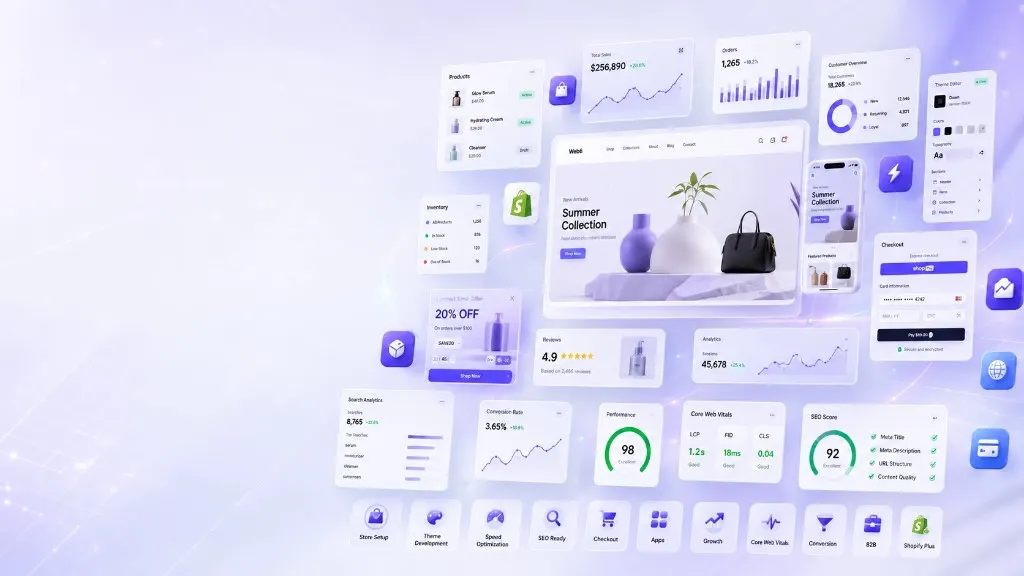
Most brands do not fail because Shopify is the wrong platform. They fail because the theme is slow, checkout is confusing, the app stack is bloated, and nobody owns Core Web Vitals after launch. Web6 closes that gap.
Rooted in Surat, we understand Indian ecommerce — COD, RTO, WhatsApp support, GST, and couriers — while building stores ready for international Markets, multi-currency, and clean SEO.
Custom Shopify development plus published app experience means we know which widgets destroy LCP and how to replace hacks with Liquid, metafields, and APIs. See also our Shopify app development, ecommerce website development, and SEO services.
Explore related work: Shopify App Development Shopify SEO and technical optimization Mobile App Development Custom CRM Development Ecommerce Website Development
Why Web6
Eight reasons brands hire us instead of a generic website vendor — with proof baked into how we work.
Senior Liquid and JavaScript engineers who ship Online Store 2.0 themes, Plus checkouts, private apps, and migrations — grounded in App Store production experience, not slide decks.
We budget LCP, INP, and CLS before coding, profile Liquid renders, and refuse “add another app” as the default. Staging uses mobile throttling so approvals match real 4G shoppers.
Crawlable structure, JSON-LD, image pipelines, and migration redirects ship with the build. Metafields keep content editable. Pair with our SEO services for ongoing organic growth.
PDP clarity, sticky ATCs, and thumb-friendly filters come first. Indian patterns — COD messaging, trust near price, WhatsApp help — are designed in, not bolted on.
We extend Dawn or craft custom themes with section schemas so marketing iterates without tickets. Fashion gets editorial layouts; B2B gets density and clarity.
Retainers cover theme updates, app conflicts, seasonal pages, and speed regressions. You work with the team that built the store — not a rotating L1 queue.
Scoped milestones, staging URLs, and honest trade-offs. If a request hurts conversion or speed, we say so before billing. Surat hours cover India and morning US/EU windows.
Metafields, metaobjects, modular sections, and clean app boundaries so you can grow into Plus, B2B, headless, or multi-market without a rewrite.
Free discovery call · Clear next steps · No hard sell
Services
From store setup and custom themes to Plus, headless, integrations, and ongoing support — expand any service for process, features, and use cases.
Getting a Shopify store live the right way is more than flipping a switch. From Vesu, Surat, Web6 configures your shop for real operations—catalog structure, tax and shipping rules, payment readiness, and launch hygiene—so you open with confidence instead of patching gaps after traffic arrives.
Why businesses need it: A rushed setup creates silent friction—wrong taxes, broken shipping, messy collections—that costs sales for months. Proper setup from a Surat Shopify team means you launch sellable, not almost ready.
Discuss Shopify store setupWeb6 builds Online Store 2.0 themes that merchants can edit without calling a developer for every change. Our Surat team writes Liquid, JSON templates, and sections that respect Shopify architecture while giving your brand layout control, performance, and maintainability designed in—not bolted on later.
Why businesses need it: Generic themes force workarounds that slow the site and confuse editors. Purpose-built theme development gives you control, speed, and a codebase your team can own after launch.
Discuss theme developmentDesign at Web6 starts from how your customers browse and buy—not from a moodboard alone. From Surat, we craft Shopify theme designs that carry brand presence into product grids, PDP storytelling, and checkout-adjacent trust, grounded in ecommerce patterns we have shipped for D2C and retail.
Why businesses need it: Template lookalikes dilute trust and conversion. Custom theme design aligns brand signal with shopper behavior so the first viewport and product page both do commercial work.
Discuss custom theme designYou do not always need a rebuild. Web6 customizes existing Shopify themes—Dawn, paid themes, or inherited codebases—so they match your brand, workflows, and growth goals. From Surat, we surgically extend sections, fix UX debt, and remove friction without throwing away what already works for your store.
Why businesses need it: Leaving a half-fit theme alone leaves money on the table. Focused customization unlocks conversion and brand fit while protecting the Shopify investment you already made.
Discuss theme customizationA redesign at Web6 is a commercial reset, not a coat of paint. We rebuild information architecture, visual system, and theme performance for stores that have outgrown their first version. Based in Surat, we redesign with SEO continuity, migration safety, and measurable conversion goals built in.
Why businesses need it: Aging storefronts train customers to bounce. A structured Shopify redesign restores trust, speed, and clarity without gambling away the SEO and ops setup that already works.
Discuss store redesignMigrating to Shopify is a data and operations project first. Web6 moves catalogs, customers, orders, redirects, and integrations from WooCommerce, Magento, custom stacks, or other platforms with a plan that protects revenue. From Surat, we migrate with rehearsal runs, SEO maps, and clear rollback thinking.
Why businesses need it: A botched migration loses rankings, order history, and customer trust overnight. Expert Shopify migration keeps commercial continuity while you gain a platform you can grow on.
Discuss Shopify migrationShopify Plus unlocks checkout extensibility, B2B, and multi-market depth—if the build matches the plan. Web6 delivers Plus development from Surat for brands that need Scripts/Functions, checkout UI extensions, and operational rigor beyond standard Shopify—built for high volume, complex catalogs, and teams running marketing and ops together.
Why businesses need it: Plus features unused or misconfigured waste license value. Purpose-built Plus development turns those capabilities into checkout lift, ops efficiency, and real market expansion for growing brands.
Discuss Shopify Plus developmentWeb6 builds Shopify apps the way product teams ship software—scopes, billing, webhooks, and merchant UX included. From Surat, with published App Store experience of our own, we deliver public and private apps on Remix, Polaris, Functions, and extensions that pass review and survive real merchant traffic.
Why businesses need it: Scripts and one-off hacks do not scale. Proper Shopify app development gives review-ready software, secure data handling, and a path to grow installs or internal usage.
Discuss Shopify app developmentWhen no App Store listing fits your operations, Web6 builds custom Shopify apps tailored to your store or multi-store fleet. We design private tools for pricing rules, wholesale portals, warehouse sync, and internal workflows—without bloated third-party subscriptions. Built in Surat for merchants who need software that matches how they work.
Why businesses need it: Forcing operations into generic apps creates workarounds and data drift. Custom Shopify apps encode your process once so staff stop fighting tools and start shipping orders.
Discuss custom Shopify appsSlow stores bleed ad spend and organic trust. Web6 audits and optimizes Shopify storefront speed—theme weight, app scripts, images, and critical rendering path—so pages feel instant on real Indian and global networks. From Surat, we prioritize measurable gains on collections, PDPs, and leaner carts.
Why businesses need it: Every extra second costs conversions. Shopify speed optimization recovers revenue you already pay to acquire by making the storefront keep up with buyer intent.
Discuss speed optimizationCore Web Vitals are how Google and shoppers experience your Shopify store in the wild. Web6 tunes LCP, INP, and CLS with theme-level fixes, media strategy, and interaction hygiene—not superficial score chasing. Our Surat engineers work from CrUX and page diagnostics so gains hold after marketing tags return.
Why businesses need it: Lab-only tweaks fade when real users and tags load. Dedicated Core Web Vitals work aligns Shopify delivery with metrics that influence rankings and perceived quality.
Discuss Core Web VitalsShopify SEO at Web6 is technical structure plus commercial intent—not keyword stuffing. We harden crawlability, templates, structured data, and page connections so product and collection pages can compete. From Surat, we pair storefront engineering with content guidance so organic growth compounds instead of resetting.
Why businesses need it: Paid traffic alone is fragile. Shopify SEO optimization builds durable demand by making your catalog discoverable, trustworthy, and aligned with how people search.
Discuss SEO optimizationTraffic without conversion is expensive noise. Web6 runs conversion rate optimization on Shopify with hypothesis-driven UX changes—PDP clarity, trust, cart friction, and offer presentation—backed by analytics. From Surat, we focus on the steps between landing and paid order, not cosmetic A/B theater.
Why businesses need it: Scaling ads on a leaky funnel wastes budget. CRO on Shopify turns existing visitors into customers by removing friction your competitors may already have fixed.
Discuss conversion optimizationPayments fail silently when gateways, currencies, and Shopify checkout settings disagree. Web6 integrates and validates payment providers for Indian and international merchants—Razorpay, Stripe, PayPal, Shop Pay, and others—so authorization, capture, and refunds behave as ops expects, with staged tests from Surat.
Why businesses need it: Checkout is where revenue either clears or disappears. Reliable payment gateway integration protects conversion and keeps reconciliation sane for your finance team.
Discuss payment integrationShipping promises that lie at checkout destroy trust. Web6 connects Shopify to carriers and logistics platforms—rate calculation, label flows, and delivery estimates—so shoppers see accurate options and ops gets clean handoffs. From Surat, we integrate India networks and international carriers without burying carts in confusing choices.
Why businesses need it: Guesswork shipping margins erode profit and CX. Proper shipping integration makes checkout promises operationally true and keeps fulfillment from becoming a manual scramble.
Discuss shipping integrationWhen Shopify and your ERP disagree, inventory, invoices, and fulfillment drift apart. Web6 integrates Shopify with ERP systems so orders, stock, customers, and financial postings stay synchronized. Working from Surat with growing brands, we design durable sync—not fragile spreadsheet exports that break every week.
Why businesses need it: Disconnected ERP and Shopify data creates stockouts, oversells, and accounting pain. Integration turns ecommerce into a reliable channel inside your existing operational spine.
Discuss ERP integrationShopify holds commerce events; your CRM holds relationships. Web6 connects the two so leads, customers, orders, and support context move without copy-paste. From Surat, we integrate major CRMs—or pair Shopify with custom CRM work via our custom CRM development practice—so teams act on fresh purchase data.
Why businesses need it: Without CRM integration, post-purchase growth guesses. Connecting Shopify—and escalating to custom CRM when needed—keeps every customer touch informed by real commerce data.
Discuss CRM integrationOversells and ghost stock kill trust faster than slow pages. Web6 designs Shopify inventory management across locations, channels, and sync partners so available-to-sell numbers stay honest. From our Surat base, we configure multi-location stock, buffers, and operational alerts for brands beyond spreadsheets.
Why businesses need it: Inventory errors become public reviews and refund spikes. Disciplined Shopify inventory management protects margin and reputation while you scale sales channels with confidence.
Discuss inventory managementSelling on Amazon, Flipkart, or other marketplaces while running Shopify needs synchronized catalog and stock discipline. From Surat, Web6 integrates marketplace channels with Shopify so listings, inventory, and order intake stay coherent—avoiding the trap where marketplace orders empty stock the DTC site still shows available.
Why businesses need it: Marketplaces amplify demand and operational risk together. Integration keeps Shopify and channel inventory honest so growth does not create cancellations and bad reviews.
Discuss marketplace integrationShopify Admin and Storefront APIs are powerful; wrapping them poorly creates fragile ops. Web6 builds custom APIs and middleware around Admin, Storefront, and webhook events so your systems talk to Shopify safely. From Surat, we ship authenticated services, rate-limit-aware clients, and clear contracts for consumers.
Why businesses need it: Direct Admin API calls scattered across tools become outages waiting to happen. Dedicated API development gives Shopify integrations a maintainable, observable backbone your team can trust.
Discuss API developmentHeadless Shopify makes sense when experience requirements outgrow Liquid themes—not as a vanity architecture. Web6 builds headless storefronts with Hydrogen, Remix, or tailored frontends on the Storefront API, keeping Shopify as commerce engine. From Surat, we scope headless only when performance, content, or multi-channel UX justify it.
Why businesses need it: Choosing headless for the wrong reasons burns budget. Done with intent, headless Shopify unlocks experience freedom without abandoning Shopify commerce reliability and ops tools.
Discuss headless ShopifyShopify stores drift—apps update, themes break, campaigns inject scripts. Web6 provides maintenance and support retainers from Surat so merchants have a known team for fixes, small enhancements, and proactive health checks. We keep production stable while your marketing calendar keeps moving through peak seasons.
Why businesses need it: Ecommerce never sits still. Maintenance and support keep your Shopify store reliable, secure, and improvable so growth work is not interrupted by preventable outages or drift.
Book a consultationFree discovery call · Clear next steps · No hard sell
Stack
Modern Shopify is more than Liquid. The stack we use to ship durable storefronts and integrations.
Maintainable theme code with OS 2.0 section schemas and performance-conscious loops so merchants edit without developer bottlenecks.
Admin and Storefront GraphQL for precise payloads in apps, tools, and headless experiences — preferred over legacy REST when efficiency matters.
Catalog, cart, and checkout handoff for custom UIs when the brand needs a storefront beyond theme constraints.
Orders, inventory, metafields, and merchant tooling with scoped access and idempotent automation for ERP/CRM teams.
Size guides, lookbooks, locators, and structured content editable in admin — rendered consistently across templates.
Platform-level discounts, delivery, and payment rules on Plus and eligible plans — without fragile theme scripts.
Supported checkout and thank-you extensions for trust modules, upsells, and fields — upgrade-friendly on Plus.
React storefronts when full front-end control is justified. Paired with Oxygen when headless is the right call.
Hosting for Hydrogen with predictable deploys, caching, and environments for previews and production.
Familiar admin UX for embedded apps — used in our App Store products and private merchant tools.
Retry-safe handlers for orders, inventory, and GDPR topics into CRMs, ERPs, and warehouses.
Platform references: Shopify Partner Program Shopify Help Center Shopify.dev documentation
Industries
UX, catalogs, and integrations adapted to how your buyers decide.
Lookbooks, size guidance, swatches, and drop calendars — with Surat textile intuition.
High-trust PDPs, purity metafields, appointments, and sharp imagery without killing LCP.
Spec tables, dense variants, warranty content, and comparison-friendly layouts.
Large-item shipping rules, metafield visualizers, and content-led consideration journeys.
Routines, bundles, subscription-ready architecture, and WhatsApp recovery paths.
Compliant messaging, clear disclaimers, and careful app selection.
Regional delivery constraints, subscriptions, and mobile checkout that survives weak 4G.
Factory-true catalogs, RFQs, and ERP-connected inventory as the source of truth.
Company accounts, price lists, and draft orders — Plus B2B or custom apps when needed.
MOQs, tiered pricing, and quotes without forcing buyers through a D2C toy cart.
Fitment data, parts finders via metaobjects, and dense catalogs that stay fast.
Editorial storytelling, concierge contact, and performance that never excuses “slow beauty.”
Process
A clear path from first call to post-launch support — so marketing, ops, and engineering stay aligned.
Goals, catalog reality, markets, and constraints — success defined as revenue levers, not vanity redesigns.
Competitive teardowns, analytics review, and technical audit of the current or source platform.
IA, app shortlist, integration map, milestones, and acceptance criteria before pixels are pushed.
Mobile-first ecommerce patterns for home, collection, PDP, cart, and key landing templates.
Theme or headless build, integrations, and staging — with early performance and a11y reviews.
Cross-device QA, checkout paths (including COD), app conflicts, and editor walkthroughs.
Meta patterns, structured data, redirects, sitemap sanity, and indexation checks pre-launch.
DNS cutover, payments/shipping verification, analytics validation, and a fast-fix window.
Hypercare then optional retainer: iteration, seasonal pages, speed watch, Plus/app roadmap.
Free discovery call · Clear next steps · No hard sell
Platform
Platform-honest guidance — when Shopify fits, here is what Web6 unlocks.
Hardened checkout and hosting so your team focuses on merchandising, not patching servers.
From first SKU to flash sales without becoming a DevOps company. Plus unlocks B2B and checkout depth.
Strong Core Web Vitals are achievable; bloated apps are usually what make stores slow.
We curate ruthlessly and build custom when the catalog of apps is the wrong hammer.
Clean URLs, fast pages, and structured data — plus migration discipline that preserves equity.
OS 2.0 themes keep products and sections editable daily without developer tickets.
Markets, multi-currency, and multi-language without bolting on a second platform.
Shopify Payments where available, plus local gateways your customers already trust.
Location-aware stock wired to apps or ERPs so the storefront reflects truth.
Prices and content presented the way each market expects — UX and SEO planned together.
Compare
Straight talk for founders choosing themes, platforms, and plans.
| Factor | Premium theme (customized) | Custom theme |
|---|---|---|
| Time to launch | Faster (weeks) | Longer (often 6–10+ weeks) |
| Design uniqueness | Limited by theme architecture | Full control of UX and components |
| Editor flexibility | Strong with OS 2.0 sections | Designed around your content model |
| Performance risk | Depends on theme quality + apps | Budgeted by your team’s standards |
| Best for | Validated brands needing speed | Differentiated brands and complex catalogs |
| Factor | Shopify | WooCommerce |
|---|---|---|
| Hosting & security | Managed by Shopify | You (or your host) own the stack |
| Maintenance load | Lower for most teams | Higher — plugins, PHP, updates |
| Checkout | Optimized, Plus-extensible | Flexible but easy to break |
| Apps vs plugins | Curated app ecosystem | Huge plugin ecosystem, uneven quality |
| Best for | Teams focused on growth, not servers | Teams already deep in WordPress |
| Factor | Shopify | Magento / Adobe Commerce |
|---|---|---|
| Total cost of ownership | Predictable SaaS + apps | Often higher with agency + hosting |
| Time to iterate | Fast theme and app changes | Heavier release cycles |
| Complexity fit | Excellent for most D2C/B2B | Enterprise complexity by default |
| Talent availability | Strong Shopify ecosystem | Specialized Magento talent |
| Best for | Brands that want leverage | Orgs already standardized on Adobe |
| Factor | Shopify (Basic/Grow/Advanced) | Shopify Plus |
|---|---|---|
| Checkout customization | Limited | Checkout Extensibility + Functions |
| B2B | Workarounds / apps | Native B2B features |
| Automation | Standard workflows | Shopify Flow at scale + APIs |
| Support & limits | Standard plans | Higher limits, merchant success |
| Best for | Growing D2C and SMEs | High volume, multi-store, complex ops |
Portfolio
Portfolio quality is a process, not a gallery of screenshots.
Every engagement starts with constraints: catalog, markets, app debt, and the revenue lever that matters — conversion, speed, AOV, or ops time. We prototype risky UX early and refuse to launch with known checkout defects.
Design and engineering share one loop: section schemas, metafields, and analytics specified together. See selected work on the homepage and deeper narratives in case studies.
Need native mobile or wholesale CRM? We connect to mobile app development and custom CRM development instead of pretending another app fixes process debt.
Services
Supporting capabilities that extend a Shopify Development engagement — apps, storefronts, B2B, and SEO.
Public and private Shopify apps — Polaris admin UX, webhooks, Functions, and Checkout Extensibility.
Shopify app development expertiseConversion-focused storefronts with clear PDPs, cart flows, and measurement for Indian ecommerce.
ecommerce development servicesAccount-based catalogs, wholesale pricing, draft orders, and sales-rep workflows on Shopify.
B2B ecommerce solutionsTechnical Shopify SEO, collection architecture, and local visibility for Surat brands.
technical SEO servicesCase studies
Verified outcomes from confidential Shopify engagements — migration, speed, apps, Plus, and international Markets.
Confidential Fashion Brand · Fashion / Apparel · 2025
Magento 2 replatform to Shopify Online Store 2.0 with catalog mapping, SEO-safe redirects, and a performance-focused theme rebuild — delivered in 14 weeks from Surat.
Leading D2C Brand · Beauty & Lifestyle · 2025
Six-week Shopify speed optimization: theme refactor, app audit, Cloudflare, and Core Web Vitals work that moved mobile LCP from ~4s+ toward ~2s on key templates.
Growing Lifestyle Brand · Lifestyle / Home goods · 2025
Private embedded app for account-based wholesale pricing, rep-driven draft orders, and fewer pricing mistakes across B2B buyers.
Premium Beauty Brand · Beauty · 2025
Shopify Plus rebuild with checkout extensibility, Functions-based promotions, and metaobject-driven merchandising — shipped on an 18-week timeline.
International Home Decor Company · Home & Living · 2025
Shopify Markets rollout across EU, US, India, and GCC with localized UX, multi-currency checkout, translation workflow, and hreflang SEO.
Insights
Guides for brands evaluating Shopify partners, apps, SEO, and COD risk in India.
Checklist for hiring Shopify experts in Surat.
Shopify development guideWhat merchants should expect from modern Shopify app teams.
Shopify app development guideRisk scoring and confirmations to cut COD return-to-origin losses.
COD RTO reduction playbookTechnical and local SEO tactics for Surat ecommerce brands.
ecommerce SEO playbookShopify apps
Published products and the app development practice behind them.
Browse published App Store products from the Web6 Shopify team.
explore our Shopify appsAdd a WhatsApp chat button to your Shopify store for instant customer messages
EzychatAdvanced COD rules, fees, and pincode restrictions for Shopify checkout
COD Risk GuardRecover abandoned carts with manual WhatsApp conversations and pre-filled order follow-ups
EZ WhatsApp RecoverTrack live Shopify carts, add-to-cart activity, and shopper journeys in real time
CartPulseTestimonials
“Web6 rebuilt our Shopify storefront with a conversion mindset. Mobile speed and checkout clarity changed our numbers within the first month — and they did not flood us with useless apps.”
“We migrated off a fragile Woo stack. Redirects, metafields, and a clean OS 2.0 theme meant organic traffic recovered faster than our last agency predicted.”
“Their developers speak Liquid and business. We got Plus checkout extensions that match how our wholesale reps actually sell — not a D2C theme with a price list hacked on.”
“Transparent milestones, honest pushback, and apps they actually maintain. Hiring Shopify developers through Web6 felt like adding a product squad, not a vendor.”
FAQ
Pricing, timelines, migrations, Plus, headless, SEO, and hiring Shopify developers — answered plainly.
Scope drives price. Focused theme customization and launch setup typically lands ₹1.5–4 lakh. Custom Liquid themes with design, apps, and integrations usually run ₹4–12 lakh. Plus, headless, or ERP-connected builds cost more for checkout and systems work.
Premium theme setups with light customization ship in 3–5 weeks. Custom Liquid themes with unique UX, apps, and payment or logistics wiring take 6–10 weeks. Migrations and Plus projects often need 8–14 weeks for catalog cleanup, redirects, and ERP testing.
Yes. We migrate products, collections, customers, and orders with mapped metafields, plus redirect maps to protect SEO. Themes are rebuilt in Liquid, not pasted HTML. Indian brands also get GST invoices, COD flows, and courier apps rewired in the same window. Typical migrations take 4–10 weeks.
Both. Many brands start on Dawn or another OS 2.0 theme; we extend sections, metafields, and cart UX. When lookbooks, B2B catalogs, or content-heavy PDPs need a unique layout system, we build custom Liquid from scratch. Merchants keep editing sections without tickets for every copy change.
We publish App Store apps — Ezychat: Whatsapp Chat Button, Ezy All in One Chat Widgets, CartPulse, COD Risk Guard, and EZ WhatsApp Abandoned Order — so advice comes from shipping production software. We audit your stack and cut duplicates that hurt page weight.
SEO ships with the build. Templates get clean heading hierarchy, crawlable collection filters where useful, and JSON-LD for products and FAQs. Image pipelines, lazy loading, and Core Web Vitals feed organic as much as meta titles. Migrations include redirect maps and preserved handles.
Performance is a build constraint. We profile Liquid renders, limit blocking scripts, and prefer theme-native features over redundant app widgets. Our apps, like Ezychat, stay lightweight so chat CTAs do not trash LCP. We measure LCP, INP, and CLS on staging with mobile 4G throttling.
Yes. Web6 builds and optimizes Plus stores for checkout extensibility, Shopify Functions, B2B catalogs, and multi-market setups. Work often includes Functions for discounts, checkout UI extensions, and tighter ERP sync than standard plans allow.
Retainers cover bug fixes, small features, theme updates, and app upgrades monthly. Priority support handles checkout blockers and outages with clear response windows. Surat and remote clients triage via WhatsApp, then move tracked work into a shared backlog.
Shopify hosts the platform; custom code and apps still create risk. We avoid secrets in theme files, use least-privilege Staff accounts, and review app permissions before install. Private apps use proper OAuth scopes and webhook verification.
Yes. Retainers cover theme compatibility after Shopify updates, app version bumps, section tweaks, and light CRO. We watch Core Web Vitals and broken scripts after marketing tag dumps.
We configure Shopify Payments where available, plus Razorpay, PayU, and other India-ready gateways. COD gets risk rules so RTO does not erase margin — COD Risk Guard helps score and hold suspicious orders. Multi-currency stores align Markets, price lists, and settlement currencies for clean finance reconciliation.
We connect Indian courier and aggregator apps — Shiprocket, Delhivery, and similar — with rates, zones, and delivery estimates that match real fulfillment. Local pickup, partial shipping, and split fulfillments work when inventory spans warehouses. Plus brands can tighten carrier rules with Functions or custom logic.
Yes. We map products, inventory, orders, and fulfillments to SAP Business One, Tally-connected middleware, Microsoft Dynamics, or custom ERPs via APIs and queues. Design choices matter: near-real-time stock for bestsellers, batched sync for heavy catalogs, and alerts when webhooks fail overnight.
We connect Shopify to HubSpot, Salesforce, Zoho, and WhatsApp-centric stacks common in Indian ecommerce. Customer, order, and abandoned-checkout events feed sales and support without spreadsheet copying. EZ WhatsApp Abandoned Order and Ezy chat widgets complement CRM workflows rather than replace them.
When brands need content-heavy UX, app-like mobile experiences, or multi-channel composition beyond Liquid, we build headless with Hydrogen, Remix, or Next.js on the Storefront API. Headless adds hosting, caching, and release complexity — we recommend it only when OS 2.0 cannot deliver.
We set up Shopify Markets for languages, currencies, domains, and duty messaging so cross-border buyers see a coherent storefront. Content models support translated PDPs without duplicating the full catalog. Payment and shipping rules are set per market, not one global rate card. India-expanding brands plan catalog, FX, and returns before ad spend. Primary market first, then regions — Plus when checkout or B2B gets complex.
Yes. On Plus we implement B2B catalogs, company accounts, quantity breaks, and payment terms for how distributors buy. Theme UX shows net pricing and logged-in catalogs without exposing wholesale to retail. Custom apps or Functions cover edge rules native B2B cannot.
Custom work covers what the theme editor and public apps cannot do cleanly: tailored Liquid sections, checkout extensions, Shopify Functions, private apps, ERP or WMS middleware, and unique PDP or cart flows. We prototype against real merchant workflows, then ship reviewable PRs on staging. Published App Store products mean the same bar for performance, webhooks, and admin UX.
Design and engineering sit in one Surat studio, so mockups respect Shopify constraints — cart drawers, variant UX, mobile thumbs — instead of comps that break in Liquid. We start from brand inputs, competitor audits, and category conversion patterns.
We baseline mobile and desktop Core Web Vitals, app waterfalls, and theme render cost. Fixes remove unused apps, defer non-critical scripts, correctly size media, and simplify Liquid loops that hammer collections. Sometimes the win is architectural — fewer metafield lookups, better section caching — not another CDN toggle. Re-tests after each change show what moved LCP or INP.
Yes. Public App Store and private merchant apps are a core service. We ship Remix or modern embedded stacks, Polaris admin UX, billing APIs, GDPR webhooks, and review-ready listings. Published apps — CartPulse, COD Risk Guard, Ezychat — mean we know review expectations and onboarding friction. Private apps target your ERP, pricing, or ops tooling without listing overhead. Timelines usually run 6–16 weeks.
Setup covers foundations: theme install or custom build, navigation, collections, product templates, checkout, taxes, payments, shipping, and essential apps. Analytics, pixels, and consent connect where required, then end-to-end test orders. Staff training covers sections, metafields, and fulfillment so day-two ops is not tribal.
Beyond color swaps, we rebuild section schemas, cart and upsell UX, mega menus, PDP storytelling blocks, and metafield-driven content so non-developers edit safely. OS 2.0 patterns stay upgrade-friendly instead of forking Dawn into an unmaintainable mess. We document safe-to-touch files versus performance-critical ones.
You get a studio with published App Store products, Plus experience, and process that survives turnover — not a freelancer who vanishes mid-migration. Indian business hours, English, and local context for COD, GST, and couriers.
Web6 is a Surat Shopify development and app studio that ships client stores and App Store products used by thousands of merchants. Dual practice keeps advice practical: what breaks Core Web Vitals, when Plus matters, and when Liquid beats headless. We know Indian ecommerce — COD risk, WhatsApp recovery, local logistics — plus Markets and B2B. See https://web6.in, review our apps, then book a consult.
Plus and integration work quotes in phases: discovery and architecture, build, UAT, and hypercare. Budgets commonly start in the higher mid-six-figure INR range and scale with checkout extensions, ERP connectors, and multi-market rollouts.
Discovery is a short paid or credited engagement mapping goals, catalog complexity, apps to keep or kill, and systems that must sync. We review analytics, theme debt, and competitor UX, then deliver milestones with timeline ranges and open risks — especially ERP data quality or migration redirects. Plus and headless candidates decide whether native OS 2.0 wins without extra stack. You leave with written scope.
Optional tools, not a forced bundle. WhatsApp-first support can use Ezychat: Whatsapp Chat Button or Ezy All in One Chat Widgets. CartPulse aids high-intent cart visibility; EZ WhatsApp Abandoned Order covers recovery where email underperforms in India; COD Risk Guard reduces RTO.
You own product truth: catalog accuracy, brand assets, legal pages, and UAT sign-off. We own engineering, theme architecture, and integrations. Expect weekly check-ins, staging previews, and a shared task board. Content and photography usually gate launch more than code.
Tell us what you are building, migrating, optimizing, or automating. Web6 will help you plan the right Shopify approach.
If you are evaluating a Shopify development company in India — or specifically Shopify experts in Surat — bring us the catalog, the constraints, and the number you care about most. We will tell you what a theme can do, what Plus unlocks, and what you should not waste budget on.
Book a free consultation with our Surat-based team. Clear advice on websites, Shopify, custom software, SEO, and growth — no theater.