
SaaS
SaaS Development Cost in India: MVP, Architecture, Features & Ongoing Costs
Written by Web6 Editorial Team · Published 4 September 2026 · 20 min read
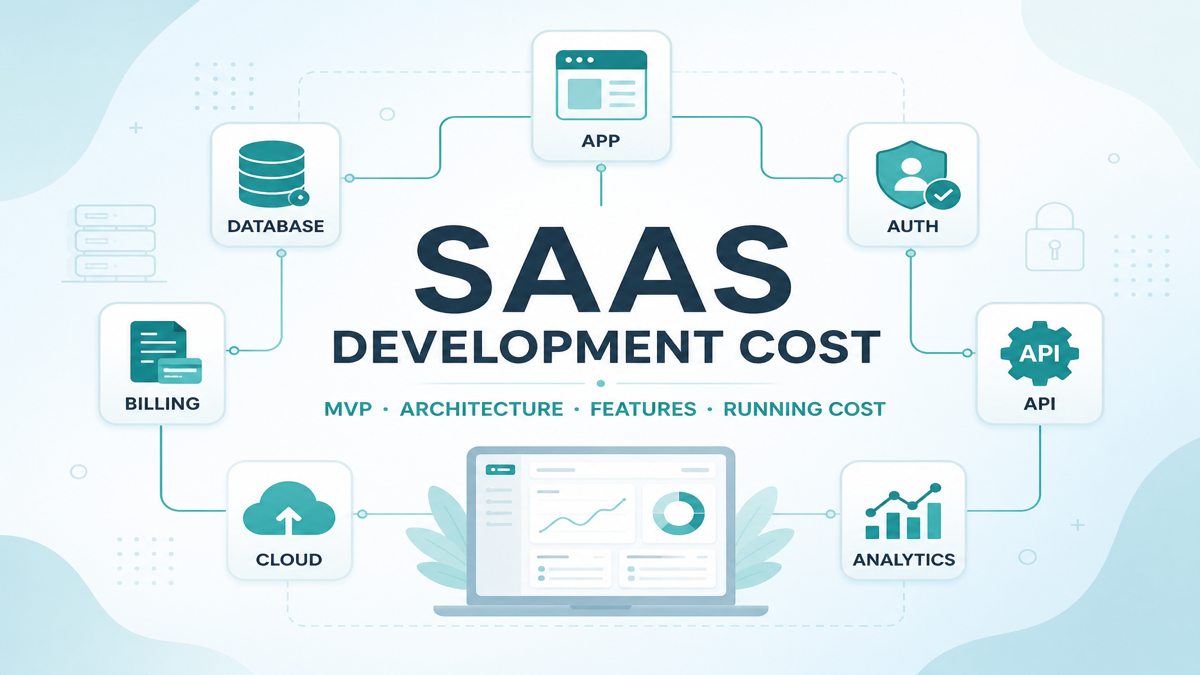
Founders asking “how much does SaaS development cost in India?” often receive a single number that hides the real product. A login form is not SaaS. A brochure website with a dashboard screenshot is not SaaS. SaaS cost is the price of discovering a paid workflow, engineering it as a multi-user product, operating it safely, and keeping it alive after launch.
This guide explains what actually determines SaaS development cost in India — MVP scope, architecture, multi-tenancy, billing, integrations, infrastructure, security, testing and ongoing development. It is a budgeting framework for commercial investigation, not a Web6 price list. Web6 does not publish fixed SaaS package rates here; accurate quotes still need discovery. For delivery of product builds, see SaaS development.
How much does SaaS development cost in India?
There is no honest single “India average SaaS price.” Public agency blogs publish wide, conflicting ranges for MVP and full platforms, so treating any one figure as market truth is unreliable. Budget with complexity bands instead:
- Lean MVP — one core workflow, auth, basic admin, limited roles; billing only if needed to validate monetization.
- Billing-ready multi-tenant MVP — tenant model, plans/subscriptions, permissions, operational basics.
- Mature SaaS — expanded roles, integrations, automation, analytics, stronger admin and scale paths.
- Enterprise / regulated — SSO, advanced isolation, compliance-oriented controls, multi-region or heavy data volume.
Compare vendors on equal written scopes. A lower quote that omits multi-tenancy, QA, migration of assumptions, or post-launch ownership is not cheaper — it is incomplete.
The SaaS cost model
SAAS COST
=
PRODUCT DISCOVERY
+ UX
+ FRONTEND
+ BACKEND
+ DATABASE
+ AUTH
+ MULTI-TENANCY
+ BILLING
+ INTEGRATIONS
+ INFRASTRUCTURE
+ SECURITY
+ TESTING
+ ONGOING DEVELOPMENT
Build cost and running cost are different ledgers. Confusing them produces launch surprises when hosting, email, storage, monitoring and API usage appear after go-live.
What is SaaS — and what is not
Differentiate three layers that are often mixed in quotes:
- Marketing website — pages, forms, SEO, content. Explains the product; does not run the product. See custom website development when the site and product are separate workstreams.
- Web application — authenticated software for a known set of users (often one company). Valuable, but not automatically multi-tenant SaaS.
- SaaS product — software delivered as a service to multiple customers (tenants), usually with subscription or usage economics, shared operations, and productized onboarding.
A login screen does not make software SaaS. SaaS implies product boundaries: who the customer is, how their data is isolated, how access is sold, how updates ship without breaking every account, and how support operates at scale.
What should a SaaS MVP include?
An MVP exists to prove one paid (or clearly monetizable) workflow with real users — not to preview the five-year roadmap.
- Core user problem — the job customers will repeatedly pay to complete.
- Authentication — sign-up, login, password reset or SSO later if enterprise requires it.
- Main workflow — the end-to-end path that delivers value.
- Basic admin — enough visibility to support users and fix data issues.
- Billing only if needed — charge when monetization is part of the learning goal; delay complex pricing until the workflow sticks.
- Analytics basics — activation, retention and funnel events that inform the next build.
- Support basics — contact path, status clarity, and enough logs to diagnose failures.
Avoid building every future feature into V1. Premature role matrices, marketplace mechanics and AI wrappers inflate cost without proving demand.
MVP vs mature SaaS
MVP should be appropriately engineered — not disposable spaghetti. “Lean” means fewer product surfaces, not careless security or unmaintainable data models.
| Area | MVP | Mature SaaS |
|---|---|---|
| Core workflow | ✓ | ✓ |
| Advanced roles | Basic | Advanced |
| Billing | Basic | Advanced |
| Analytics | Basic | Advanced |
| Integrations | Limited | Expanded |
| Automation | Limited | Advanced |
| Admin | Basic | Advanced |
| Scale architecture | Appropriate | Expanded |
What affects SaaS development cost
- Product complexity — number of workflows, edge cases and domain rules.
- Number of user roles — each role multiplies screens, permissions and test cases.
- UI/UX — clarity for onboarding and retention; design systems reduce later rewrite cost.
- Frontend — web app surfaces, state complexity, accessibility and performance.
- Backend — domain services, APIs, jobs, background processing.
- Database — schema design, migrations, reporting queries, growth assumptions.
- Authentication — email/password, social login, MFA, SSO/SAML for enterprises.
- Multi-tenancy — isolation model, tenant provisioning, admin boundaries.
- Billing / subscriptions — plans, trials, proration, invoices, failed payments.
- Permissions — RBAC, resource-level rules, auditability.
- Integrations — CRM, ERP, email, calendar, storage, industry APIs.
- Notifications — email, SMS, push, in-app; delivery reliability and templates.
- Analytics — product events, billing metrics, admin reporting.
- Admin dashboard — support tools, impersonation policies, configuration.
- Mobile app — responsive web vs PWA vs native/cross-platform. See mobile app development.
- Infrastructure — environments, CI/CD, observability, backups.
- Security — secrets, isolation, dependency hygiene, incident readiness.
- QA — automated tests, UAT, regression around billing and tenancy.
- DevOps — deploys, scaling policies, cost controls.
- Maintenance — roadmap velocity after launch; often under-budgeted.
Architecture that drives cost
CLIENT
  ↓
APP
  ↓
API
  ↓
DATABASE

with supporting systems:
AUTH · BILLING · EMAIL · STORAGE · ANALYTICS · THIRD-PARTY APIs
Architecture depends on scale and use case. Early products often ship as a modular monolith with clear boundaries (identity, billing, core domain, integrations). Premature microservices raise ops cost before product-market fit. Vertical products that resemble CRM or operations software may share patterns with custom CRM development or ERP development — but SaaS still adds tenancy, packaging and subscription economics.
Multi-tenancy — concepts without one universal design
A tenant is typically a customer organization (or account) whose users, data and configuration must stay correctly scoped. Common approaches include shared database with tenant keys, schema-per-tenant, or database-per-tenant. Each trades cost, isolation strength, migration complexity and operational overhead differently.
There is no universal “correct” tenancy architecture. Choose based on data sensitivity, customization needs, compliance expectations, expected tenant count and team ability to operate the model. Under-engineering isolation creates security risk; over-engineering isolation creates cost and release friction before you have customers.
Billing and subscriptions
Billing is a product surface: plans, seats, usage meters, trials, invoices, taxes where applicable, upgrades/downgrades and failed-payment recovery. Payment providers differ in India and globally.
As of current provider documentation:
- Razorpay Subscriptions supports plans and recurring subscriptions (including trial/start-date patterns and quantity on plans). Fixed recurring models are a common India MVP path; complex usage-based pricing often needs additional application logic or a billing layer.
- Stripe Billing is widely used for subscription products and offers broader native tooling for advanced subscription models (including metered/usage-oriented billing patterns). Fit depends on customer geography, payment methods and pricing complexity.
Do not treat gateway fees as development cost — they are running economics. Confirm current capabilities and commercial terms on the provider’s docs before locking architecture; capabilities change over time.
When SaaS needs mobile
- Web-only — desk-heavy B2B workflows where browsers suffice.
- Responsive web — most SaaS should work on phones even if mobile is secondary.
- PWA — useful when installability and offline-light behaviour matter without native stores.
- Native / React Native / Flutter — field workflows, offline sync, camera/barcode intensity, push-first engagement, or store distribution requirements.
Mobile is a major cost multiplier when it duplicates complex workflows. Decide from role needs, not from “apps are expected.” Pair with mobile app development when native or cross-platform is justified.
AI features and variable cost
LLM APIs, document processing, recommendations and automation can accelerate product value — and introduce usage-based spend that scales with customers. Cost drivers include prompt/evaluation engineering, guardrails, caching, rate limits, human review paths and observability for model failures.
AI does not guarantee retention, accuracy or category leadership. Treat model calls as infrastructure with budgets and product boundaries: which jobs are automated, which need human confirmation, and how failures surface to users.
Build cost vs running cost
Build cost covers discovery, design, engineering, QA and launch readiness.
Running cost typically includes:
- Hosting / compute
- Database
- Object storage
- Email / SMS delivery
- CDN
- Monitoring and logging
- Third-party APIs
- AI API usage (if any)
- Payment processing fees
Provider bills vary by traffic, storage, region and discount plans. Do not budget from invented monthly cloud numbers — estimate from expected users, data volume and feature load, then refine after staging metrics.
India market research — why ranges conflict
India SaaS quotes vary with seniority mix, agency vs freelancer, fixed-price buffers, and whether “MVP” includes multi-tenancy, billing, QA and ownership documentation. Online articles in 2025–2026 advertise overlapping but inconsistent bands for SaaS MVP and full platforms. Because those published figures disagree and often reflect marketing packages rather than audited market surveys, this guide does not invent an “India average SaaS development cost.”
Use complexity bands and written scope. Ask what is excluded: design, DevOps, UAT support, post-launch retainer, third-party licenses, GST and infrastructure. Two proposals can look comparable until exclusions differ.
Illustrative MVP phasing
- Phase 1 — Core MVP: problem, auth, main workflow, basic admin.
- Phase 2 — Retention / analytics: activation metrics, feedback loops, reliability.
- Phase 3 — Integrations: CRM, email, storage or industry systems customers demand.
- Phase 4 — Automation: workflows that reduce manual ops inside the product.
- Phase 5 — Enterprise features: SSO, advanced roles, audit exports, procurement-ready admin.
Phasing is illustrative. Some B2B products need billing or SSO earlier because buyers will not trial without them. Sequence to learning and revenue, not to a generic checklist.
Customer types change cost shape
- B2B SaaS — roles, permissions, onboarding, often sales-assisted expansion.
- B2C SaaS — higher volume UX polish, growth loops, support scale.
- Vertical SaaS — deep domain logic; fewer features but harder correctness.
- Marketplace-like SaaS — two-sided liquidity, payouts, trust and dispute complexity.
- Internal-to-commercial transition — turning an internal tool into a productized SaaS (tenancy, packaging, support model).
Common expensive features
- Real-time collaboration
- Video / media pipelines
- Complex permission graphs
- High-volume data ingest and search
- AI processing at scale
- Multi-region deployment
- Advanced analytics warehouses
- Marketplace mechanics
- Complex billing (usage + seats + add-ons + tax)
- Offline sync for mobile field work
Each can be justified. None should enter an MVP by default.
Security and operational controls
Budget for authentication hardening, permission checks, secrets management, tenant data isolation, logging, backups, dependency updates and environment separation. These reduce risk; they are not legal or compliance guarantees. Regulated industries may need additional architecture and process work — scope those explicitly rather than assuming a generic SaaS build covers them.
Build vs no-code / low-code
No-code and low-code tools can be valid for prototypes, internal tools and simple workflow products — especially when speed to learning matters more than long-term uniqueness. Custom development becomes more relevant when architecture, scale, integrations, performance, packaging or intellectual property requirements exceed what the platform can sustain without brittle workarounds.
Do not dismiss no-code. Also do not pretend every no-code stack is production SaaS for multi-tenant commercial growth. Choose based on constraints, exit path and who will maintain the system.
Agency vs freelancer vs in-house
| Model | Strengths | Trade-offs |
|---|---|---|
| Agency / product studio | Cross-discipline delivery, process, replacement coverage | Higher coordination overhead; quality varies by team |
| Freelancer / small pod | Speed and cost flexibility for narrow scopes | Bus factor; weaker coverage across design, QA, DevOps |
| In-house team | Deep product context and long-term ownership | Hiring time, management load, fixed burn |
No model is always cheaper or always better. Match the delivery model to risk, timeline and how central the product is to the business.
Choosing a tech stack without dogma
Do not start from “React is best” or “Node is best.” Stack follows team skill, requirements, performance needs, ecosystem maturity, operational familiarity and maintainability. Prefer boring, well-supported choices your team can operate. Rewrites driven by fashion are a cost category of their own.
Total cost of ownership (TCO)
TOTAL COST
=
INITIAL PRODUCT DEVELOPMENT
+ INFRASTRUCTURE
+ THIRD-PARTY SERVICES
+ SUPPORT
+ FEATURE DEVELOPMENT
+ SECURITY / MAINTENANCE
+ CUSTOMER-SUCCESS / OPERATIONS (where relevant)
A cheaper build that cannot be operated, secured or extended becomes expensive within a year. Plan 12–24 month TCO, not only the first invoice.
Questions to answer before a quote
- What is the core workflow?
- How many roles?
- Multi-tenant — and which isolation model?
- Billing model — seats, plans, usage, trials?
- Mobile — web, PWA or native?
- Which integrations are day-one vs later?
- Any AI features — and expected usage volume?
- Admin and support tooling needs?
- Expected data volume and real-time requirements?
- Compliance or industry constraints?
- Expected scale in year one?
- MVP validation or full product launch?
How long does SaaS development take?
There is no universal timeline. Duration follows discovery clarity, workflow complexity, tenancy/billing scope, integrations, mobile surface, QA depth and stakeholder availability for UAT. Lean MVPs can ship in weeks when scope is ruthless; mature platforms take multiple phases. Demand milestone plans tied to written requirements rather than calendar slogans.
Cost mistakes that inflate SaaS budgets
- Building a platform before proving one workflow
- Skipping tenancy until “later” then rewriting
- Complex billing before paying customers exist
- Mobile apps that mirror unfinished web product
- No analytics — flying blind on retention
- Underfunding security, backups and monitoring
- Comparing quotes without identical exclusions
- Zero budget for post-launch iteration
How to budget responsibly
- Write the core workflow and roles in one page.
- Separate marketing site, app and SaaS product needs.
- Choose a complexity band (lean / billing-ready / mature / enterprise).
- List day-one integrations and expensive features explicitly.
- Budget running costs separately from build.
- Request two or three proposals against the same written scope.
- Plan phase 2 funding before launch day celebration.
Web6 scopes SaaS application development after architecture discovery. Pair with custom website development for go-to-market sites, mobile app development when field or store apps are required, and custom CRM development when the product is CRM-shaped rather than a general SaaS shell.
Product discovery is part of the bill
Discovery is often underpriced because it looks like meetings. In practice it prevents the most expensive failure mode in SaaS: building the wrong workflow with the right stack. A useful discovery pass clarifies the buyer, the end user, the paid job-to-be-done, success metrics, must-have integrations and non-goals for V1.
Expect discovery outputs to include workflow diagrams, role definitions, data entities, tenancy assumptions, billing hypotheses and a phased backlog. Teams that skip this and jump straight to screens usually pay twice — once for the first build and again for the rewrite when paying customers reject the product model.
Discovery also surfaces whether you need SaaS at all. Some “SaaS ideas” are better as a configured CRM, an internal tool, a marketplace plugin or a marketing site plus human service. Honest discovery includes that fork.
Roles and permissions as a cost multiplier
Every additional role is not just another label in a dropdown. It creates screens, empty states, permission checks, audit expectations and QA paths. A founder-admin plus end-user model is far cheaper than org admin, team lead, contributor, read-only auditor and external collaborator — especially when permissions apply to resources (projects, files, records) rather than only navigation menus.
For B2B SaaS, buyers often demand role flexibility before they have proved usage. Resist implementing every enterprise permission pattern on day one unless procurement blocks the sale. Document the permission model you will support in V1 and the ones you defer.
UX, onboarding and activation cost
SaaS revenue depends on activation more than on feature count. Onboarding flows, empty-state guidance, sample data, invite flows and time-to-first-value are product work with real engineering and design cost. Skipping UX to “save money” often increases support load and churn, which are also costs — just not on the development invoice.
Design systems, component libraries and consistent patterns reduce later feature cost. Early visual polish without a coherent interaction model is not the same investment. Prioritize clarity of the core workflow over decorative dashboards.
Database and data model decisions
Database cost is not only hosting. It is schema design, migration discipline, indexing for common queries, soft-delete strategies, audit tables and reporting without locking production. Multi-tenant shared databases need careful tenant scoping on every query. Poor early models force expensive migrations once you have customers and historical data.
Plan for exports and backups early. Customers eventually ask for data portability; support teams need safe ways to investigate without production risk. These capabilities are cheaper when designed in than when bolted on after an incident.
Notifications, email and operational glue
Transactional email, invites, billing receipts, failed-payment notices and security alerts are part of the product. Deliverability, templates, localization and retry logic take time. SMS and push add provider setup and cost controls. Treat notification design as a workflow: who gets notified, when, through which channel, and what happens if delivery fails.
Background jobs — report generation, sync workers, webhook processors — also belong in the cost model. They need queues, monitoring and failure recovery. Ignoring them produces “it works on staging” launches that break under real customer events.
Integration depth and ownership
Integrations are rarely “just an API call.” They require authentication, field mapping, rate limits, idempotency, error queues, replay tools and a clear owner when the third party changes behaviour. Decide which system is source of truth for each entity — customer, invoice, inventory, ticket — before wiring sync.
CRM and ERP integrations are common for B2B SaaS that sits beside sales or operations systems. If your product is itself CRM-shaped, evaluate whether you are building SaaS CRM packaging or a single-tenant custom CRM first; see custom CRM development and Zoho CRM vs custom CRM for that decision path. Operational inventory products may overlap with patterns in the custom ERP development guide.
Testing, UAT and release discipline
SaaS QA must cover tenancy isolation, billing edge cases, permission boundaries and upgrade paths — not only happy-path screenshots. Automated tests around auth, billing webhooks and critical workflows reduce regression cost as the product grows. UAT with real roles catches process mismatches engineering cannot invent alone.
Release discipline — staging environments, migration checks, feature flags, rollback plans — is part of development cost and later maintenance. Teams that ship only to production save a week and spend months recovering trust.
How to compare SaaS development quotes in India
Ask every vendor to respond to the same brief. Then score proposals on scope completeness, not only headline price:
- Is multi-tenancy included, and which model?
- Is billing included, and which provider assumptions?
- Who owns source code, cloud accounts and domain DNS?
- What environments are included (dev/staging/prod)?
- What QA and UAT support is in scope?
- What is explicitly excluded (mobile, SSO, AI, integrations)?
- What post-launch support window exists?
- How are change requests priced?
A higher quote with clearer architecture and ownership can be lower TCO than a bargain that forces a rebuild when the first ten customers arrive. Web6 is a SaaS development company in India (Surat-based) that scopes after discovery — this article does not replace a project proposal.
Ongoing development after launch
Launch is the start of product cost, not the end. Roadmap work includes bug fixes, security patches, dependency updates, performance tuning, customer-requested integrations and packaging improvements for enterprise sales. Many teams under-budget this line and then stall growth because engineering capacity is consumed by firefighting.
Plan a continuous improvement cadence: triage, small weekly releases, and periodic larger initiatives. Customer success and support tooling also consume product time — macros, admin fixes, audit logs and status communication are product surfaces even when they are not marketed as features.
Building SaaS with India teams — practical notes
India remains a common location for SaaS engineering because of talent depth and commercial rates relative to US/EU agencies. Quality variance is also wide. Senior product engineers who have shipped multi-tenant billing systems cost more than generic CRUD developers — and usually reduce rewrite risk.
Timezone overlap, English product writing, payment-provider familiarity (including India-first checkout patterns) and ownership documentation matter as much as hourly rate. Remote founders should insist on written architecture decisions, accessible repositories and cloud accounts in the customer’s name from day one.
Related services and guides
Frequently asked questions
How much does SaaS development cost in India?
Cost follows complexity — lean MVP, billing-ready multi-tenant MVP, mature platform or enterprise/regulated scope. Public “average” figures conflict; compare equal written scopes instead of chasing a single India number.
How much does a SaaS MVP cost?
MVP cost depends on workflow depth, roles, tenancy, billing needs, design quality and QA. A lean single-workflow MVP and a billing-ready multi-tenant MVP are different products. Avoid quotes that cannot list exclusions.
How long does SaaS development take?
Timelines are scope-based. Clear requirements and ruthless MVP cuts shorten delivery; integrations, mobile and enterprise controls extend it. Ask for milestones tied to features, not only calendar weeks.
What affects SaaS development cost the most?
Product complexity, roles/permissions, multi-tenancy, billing, integrations, mobile, security/QA and ongoing development after launch.
What is multi-tenant SaaS?
Software serving multiple customer organizations with scoped data and configuration. Isolation can be shared-database, schema-per-tenant or database-per-tenant — chosen by risk, scale and ops capability.
Does SaaS need a mobile app?
Not always. Many products succeed as responsive web or PWA. Native or cross-platform apps matter for field workflows, offline sync, device features or store distribution.
How much does SaaS hosting cost?
Hosting is usage-dependent — compute, database, storage, CDN, email and APIs. There is no fixed monthly number that fits all products. Estimate from traffic and data, then refine with staging metrics.
Should I use no-code for SaaS?
No-code can validate ideas and power simple workflows. Custom builds fit unique architecture, scale, integrations or product requirements better. Decide from constraints and exit path.
Which tech stack is best for SaaS?
No stack is universally best. Choose for team skill, requirements, ecosystem, operations and maintainability — not trend lists.
How much does AI add to SaaS cost?
AI adds build work (integration, evaluation, guardrails) and variable running cost (model API usage). Budget both; do not assume AI alone creates a durable product.
How do SaaS subscriptions work?
Customers subscribe to plans (and sometimes seats or usage). Providers like Razorpay Subscriptions and Stripe Billing handle recurring charges for many models; complex usage pricing may need extra application or billing-platform logic. Confirm current provider capabilities before architecture lock-in.
Agency vs in-house for SaaS — which is better?
Neither always wins. Agencies can ship cross-discipline faster; in-house teams hold long-term context. Freelancers suit narrow scopes. Match model to risk and ownership needs.