
SEO
Local SEO for Surat Businesses: Complete 2026 Checklist
Written by Web6 Editorial Team · Published 16 August 2026 · 26 min read
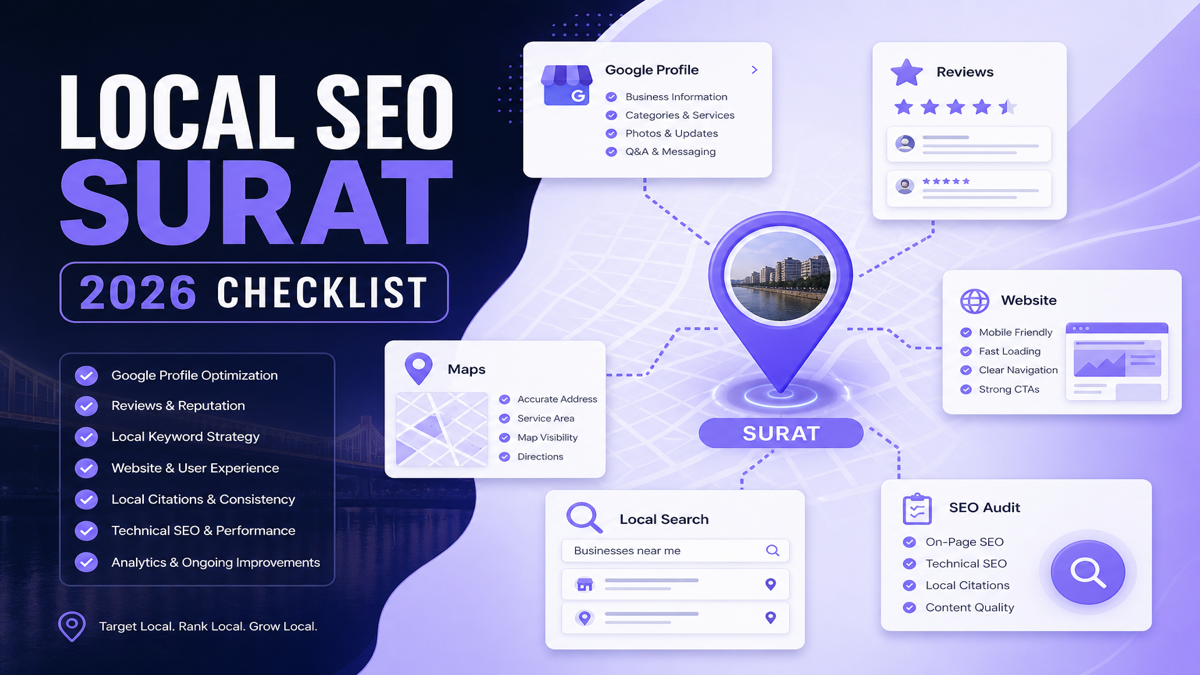
When someone searches for a nearby service, store or company, Google may show local businesses through Maps, the local results and traditional organic listings. For a Surat business, local SEO is the process of making your business information, website and online presence clear enough for search engines and potential customers to understand what you offer, where you operate and why your business is relevant to the search.
This checklist covers both Google Business Profile work and website SEO — without ranking guarantees and without recommending spammy location pages.
What is local SEO for a Surat business?
Local SEO helps a business improve its visibility for searches connected to a geographic area, such as “website developer in Surat,” “dentist near me,” or “restaurant in Vesu.” It usually involves optimizing Google Business Profile, keeping business details consistent, earning genuine reviews, creating locally relevant website content, improving technical SEO and building trustworthy local signals. Google describes local results mainly in terms of relevance, distance and popularity, so businesses should optimize for accurate information and usefulness rather than trying to manipulate location signals.
Key takeaways
- Fully complete and maintain Google Business Profile.
- Keep business name, address and phone information consistent.
- Build useful pages around real services and locations.
- Collect genuine customer reviews without manipulation.
- Make the website technically crawlable and mobile-friendly.
- Use relevant local structured data correctly.
- Build genuine local authority rather than bulk citations/backlinks.
- Track leads and conversions, not only rankings.
Local SEO checklist
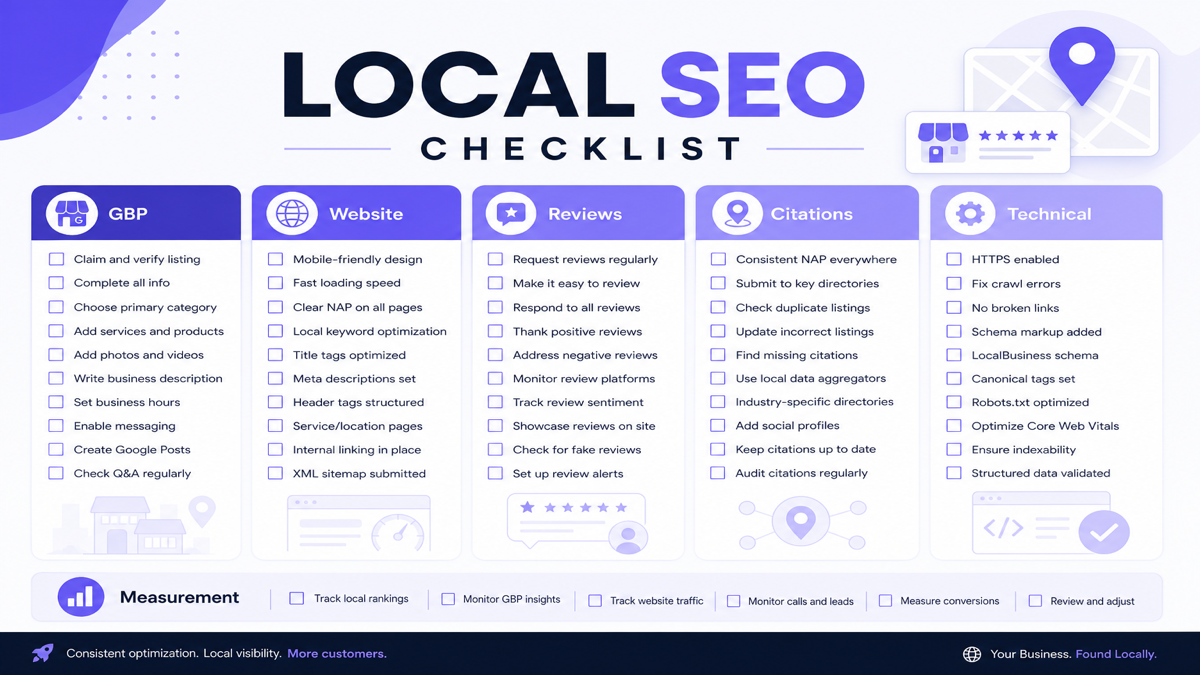
Google Business Profile
- [ ] Business name accurate
- [ ] Primary category selected
- [ ] Address or service area correct
- [ ] Hours current
- [ ] Website linked
- [ ] Phone correct
- [ ] Services or products added where appropriate
- [ ] Photos updated
- [ ] Reviews monitored
Website & on-page
- [ ] NAP consistent with GBP
- [ ] Local landing/service pages optimized
- [ ] Title and H1 aligned with search intent
- [ ] Internal links added
- [ ] Contact and About details complete
Technical, content & measurement
- [ ] Mobile performance checked
- [ ] Indexability, robots and sitemap checked
- [ ] Schema validated
- [ ] Search Console configured
- [ ] Conversions measured
- [ ] Important citations accurate
How Google decides which local businesses to show
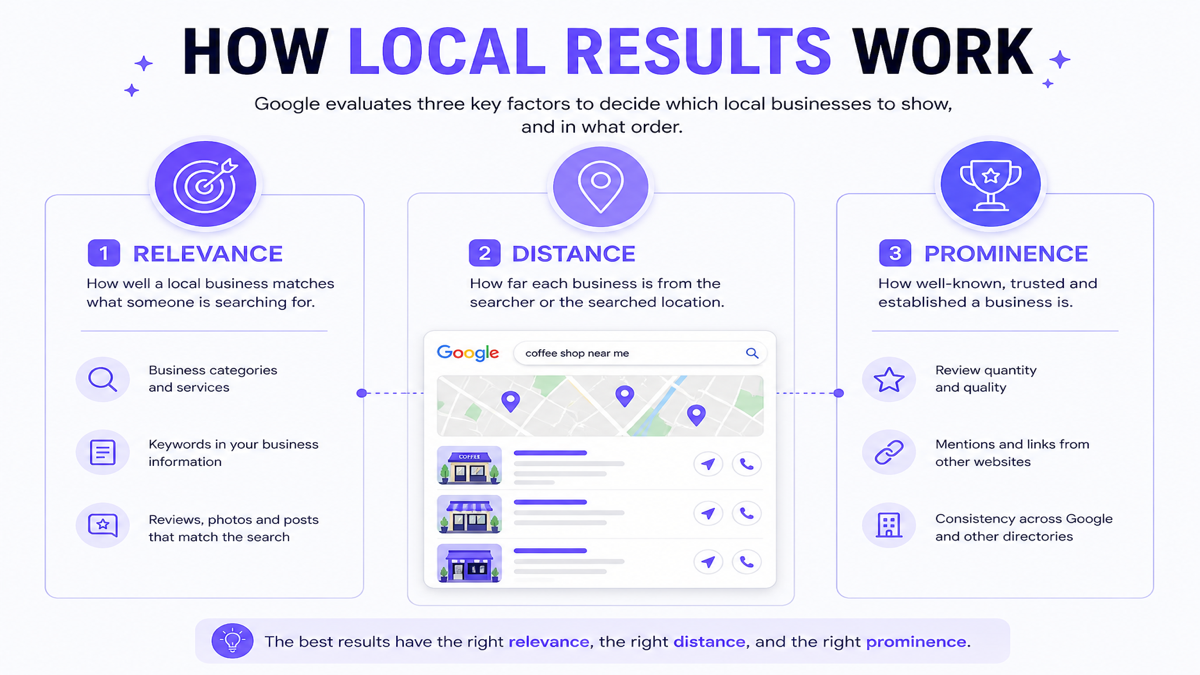
According to Google Business Profile Help, local results are mainly based on relevance, distance and popularity. Google also explains prominence as how well-known a business is. There is no way to request or pay for a better local ranking.
- Relevance: how well a Business Profile matches what someone is searching for. Complete, detailed business information helps matching.
- Distance: how far each business is from the customer who’s searching. If the customer doesn’t share a location, Google uses what it knows about their location.
- Prominence / popularity: how well-known a business is. Google notes this can relate to information such as websites that link to the business and review signals. More reviews and positive ratings can help local ranking, but there is no published percentage formula.
Do not treat unofficial ranking-factor percentage charts as Google policy.
1. Complete your Google Business Profile
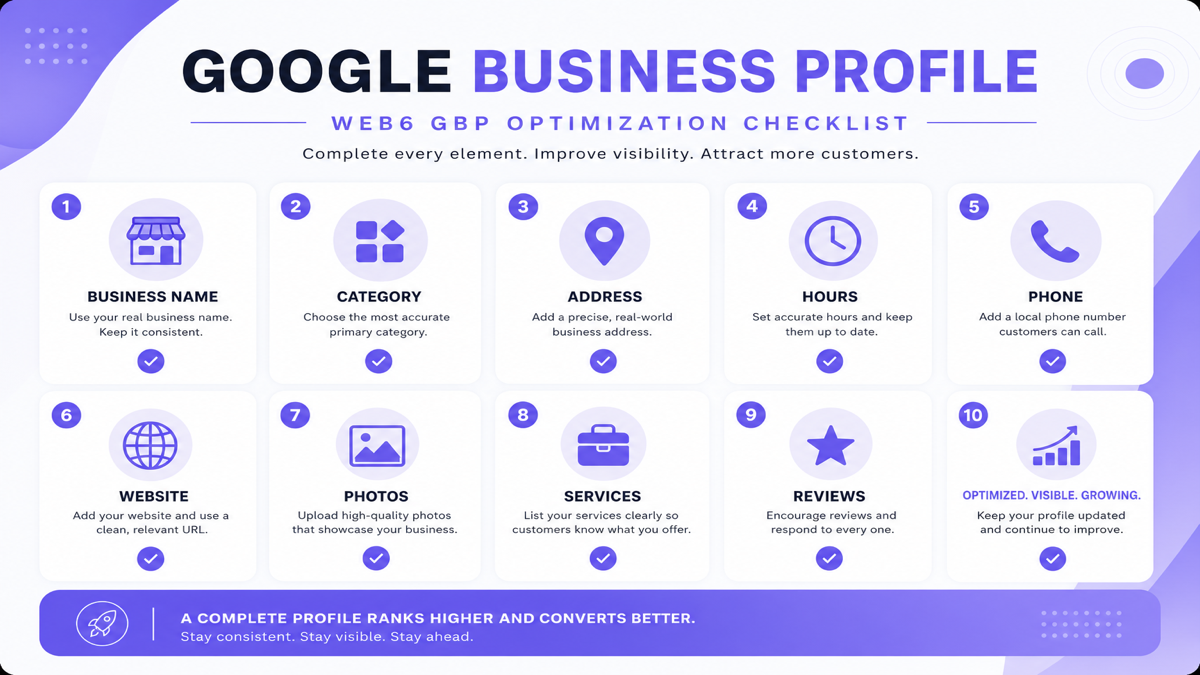
Google Business Profile is central to Maps and local result visibility. Businesses with complete and accurate information are more likely to show up for relevant local searches. Google also notes there is no way to request or pay for a better local ranking.
Start by verifying the profile if it is not verified yet. Verification helps Google understand that an authorized representative manages the business listing.
- [ ] Correct business name
- [ ] Correct category
- [ ] Address and/or service area
- [ ] Phone
- [ ] Website
- [ ] Opening hours
- [ ] Services/products where relevant
- [ ] Business description
- [ ] Photos
- [ ] Attributes where applicable
Use your real business name
Do not add marketing keywords to the business name unless they are genuinely part of the real-world business name and allowed under Google’s guidelines.
Bad conceptual example: Web6 Best SEO Company Website Developer Surat
Good: Web6
Choose the most accurate primary category
Primary category should represent the main business. Secondary categories may be used where genuinely applicable. Do not add unrelated categories only for visibility.
Address vs service area
Physical-location businesses that customers visit should use an accurate address. Service-area businesses may define areas they genuinely serve according to current Google Business Profile rules. Do not invent fake offices, virtual addresses or locations where the business does not operate.
Keep hours accurate
Maintain regular hours, special hours and holiday hours. Accurate hours improve trust and reduce wasted customer trips.
Add genuine business photos
Use real photos of the office or store, team, products, work, exterior, interior and customer-facing areas where appropriate. Photos help profile completeness and customer confidence. They do not guarantee ranking improvements.
2. Build a genuine Google review strategy
Ask real customers for reviews, make the process easy, monitor feedback and respond professionally — including to negative reviews. A simple operational habit is to ask after a successful delivery, appointment or project milestone, when the customer already feels helped.
Do not buy reviews, invent reviews, use employee-created fake customer reviews, join review networks, use review gating, or offer incentives that violate platform policies.
Respond naturally
Avoid keyword-stuffed reply templates. Respond to the customer’s actual experience.
As a consistency example, Web6 keeps its verified Google Business Profile rating and review count in a single site configuration (currently 4.9 from 40 Google reviews) rather than hardcoding different numbers across pages. Use your own verified profile data the same way.
3. Keep your business information consistent
NAP means Name, Address and Phone. Also keep website URL and hours consistent where relevant across:
- website
- Google Business Profile
- social profiles
- business directories
- industry listings
Consistency reduces confusion for customers and search systems. It is not a magic ranking switch by itself.
4. Clean up important local citations
A citation is a mention of your business details on another site — for example a business directory, industry directory, local chamber/association listing or trusted marketplace profile.
Focus on quality, accuracy and relevance. Do not submit to hundreds of low-quality directories for volume. Clean the listings that matter and keep them aligned with your current NAP.
5. Make it obvious where your business operates
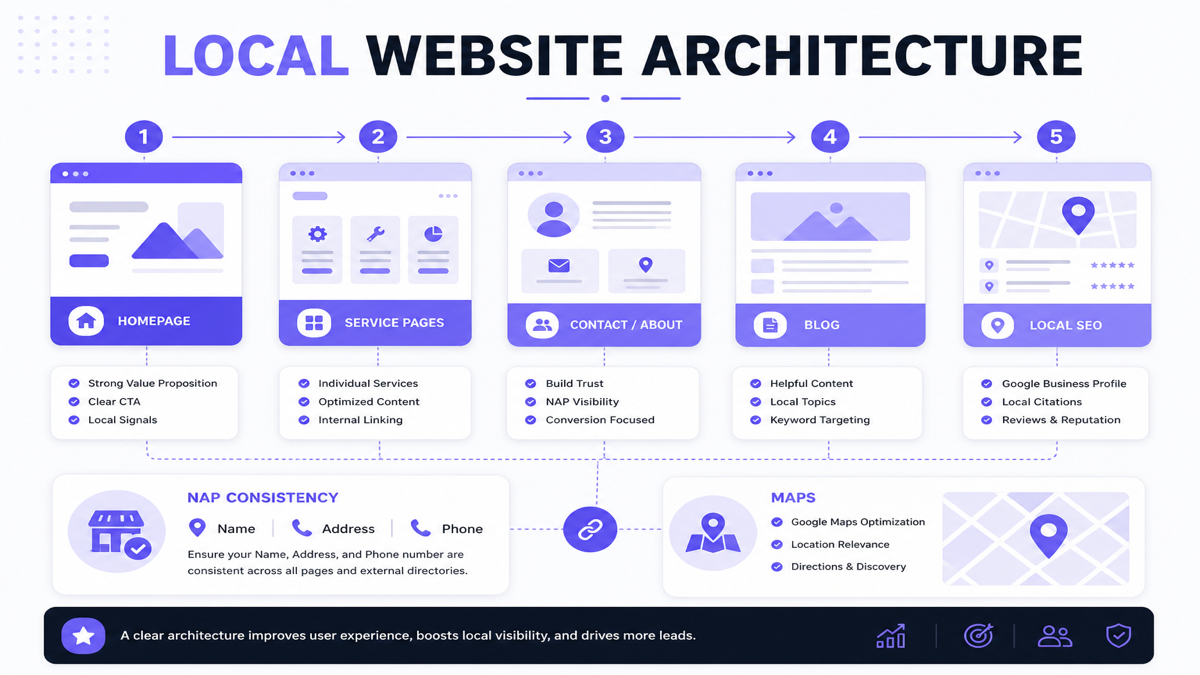
Your website should clearly communicate business name, services, location, contact details and areas genuinely served. For a Surat company, location can appear naturally on the homepage, contact page, about page and relevant service pages. Do not force “Surat” into every sentence.
Homepage local SEO
The homepage can target a core local commercial term when it reflects the real business — for example a web development company in Surat can say so clearly. Do not force every service and neighbourhood keyword onto one homepage.
6. Optimize real service pages for local intent
Prefer strong service pages when the business genuinely serves the wider Surat market. Create area-specific pages only when there is meaningful unique value — different offers, different teams, different proof, different customer needs.
Avoid mass-producing thin city and area pages
Do not create nearly identical pages for Vesu, Adajan, Piplod, Althan and every other area with only the neighbourhood name swapped. Google’s spam policies cover doorway abuse: pages created mainly to rank for similar queries and funnel users elsewhere without unique value. Thin duplicated area pages are a common form of this risk.
7. Research how customers actually search
Common local intent patterns include:
- service + city
- service + near me
- problem + location
- product + location
- industry + service + location
Do not invent keyword combinations solely because a tool shows volume.
Match page type to intent
- “SEO company in Surat” → commercial service page
- “How to choose SEO company in Surat” → commercial investigation guide
- “What is local SEO” → informational guide
- “SEO cost in Surat” → pricing investigation
That is why Web6 separates SEO services in Surat from guides like choosing an SEO company in Surat and this local SEO checklist.
8. Optimize local title tags naturally
Good conceptual example: SEO Services in Surat | Technical, Local & Ecommerce SEO
Bad: Best SEO Company Surat #1 SEO Agency Surat SEO Expert Gujarat
Do not stuff. Do not blindly force the city into every title. Clear H1 and headings should describe the page for humans first. You can draft cleaner metadata with a meta tag generator, then refine for intent.
9. Publish locally useful content
Create content that helps your real customers:
- IT company → practical technology/ecommerce guides for businesses
- manufacturer → procurement, product or industry education
- clinic → services plus patient education
- retailer → buying guides and local availability information
- professional services → process and decision guides
Surat’s business mix includes ecommerce, textiles/apparel, jewellery, manufacturing, retail, professional services and technology. Use local context only when it improves usefulness. Do not invent economic statistics or create unrelated “Top 10 things in Surat” posts.
10. Strengthen local pages with internal links
Help users (and crawlers) move between related pages:
- Homepage → service pages
- Blog → relevant service page
- Service pages → related case studies or tools
- Related guides → supporting articles
Link because the next page helps the reader finish the job.
11. Fix technical SEO before blaming local rankings
Check indexability, robots, sitemap, canonicals, redirects, duplicate pages, mobile usability, performance, structured data, HTTPS and broken links. GBP optimization cannot compensate for a badly broken website.
A practical starting order: confirm the important pages are indexable, remove accidental noindex/blocking rules, fix broken canonical/redirect chains, then improve mobile speed and layout stability. For crawl directives, a robots.txt generator can help you draft carefully — then validate against the live site.
If your site needs foundational engineering work, that often overlaps with technical website development or platform work such as Shopify development.
Core Web Vitals
Google’s Core Web Vitals currently focus on:
- LCP — loading
- INP — interactivity
- CLS — visual stability
Passing Core Web Vitals does not guarantee higher rankings. Performance still matters for users and conversions. Compress heavy assets with tools such as an image compressor when media size is part of the problem.
Mobile UX
Local searches often happen on phones. Make content readable, navigation tap-friendly, contact actions obvious, forms usable and directions/contact details easy to find.
12. Use structured data correctly
LocalBusiness / Organization schema can help machines understand business name, URL, telephone, address, opening hours and sameAs profiles when those facts are visible and accurate on the site.
Only include properties supported by real business data. Do not fabricate ratings, reviews, service areas, coordinates or awards in schema.
Structured data helps understanding. It does not guarantee rankings, rich results or local pack inclusion. Draft carefully with a structured data generator or FAQ schema generator when FAQs are genuinely present on the page.
13. Earn relevant local and industry authority
Legitimate sources can include industry associations, business partnerships, suppliers, genuine local events, sponsorships, media coverage, useful resources and professional organizations.
Do not buy bulk local backlinks or spam directory packages. Focus on genuine relationships such as supplier lists, partner pages, event participation and expert contributions.
14. Optimize the contact page — and strengthen About
Contact pages should include accurate business name, address where applicable, phone, email/contact form, opening hours if relevant, map where useful, directions and genuine service areas.
About pages strengthen trust with real company information, team/experience, office photos, location, expertise and factual history. Do not keyword-stuff either page.
15. Show that a real business is behind the website
Useful trust elements include real company identity, team/author information, genuine reviews, contact information, original photos, case studies, policies, expertise and transparent service information.
These signals support credibility. Do not treat EEAT as a published numerical ranking score from Google.
Genuine case studies should describe problem, work performed, solution and outcome — without inventing traffic, rankings, lead counts or revenue.
16. Measure local organic performance
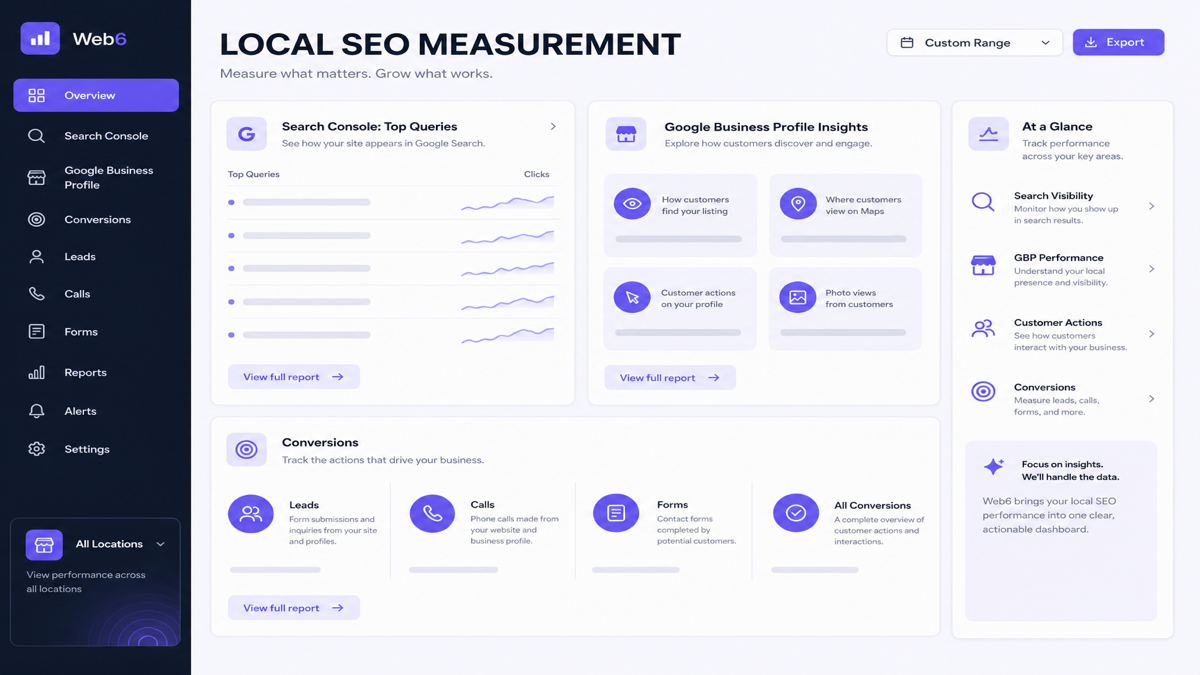
In Google Search Console, review clicks, impressions, queries and pages. For local analysis, look at searches containing Surat, near me and your service/location terms — remembering query data is not always complete.
In analytics, track outcomes: contact forms, calls where properly tracked, WhatsApp/contact clicks, quote requests, purchases, appointments and directions where measurable. Sessions alone are not success.
Also review Google Business Profile performance insights using the metrics Google currently shows in your profile manager — names and reports can change, so verify in-product rather than relying on outdated blog screenshots.
Local rank tracking reality
Someone searching from Vesu may see different local results than someone in Adajan because location can influence local results. One manual ranking screenshot is not enough measurement.
17. Turn local visibility into enquiries
SEO is incomplete if users reach the website but cannot act. Check clear phone/contact, WhatsApp where appropriate, enquiry forms, trust signals, service explanation, pricing/process clarity where applicable, mobile usability, case studies and reviews.
Common local SEO mistakes Surat businesses should avoid
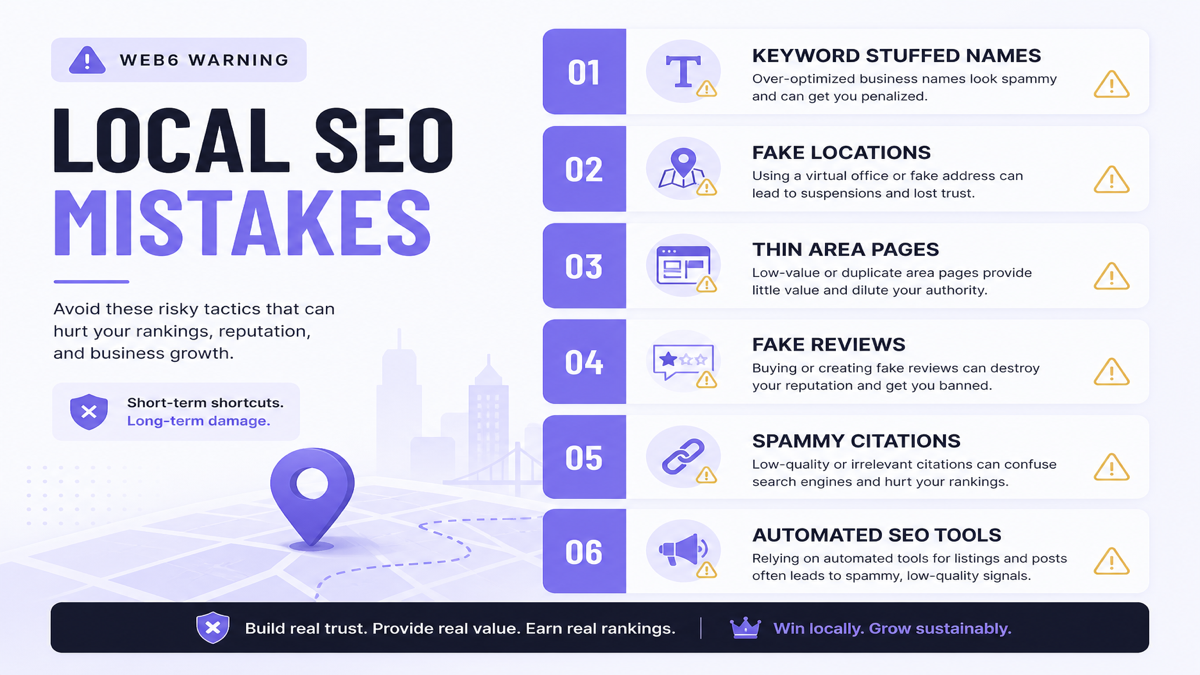
- Keyword stuffing GBP business name
- Fake locations
- Duplicate Google profiles
- Buying fake reviews
- Ignoring negative reviews
- Inconsistent contact information
- Creating dozens of thin area pages
- Bulk directory submissions
- Buying spam backlinks
- Ignoring website technical SEO
- No conversion tracking
- Copying competitor content
- Publishing generic AI content with no local/business value
- Changing URLs without redirects
- Expecting instant results
A practical 30-day local SEO plan
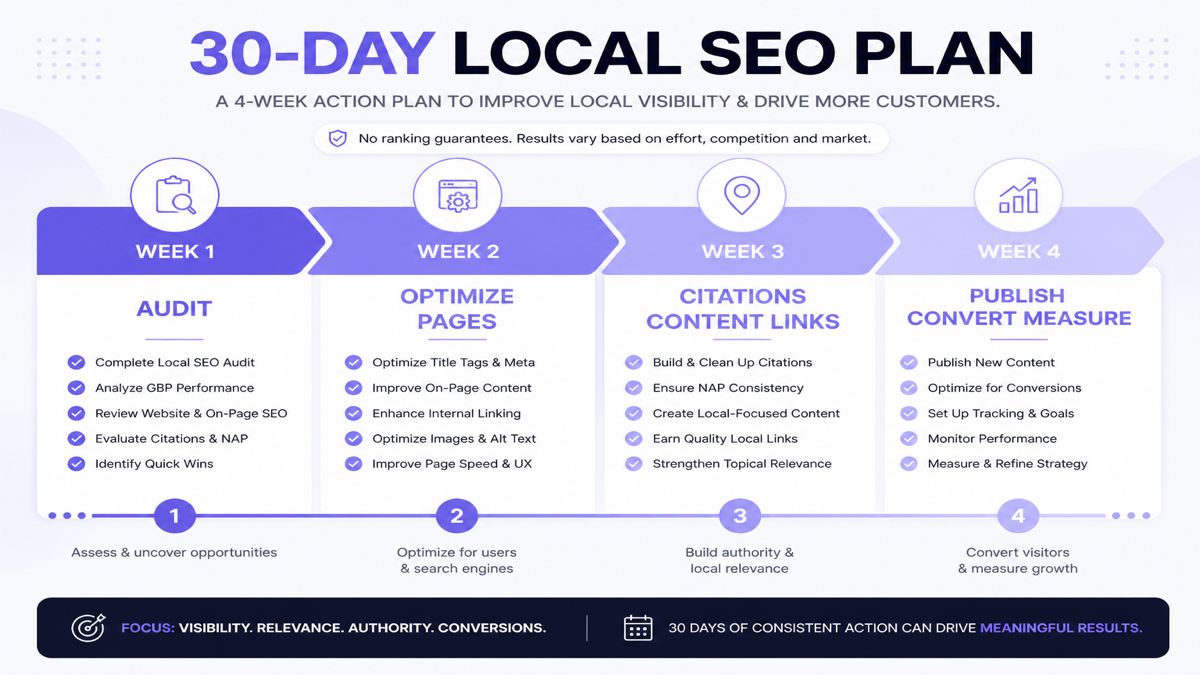
This is an implementation plan, not a ranking guarantee.
Week 1
- Audit GBP
- Verify NAP
- Inspect website indexability
- Search Console check
- Analytics/conversion check
Week 2
- Optimize primary service/location pages
- Fix metadata/headings
- Improve contact/about information
- Fix major technical problems
Week 3
- Review strategy
- Citation cleanup
- Local content opportunity research
- Internal links
Week 4
- Publish useful local content
- Improve conversion elements
- Review performance baseline
- Document next priorities
Priority matrix
| Task | Priority | Difficulty | Impact area |
|---|---|---|---|
| GBP accuracy | High | Low | Local discovery |
| NAP cleanup | High | Low/Medium | Trust / consistency |
| Technical indexability | Critical | Varies | Organic search |
| Reviews | High | Ongoing | Trust / local visibility |
| Local content | Medium/High | Medium | Organic relevance |
| Authority | Medium | Ongoing | Prominence |
Local SEO for different business types
Service business
Focus on accurate categories, service lists, service-area honesty, review quality and clear enquiry paths.
Retail store
Prioritize address accuracy, hours, photos, product/availability signals where supported, and easy directions.
Professional services
Emphasize expertise content, trust pages, consistent NAP and conversion forms.
Ecommerce + physical location
Split intents: product/category searches need ecommerce SEO; store/showroom/company searches need local SEO. Use the ecommerce SEO guide alongside this checklist, and strengthen storefront foundations via ecommerce website development when the site itself is the bottleneck.
Manufacturer / B2B
Local company discovery still matters, but many buyers use industry and product intent. Map local pages carefully and avoid thin city clones.
Service-area vs national SEO
A Surat company may target Surat locally and Gujarat/India nationally. Use different pages for different intents. Do not create duplicate location pages just to cover every city.
Does local SEO also matter for AI search?
Machine-readable, consistent, trustworthy business information and strong web content can help search systems understand the business. That does not guarantee inclusion in AI Overviews or any generative result.
Practical inputs: clear entity information, structured content, credible evidence, consistent business data and helpful answers.
Keep business facts consistent everywhere
Use the same business name, address, phone, website, services and location facts across your website and major authoritative profiles. Consistency is operational hygiene, not a buzzword strategy.
Need help auditing your local visibility?
If you want support implementing this checklist, Web6 can help with technical SEO, local SEO, content, ecommerce SEO and measurement — without ranking guarantees. Start with local and technical SEO or related digital marketing when paid and organic channels need to work together.
Frequently asked questions
What is local SEO?
Local SEO is the work of improving visibility for searches tied to a place — through Google Business Profile, consistent business information, reviews, locally relevant website pages and trustworthy signals.
How can a business improve local SEO in Surat?
Complete and maintain GBP, keep NAP consistent, earn genuine reviews, optimize real service pages, fix technical website issues, publish useful local content and measure leads — not only rankings.
How do I rank my business on Google Maps?
There is no paid ranking shortcut. Google says local results are mainly based on relevance, distance and popularity/prominence. Improve profile completeness, accuracy, reviews and online prominence while keeping location information honest.
Do Google reviews help local SEO?
Google notes that more reviews and positive ratings can help local ranking as part of prominence. Reviews also influence customer trust. Fake or policy-violating review tactics are not a strategy.
How many Google reviews does a business need?
There is no universal number that guarantees ranking. Focus on a steady flow of genuine reviews and thoughtful responses rather than chasing an invented quota.
What is NAP consistency?
NAP means Name, Address and Phone. Consistency means those details — plus related info like website and hours — match across your website, GBP and important listings.
Do I need separate pages for every area in Surat?
Usually no. Strong service pages are better than dozens of thin Vesu/Adajan/Piplod clones. Create area pages only when you can add unique, useful value.
How long does local SEO take?
It depends on competition, profile completeness, website quality, reviews and implementation speed. Treat local SEO as ongoing maintenance, not a one-week ranking purchase.
Is local SEO different from normal SEO?
They overlap. Local SEO puts more weight on GBP, Maps, reviews, NAP and location relevance, while still needing crawlable, useful website pages and technical foundations.
Can an ecommerce business benefit from local SEO?
Yes, if you have a physical store, showroom or local company discovery needs. Product and category searches still need ecommerce SEO; store and company searches need local SEO.
Use the checklist, not shortcuts
Local SEO for Surat businesses is mostly operational clarity: accurate Google Business Profile data, consistent NAP, genuine reviews, useful service pages, solid technical SEO and conversion paths that turn visibility into enquiries. Avoid thin area pages, fake locations and ranking guarantees — then improve week by week using the 30-day plan above.