
SEO
How to Choose an SEO Company in Surat: 12 Questions to Ask Before Hiring
Written by Web6 Editorial Team · Published 15 August 2026 · 20 min read
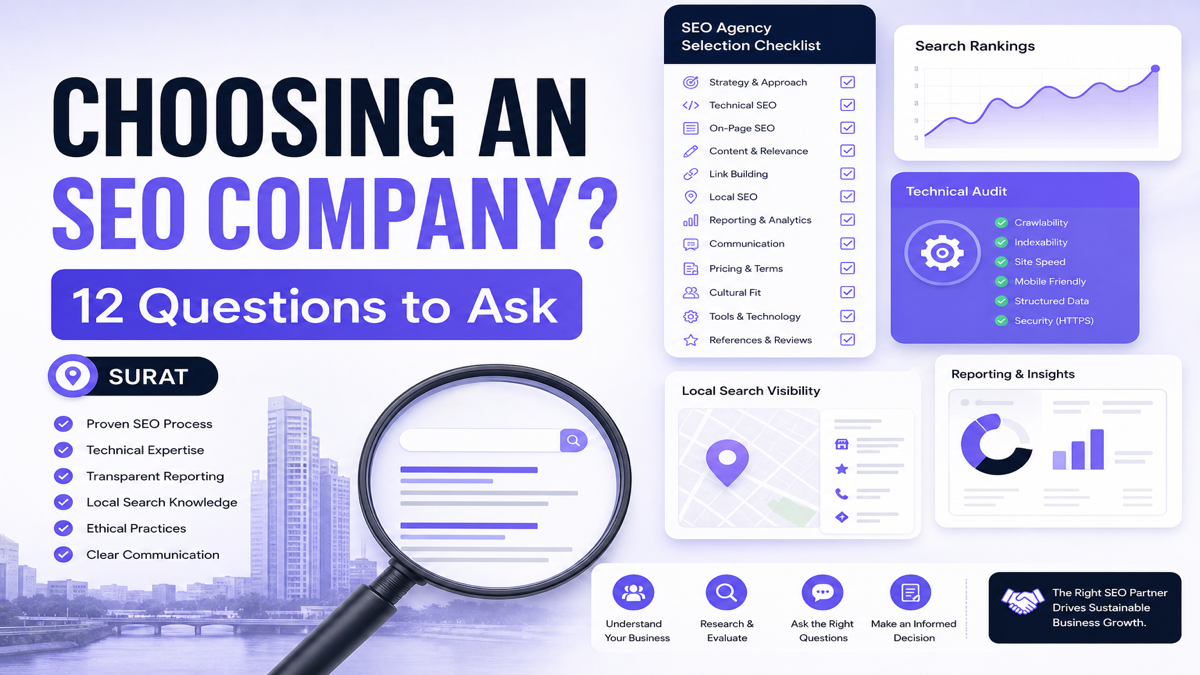
Searching for an SEO company in Surat produces many agencies offering similar promises, but their approaches can differ significantly. Before comparing monthly prices, businesses should understand how an agency audits websites, chooses priorities, measures results, communicates progress and handles technical, local and content SEO.
This guide gives you 12 practical questions to ask before hiring — so you can evaluate strategy, transparency and fit instead of ranking slogans.
How do you choose a good SEO company in Surat?
Choose an SEO company by evaluating its strategy, transparency, technical knowledge, reporting, experience with your business model and ability to explain what it will actually do. A credible SEO agency should audit your website before promising outcomes, explain how it will measure progress, distinguish technical issues from content problems, and avoid guaranteed-ranking claims. For a Surat business, local SEO experience and understanding of your target market can also be important.
Key takeaways
- Ask how the agency diagnoses SEO problems before proposing work.
- Look for transparent reporting and measurable KPIs.
- Avoid guaranteed #1 ranking promises.
- Check whether the agency understands your industry and website platform.
- Local businesses should ask specifically about Google Business Profile and local search.
- Ecommerce companies need stronger technical, category and product SEO expertise.
What should an SEO company actually do?
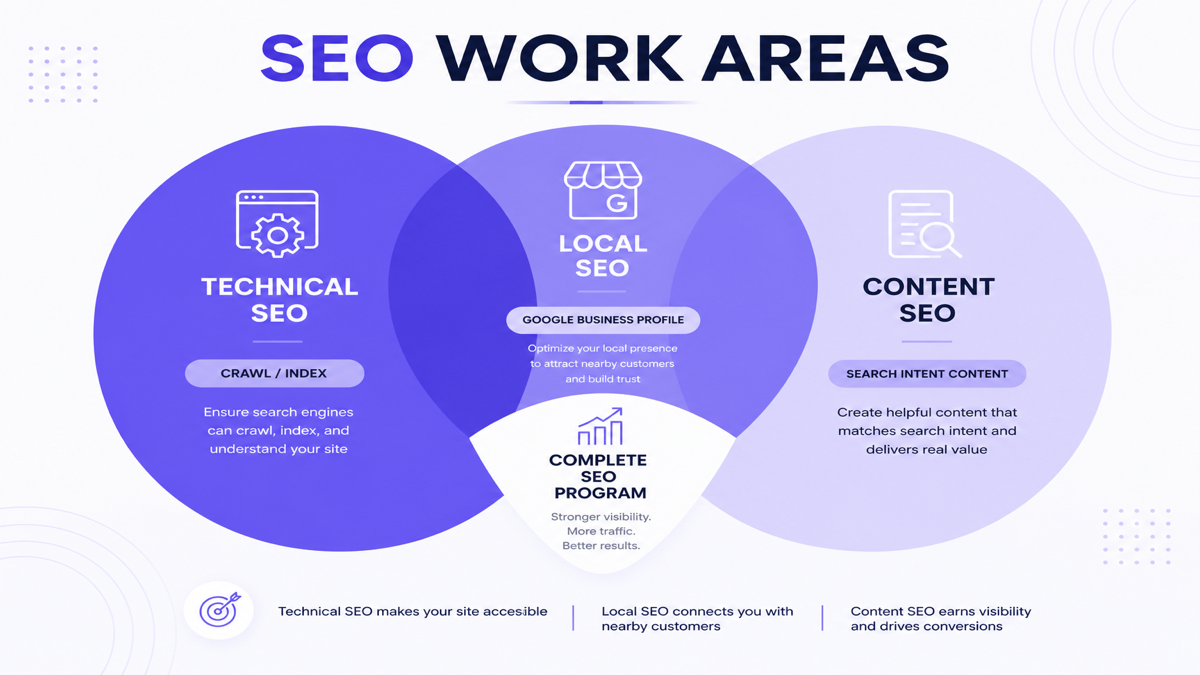
Depending on your site and goals, SEO work may include:
- Technical SEO (crawlability, indexation, architecture, performance)
- Keyword and search-intent research
- On-page optimization
- Internal linking
- Content strategy
- Local SEO
- Ecommerce SEO
- Structured data
- Core Web Vitals and page experience
- Analytics and reporting
- Authority and link development where appropriate and policy-compliant
Not every business needs the same scope. A local clinic, a manufacturer and a Shopify store can share some fundamentals while needing very different priorities.
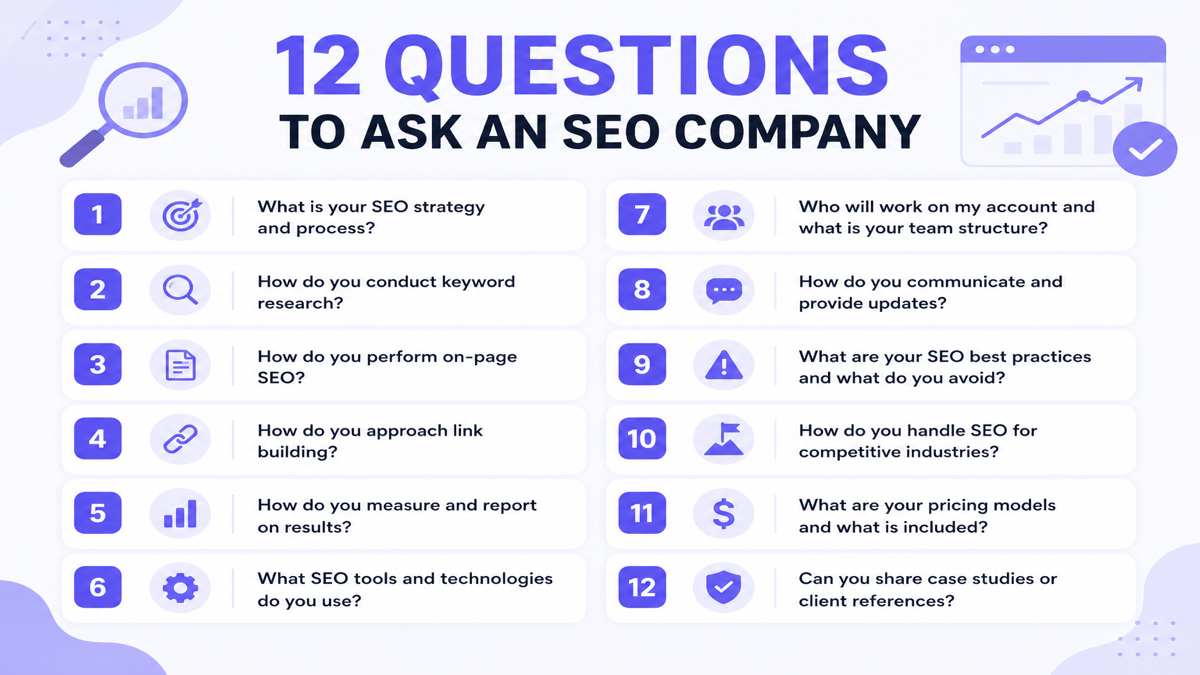
1. How will you audit our website before starting SEO?
A credible initial audit may cover indexability, crawlability, sitemaps, robots directives, canonical tags, redirects, metadata, headings, content quality, internal links, duplicate content, performance, mobile UX, structured data, local presence and analytics setup.
Ask for a prioritized issue list, not a 40-page dump with no sequence. The first questions should be: what blocks indexing or conversion today, and what can wait?
Red flag: the agency delivers a complete strategy without inspecting the site.
Good sign: the agency can explain why priorities differ between websites.
2. How will you choose the keywords and search intent to target?
Keyword choice should consider business relevance, search intent, location, page type, current authority, the customer journey and cannibalization risk.
Important distinction: “SEO company in Surat” is commercial investigation. “How to choose an SEO company in Surat” is informational. A good agency should match content and landing pages to intent instead of stuffing every page for the same commercial phrase.
3. What will you change on our website?
Ask whether the agency handles titles, descriptions, headings, content, internal links, schema, site structure, redirects and technical issues — and who implements each item.
An SEO agency should explain proposed changes before implementation.
Red flag: large-scale changes with no explanation of purpose or risk.
4. How do you approach technical SEO?
Technical SEO covers crawling, indexation, canonicalization, redirects, JavaScript rendering, site speed, Core Web Vitals, structured data, mobile UX and information architecture.
If your site uses modern frontend stacks such as Astro, Next.js or React, ask how the agency handles rendering and crawlability — not only WordPress-plugin configuration. Technical recommendations often need developer collaboration on custom or headless sites.
Core Web Vitals measure loading, interactivity and visual stability. Google documents them as page-experience metrics that its ranking systems use; they are not a guarantee of top rankings on their own.
5. How will you improve our local SEO in Surat?
For many Surat businesses, local visibility matters as much as national organic search. Ask about:
- Google Business Profile optimization and maintenance
- NAP consistency (name, address, phone)
- Local landing-page relevance
- Genuine review acquisition processes
- Clear local service information
- Useful local citations where relevant
- Locally relevant content
- Maps / local-pack considerations
Local SEO work can improve eligibility and relevance. It does not guarantee Local Pack rankings.
6. Do you have experience with our website platform?
Platform expertise matters because SEO constraints differ across Shopify, WordPress, WooCommerce, custom websites, Astro, React/Next.js and custom ecommerce builds.
On Shopify, for example, ask about product and collection architecture, theme performance, app impact, redirects, structured data and ecommerce search intent. On a custom site, developers may need to implement technical recommendations directly — so the agency should be able to work with an engineering team.
If you are comparing site platforms or rebuilds, also review Shopify development and technical website development separately from SEO selection.
7. How will you measure SEO performance?
Rankings alone are incomplete. Useful metrics can include organic clicks, impressions, qualified traffic, conversions, leads, ecommerce revenue, non-brand visibility, local visibility and landing-page performance.
Ask how the agency uses Google Search Console and Google Analytics (where implemented), and how they distinguish brand vs non-brand demand. Vanity charts without business outcomes are not enough.
8. What will your SEO reports include?
A useful report may include work completed, issues fixed, search visibility trends, organic traffic, landing-page changes, conversion trends, next priorities, remaining technical issues and content performance.
Ask who owns Search Console and Analytics access. You should retain ownership of properties and accounts. An agency can be added as a user; it should not become the only party that can see the data.
Red flag: a PDF full of charts with no explanation of actions or next steps.
9. How long should we expect SEO to take?
There is no universal timeline. Timing depends on the current site, competition, domain history, technical debt, content quality, location focus, authority and how quickly recommendations are implemented.
Separate two clocks:
- Time to implement SEO work (audits, fixes, content, local improvements)
- Time for search performance to respond (indexing, evaluation, competitive movement)
Do not treat “results guaranteed in 90 days” as a trustworthy sales promise.
10. Do you guarantee first-page or #1 rankings?
Treat ranking guarantees as a warning sign.
No agency controls Google’s ranking systems, competitor actions, search demand or algorithm updates. Google’s own Search guidance is clear that meeting technical requirements and best practices does not guarantee that a page will be crawled, indexed or ranked highly.
An agency can commit to agreed deliverables, audits, implementation work and reporting — not an exact organic ranking outcome.
11. How do you create or earn backlinks?
Ask whether the strategy involves digital PR, partnerships, genuine outreach, useful assets, relevant directories/citations and industry publications.
Red flags: promises of thousands of backlinks, paid spam networks, irrelevant directories, automated link packages or hidden PBN-style schemes.
Google’s spam policies treat buying or selling links for ranking purposes and other manipulative link practices as link spam. Prefer transparent, relevant approaches over volume theater.
12. What happens if SEO is not performing as expected?
A strong agency should review data, identify failed assumptions, revisit intent, check technical/indexing problems, analyze competitor movement, adjust content, change priorities and explain decisions.
“Just wait another six months” without evidence is not a strategy.
12 questions summary: good answers vs red flags
| Question | What a good answer sounds like | Red flag |
|---|---|---|
| 1. Audit first? | Explains site-specific priorities after inspection | Strategy without looking at the website |
| 2. Keywords & intent? | Matches intent, page type and business goals | One keyword list for every page |
| 3. What will change? | Clear scope and rationale before edits | Silent mass changes |
| 4. Technical SEO? | Crawl/index, CWV, schema, architecture | “Plugins will fix everything” |
| 5. Local SEO? | GBP, NAP, local pages, reviews process | Local Pack guarantee |
| 6. Platform experience? | Knows your stack and constraints | Generic advice for every CMS |
| 7. Measurement? | Traffic quality, conversions, Search Console | Only ranking screenshots |
| 8. Reporting? | Work done + insights + next actions | Charts with no explanation |
| 9. Timeline? | Depends on site, competition, implementation | Guaranteed results in X days |
| 10. Ranking guarantee? | Commits to deliverables, not #1 | “We guarantee #1” |
| 11. Links? | Relevant, transparent acquisition methods | Buy thousands of links / PBN talk |
| 12. If results stall? | Diagnose, adjust, explain evidence | “Just wait longer” with no review |
SEO company red flags to watch for
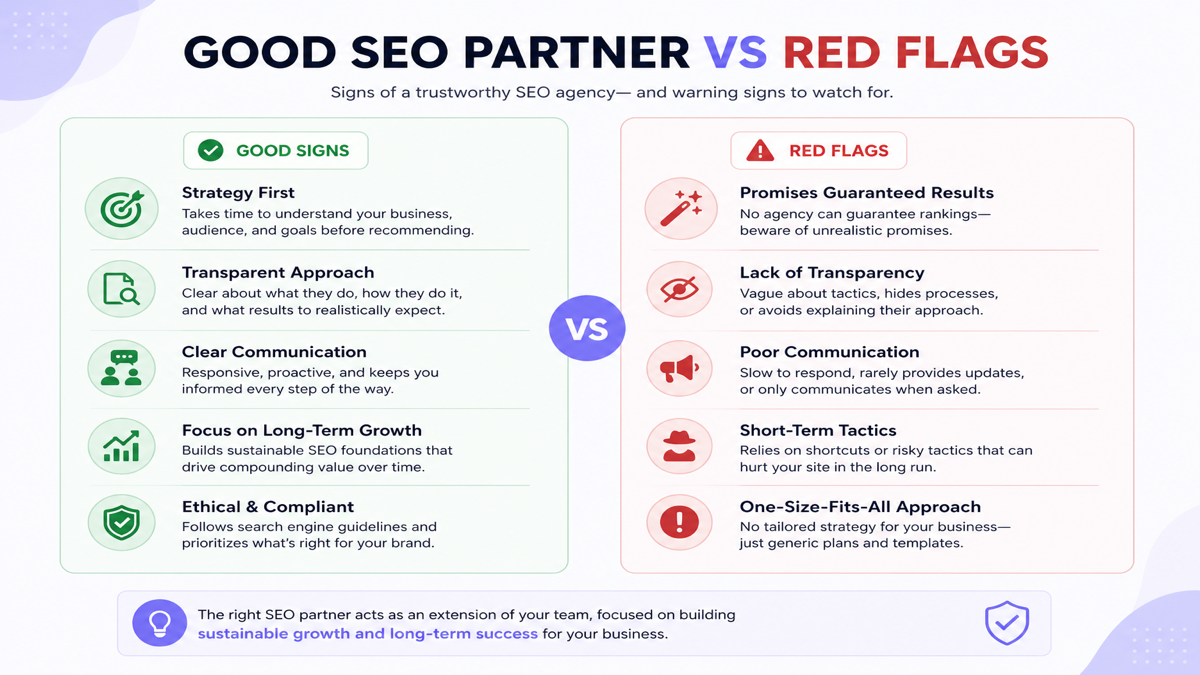
- Guaranteed #1 rankings
- “Secret strategy” that cannot be explained
- No website audit
- Keyword stuffing as a primary tactic
- Buying thousands of backlinks
- Fake review schemes
- Thin duplicate city pages
- Reporting only rankings
- No conversion measurement
- No Search Console access for you
- Clearly outdated SEO tactics
- Unwillingness to explain the work
- Changing URLs without redirect plans
Signs you may have found a good SEO partner
- Asks about business outcomes, not only keywords
- Explains search intent clearly
- Provides clear scope and exclusions
- Communicates transparently
- Understands technical SEO
- Can work with developers
- Measures conversions and qualified demand
- Sets realistic expectations
- Identifies what not to change
- Uses evidence instead of promises
Should you hire a Surat SEO company or a remote agency?
A local Surat partner may offer stronger local-market familiarity, easier meetings and better context on regional competition. A remote specialist may bring deeper niche expertise or a larger specialist talent pool.
Location alone should not determine quality. Process, technical ability, measurement and communication matter more than whether the team sits in the same city.
Freelancer vs SEO agency
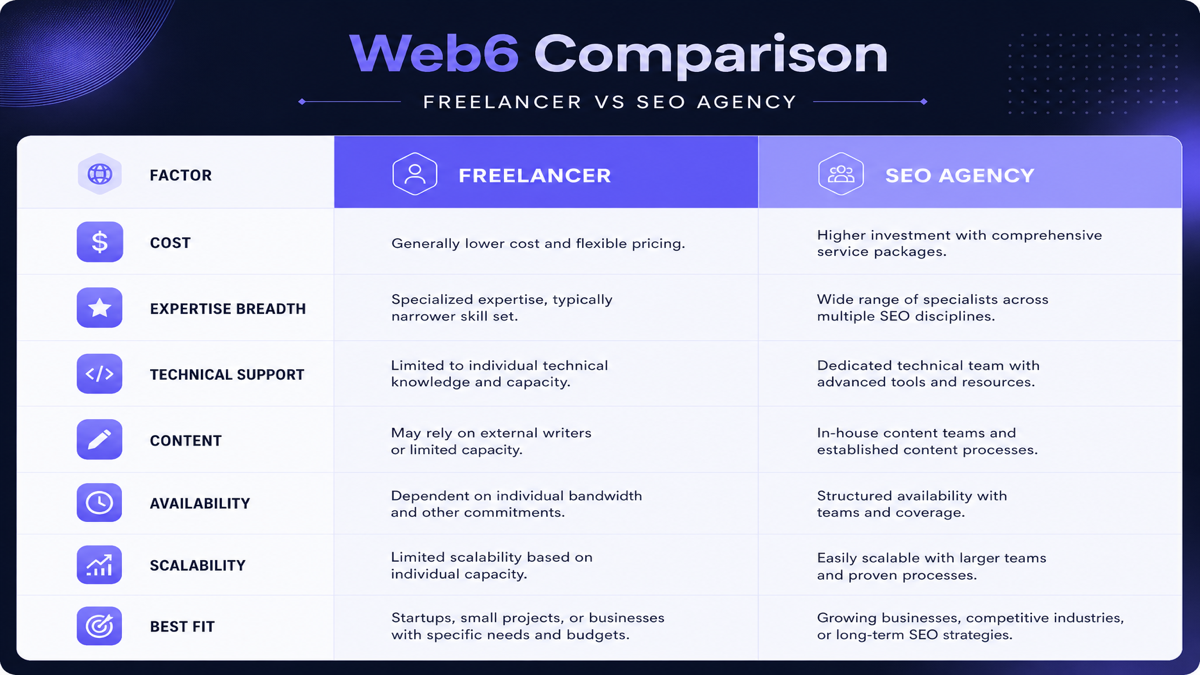
| Factor | Freelancer | SEO agency |
|---|---|---|
| Cost structure | Often leaner for focused scopes | Usually higher for multi-skill delivery |
| Breadth of expertise | Depends on one person’s range | Can combine technical, content and local skills |
| Technical support | Variable | Often stronger if engineering partners exist |
| Content resources | May be limited | Often broader capacity |
| Availability | Can be constrained | Usually more coverage |
| Scalability | Harder to scale quickly | Easier for multi-channel programs |
| Best fit | Clear, contained projects | Cross-functional ongoing SEO |
Agencies are not always better. Match capacity to the complexity of your site and goals.
Ecommerce businesses should ask different SEO questions
If you sell online, ask specifically about category architecture, product pages, faceted navigation, duplicate URLs, structured data, internal linking, product availability signals, Core Web Vitals and platform constraints.
For a deeper implementation guide, use the ecommerce SEO playbook. Site quality and conversion foundations also connect to ecommerce website development.
If you run Shopify
Ask whether the agency understands product/collection architecture, theme performance, app impact, redirects, structured data, international stores and ecommerce search intent — not only blog posting.
How SEO companies usually structure pricing
Common models include monthly retainers, project audits, consulting, one-time implementation, ongoing SEO programs and separately scoped content work.
When comparing quotes, convert price into work: hours of specialist time, number of pages in scope, technical remediation capacity, content production, reporting depth and access to developers. A lower retainer that excludes implementation can cost more once your team has to execute everything.
Price alone is a weak signal. Compare scope, responsibilities, reporting and risk. This article does not invent Surat market rates; evaluate proposals against the work included, not against a generic “cheap vs expensive” label. When comparing proposals, also use the SEO cost in Surat budget guide for pricing models and cost factors.
What should an SEO proposal include?
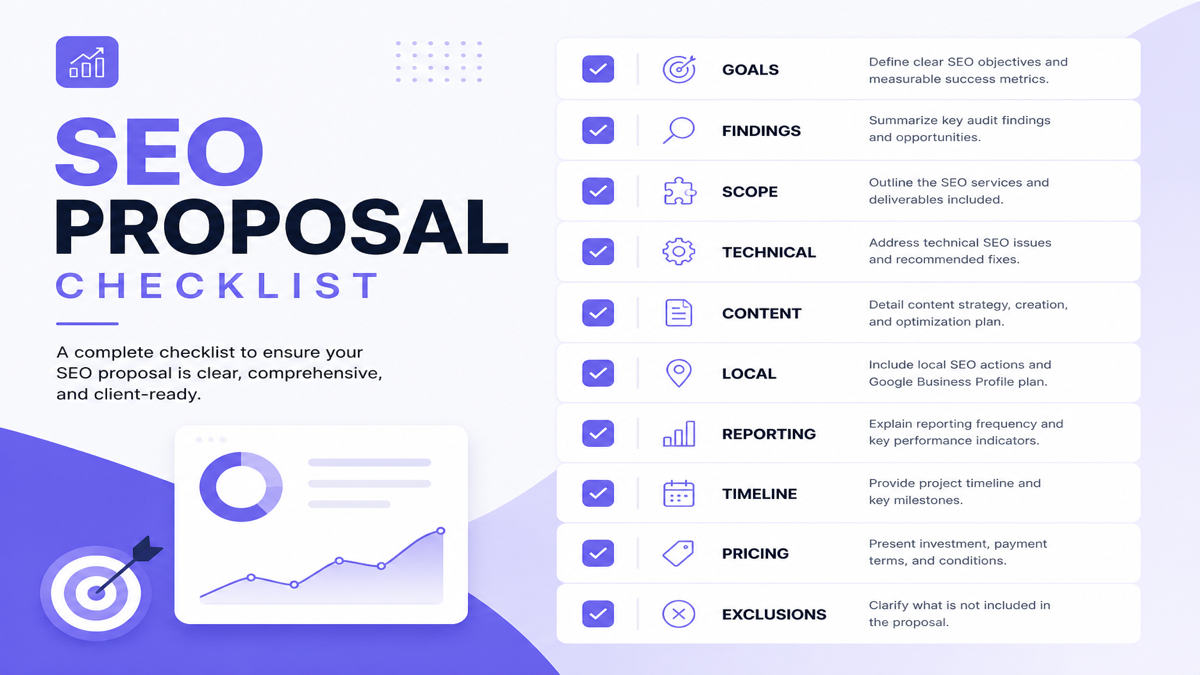
- [ ] Business goals
- [ ] Website findings
- [ ] Scope of work
- [ ] Technical work
- [ ] Content work
- [ ] Local work
- [ ] Reporting cadence and format
- [ ] Responsibilities (agency vs client vs developers)
- [ ] Deliverables
- [ ] Timeline / process
- [ ] Communication plan
- [ ] Pricing
- [ ] Exclusions
- [ ] Measurement approach
- [ ] Exit terms where relevant
What the first phases often look like
This is a general process example — not a guaranteed results timeline.
- Phase 1: audit + priority fixes
- Phase 2: implementation + content / local improvements
- Phase 3: measurement + refinement
Different sites need different sequences. A heavily broken technical site may spend longer in phase 1 than a content-gap site.
Questions the SEO company should ask you
A good provider also interviews the client. Expect questions such as:
- Who is your ideal customer?
- Which products or services matter most?
- Which locations matter?
- What converts today?
- What has been tried before?
- What website changes are possible?
- Which competitors matter?
- What are your high-value offerings?
- Which analytics systems exist?
- What are your business goals?
If the agency asks nothing about the business, treat that as a warning sign.
How to compare 3 SEO proposals
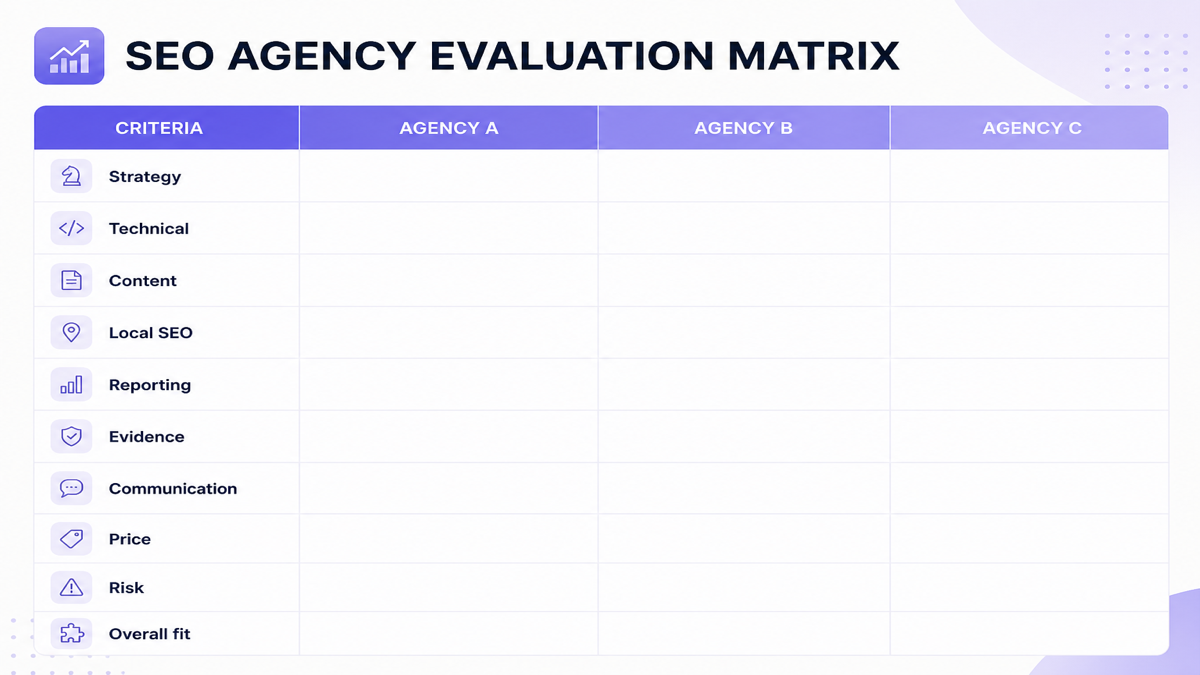
| Area | Agency A | Agency B | Agency C |
|---|---|---|---|
| Strategy clarity | |||
| Technical depth | |||
| Content plan | |||
| Local SEO | |||
| Reporting | |||
| Evidence | |||
| Communication | |||
| Price | |||
| Risk | |||
| Contract | |||
| Overall fit |
Score each area yourself. Do not outsource judgment to the flashiest pitch deck.
Useful checks while evaluating work
When reviewing proposals or early deliverables, you can sanity-check basics with lightweight tools — for example a meta tag generator for title/description hygiene, a schema markup generator when discussing structured data, or a robots.txt generator when crawl directives are part of the audit conversation. Tools do not replace strategy; they help you verify that recommendations are concrete.
How Web6 approaches SEO projects
Web6’s SEO work is grounded in technical implementation, ecommerce/Shopify constraints, structured data, Core Web Vitals and internal linking — not ranking guarantees. A typical process looks like:
- Understand the business and target customers
- Audit the website
- Identify technical, content and local issues
- Prioritize work
- Implement with developers where needed
- Measure
- Refine
If you want a scoped conversation after using this checklist, explore SEO services in Surat or related digital marketing support. Choose any partner — including Web6 — only after the questions above have clear answers.
Frequently asked questions
How do I choose an SEO company in Surat?
Evaluate strategy, audit depth, platform experience, local SEO capability, reporting, measurement and willingness to avoid ranking guarantees. Compare proposals on process and fit, not slogans.
What should I ask an SEO agency before hiring?
Ask how they audit, choose keywords, change the site, handle technical and local SEO, measure results, report progress, estimate timelines, approach links and respond when performance stalls.
Should an SEO company guarantee rankings?
No. Treat #1 or first-page guarantees as a warning sign. Agencies can guarantee deliverables and reporting, not exact organic ranking outcomes.
How long does SEO usually take?
It depends on site condition, competition, content, authority and implementation speed. Separate the time to implement work from the time search performance takes to respond.
How often should an SEO agency report results?
Monthly reporting is common for ongoing retainers, with clearer updates after major technical or content releases. Reports should explain actions and next priorities, not only charts.
Is it better to hire a local SEO company?
Local familiarity can help with Surat market context and meetings, but expertise and process matter more than location alone.
Should I hire an SEO freelancer or agency?
Freelancers can fit focused scopes. Agencies often fit broader technical + content + local programs. Choose based on complexity and required coverage.
What should an SEO proposal include?
Goals, findings, scope, technical/content/local work, reporting, responsibilities, deliverables, process, pricing, exclusions and measurement.
How can I tell if SEO work is actually helping?
Look for improvements in Search Console demand, qualified organic traffic, landing-page performance and conversions — alongside completed technical and content work — not rankings alone.
Does my business need local SEO or national SEO?
Many Surat service businesses need strong local SEO. Brands selling across India or online may need national/ecommerce SEO plus selective local coverage. Intent and market geography should drive the mix.
Hire for process, not promises
The right SEO company is not the one making the biggest ranking promise. It is the partner that can diagnose your site, explain priorities, measure outcomes and adjust when evidence changes.
Before you sign, complete three steps: run the 12 questions, mark every red flag you hear, and score at least two proposals on the evaluation matrix. If answers stay vague after that process, keep looking.